
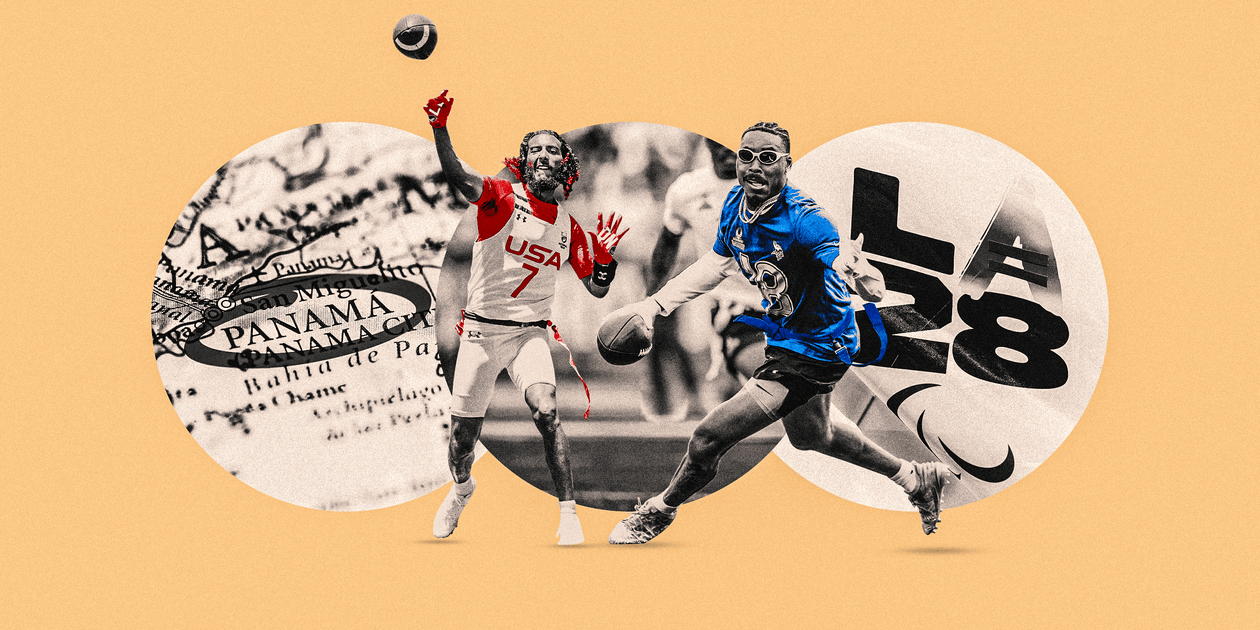
LLANO MARIN, Panama — This was not the type of place Roger Goodell or Turki Al-Sheikh would likely go.
Two and a half hours along a switchback rural highway from Panama City, the world’s greatest flag football players ventured to represent the United States in a premier tournament. Their charter bus meandered through scattered towns. Loose chickens pecked for food on the roadside. Donkeys roamed free. Above, the vultures constantly circled.
Until everything scurried from another torrential thunderstorm. Throughout this particular week, average afternoon temperatures were 88 degrees with 100 percent humidity. Whenever the skies didn’t unleash the rain and lightning, turbulent clouds loomed a few minutes away.
Team USA goes where it must to dominate the rest of the world at flag football. In September, they went deep into Panama for the chance to compete for their country in an international tournament. And the totally predictable unplayable weather canceled the men’s and women’s championship games.
“We’re not getting paid to come out here and do this,” said quarterback Darrell “Housh” Doucette. “We’re doing this out of the love.”
Doucette was sitting with teammate Pablo Smith in the sultry, open-air lobby of the Grand Decameron hotel, where teams stayed for the Americas Flag Football Continental Championship. The family-oriented, all-inclusive resort on the Gulf of Panama provided refuge, although a day earlier, the lobby’s main attraction featured a feral cat squaring off with an enormous iguana.
Conditions at major international flag football tournaments usually aren’t so dubious, but they illustrate what Team USA still endures despite being the trailblazers of an exploding sport everybody suddenly wants a piece of.
Flag football will be played at the 2028 Summer Olympics in Los Angeles, and as soon as the NFL voted to let its players participate, the pros crowed with great interest. Fans and media wasted no time cobbling together their Dream Team lineups, never mind that the current roster of amateurs has been untouchable.
Tom Brady and Al-Sheikh, the Saudi royal adviser, recently announced the Fanatics Flag Football Classic, a round-robin tournament of current and former NFL superstars scheduled for March 21 in Riyadh and televised by Fox Sports. The big-money event will use the Olympics’ five-on-five format and certainly influence the public’s perception about who should represent Team USA.
“I’ve heard from a lot of players who say, ‘Oh, I think I’d like to play.’ Well, no,” said former Green Bay Packers president/CEO Mark Murphy, a USA Football board of directors member for over 20 years and a loud voice who will help assemble the Olympic roster.
“Just because you’d like to doesn’t mean you’re going to make the team.”
When discussing NFL players diving into flag football, one main topic is whether they can transition to a different game on a smaller field with no contact allowed.
Doucette made international headlines a year ago when he told TMZ, “At the end of the day, I feel like I’m better than Patrick Mahomes because of my IQ of the game.” The interview was a follow-up to an article in The Guardian, where Doucette defended his flag brothers against the incoming NFL invasion.
Doucette was referring to flag football, but even those who understood that cackled at the audacity. Better than the three-time Super Bowl MVP at anything that involves throwing or running with a football?
“I think he said the correct thing,” Smith said across the lobby table. “I’m one of them guys that came from tackle football and had to adjust. It didn’t happen overnight. He’s better than Pat Mahomes at flag football. That’s correct.”
Doucette already has beaten a team of decorated professionals with a $1 million grand prize on the line. In 2018, the American Flag Football League staged a seven-on-seven “Pros versus Joes” tournament on a 100-yard field. Doucette’s crew, Fighting Cancer, shellacked Godspeed, quarterbacked by Seneca Wallace and featuring running backs Justin Forsett and Jahvid Best, All-Pro receiver Jacoby Jones, 10 other former NFL players and two Olympic track medalists. Other pros in the tournament included quarterbacks Michael Vick and Vince Young and receiver Chad Johnson.
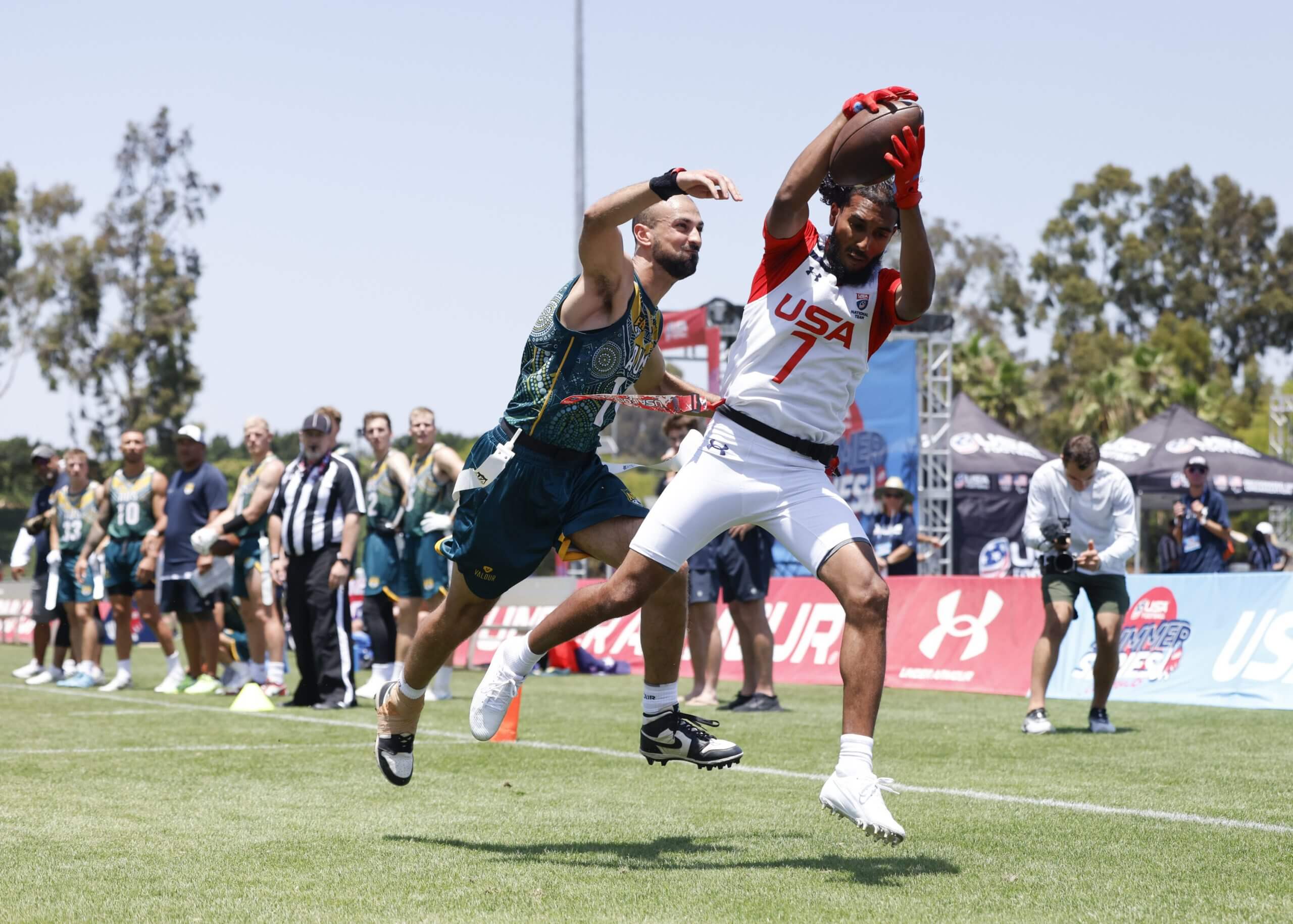
Darrell “Housh” Doucette scores in a game against Australia at USA Football’s “Summer Series” in June in Carson, Calif. The U.S. men have been dominant in recent years. (Carlin Stiehl / Los Angeles Times via Getty Images)
Post-retirement Wallace, Forsett and Jones weren’t as talented as current NFL luminaries in their primes, but Fighting Cancer still provided evidence that flag football stars are more than weekend warriors. They conquered finely trained professionals with ease and showed there’s no guarantee a group of talented newcomers will be good enough for gold.
“We showed this was different,” Doucette said. “We beat the professionals and established this was our own lane.”
And then there’s Team USA’s pristine record. The Americans haven’t lost an International Federation of American Football tournament since 2018. The U.S. has won eight consecutive IFAF events, five world championships, three continental championships and the 2022 World Games. (This year’s World Games excluded men’s flag football.) Over those 31 victories, America’s average score was 50-17.
“If you’ve never stepped on a flag football field,” Doucette said, “why should I feel like you’re better than the quarterback representing my country? We’ve won gold every single year. If we step on the flag football field today, who would be more victorious? I feel like I would. I’m not afraid to say it.”
NFL players will face sobering realities about Olympic participation. The idea of standing on the gold-medal platform sounds wonderful, but they’ll need to surrender sweet freedoms and luxuries.
The flag football competition at the 2028 Olympics will be held from July 15-22, which would run up against the start of NFL training camps. Team USA will hold a two-week training camp before the Games begin, further occupying the NFL’s precious offseason free time. NFL front offices and coaches — whether they verbalize it or not — will fret about missed workouts (agents will warn about missed bonus payments) and injuries. Contracts and workout bonuses might be impacted. Olympians must also submit to the World Anti-Doping Agency’s strict demands.
All of that would happen after going through a series of clinics, tryouts, camps and exhibitions that also will further eat into their personal time and possibly conflict with NFL offseason programs.
“The players have to decide,” USA Football executive director Scott Hallenbeck said, “if they truly want to invest into what it takes to be a part of this. Layers upon layers of things that are new and different for NFL athletes are things we have to work together to sort out.
“All of that requires a true commitment. That’s what we’ll be seeking when we identify the best possible athletes to make Team USA.”
July 2028 seems far into the future, but USA Football is in a time crunch. The process to add Olympic sports usually comes with a long, painstaking runway. But flag football was fast-tracked for the Los Angeles Games and the NFL’s propulsive powers.
Yet much of the timeline and logistics remain murky. The International Olympic Committee must provide instructions about roster regulations, workout standards and various deadlines, critical information team managers don’t expect to have until early next year.
The task will be delicate to construct the Olympic roster and to integrate big, new personalities who’ll be the prohibitive favorite not only to win the gold medal, but to rout pretty much every country along the way.
“How do you assimilate 10 players into a cohesive, superior team to win the gold medal?” Hallenbeck asked. “That’s ultimately what we have to figure out. And it’s not clear how much time we’ll have as a working unit. Those are the details we’re trying to work out with the NFL and all the decision-makers, the agents, the NFLPA and the players themselves.”
NFL players must learn and incorporate unusual rules — many of them counterintuitive to their honed instincts — essentially on the fly.
No contact is allowed. No stiff-arms. No hand checks. No leaping over defenders. No blocks. No screens. The quarterback faces an unblocked blitzer and cannot cross the line of scrimmage unless he hands the ball to a teammate. Ball carriers cannot leave their feet to avoid being tackled.
“People say, ‘Darrelle Revis will lock them up,’ or ‘Tyreek Hill can do this or that.’ Nothing against Micah Parsons, but I don’t see him at 240 pounds rushing me or Housh,” Smith said. “We don’t have shoulder pads he can grab. One little move, we’re gone.”
Pulling the flag is among the game’s most difficult tasks to learn. Runners spin and dip with gymnastic flair that mixes Barry Sanders with Misty Copeland with Simone Biles.
“I struggled pulling flags. I struggled with the contact rules,” said Team USA cornerback Mike Daniels, who played at West Virginia University and took up flag in 2022. “I struggled with the spacing. I struggled with the speed of the game. I still struggle with the IQ of the game.
“To an outsider, they just see us killing guys. Bro, it’s not as easy as you think. We work hard. We train. We study. We don’t just roll out the bed and do this.”
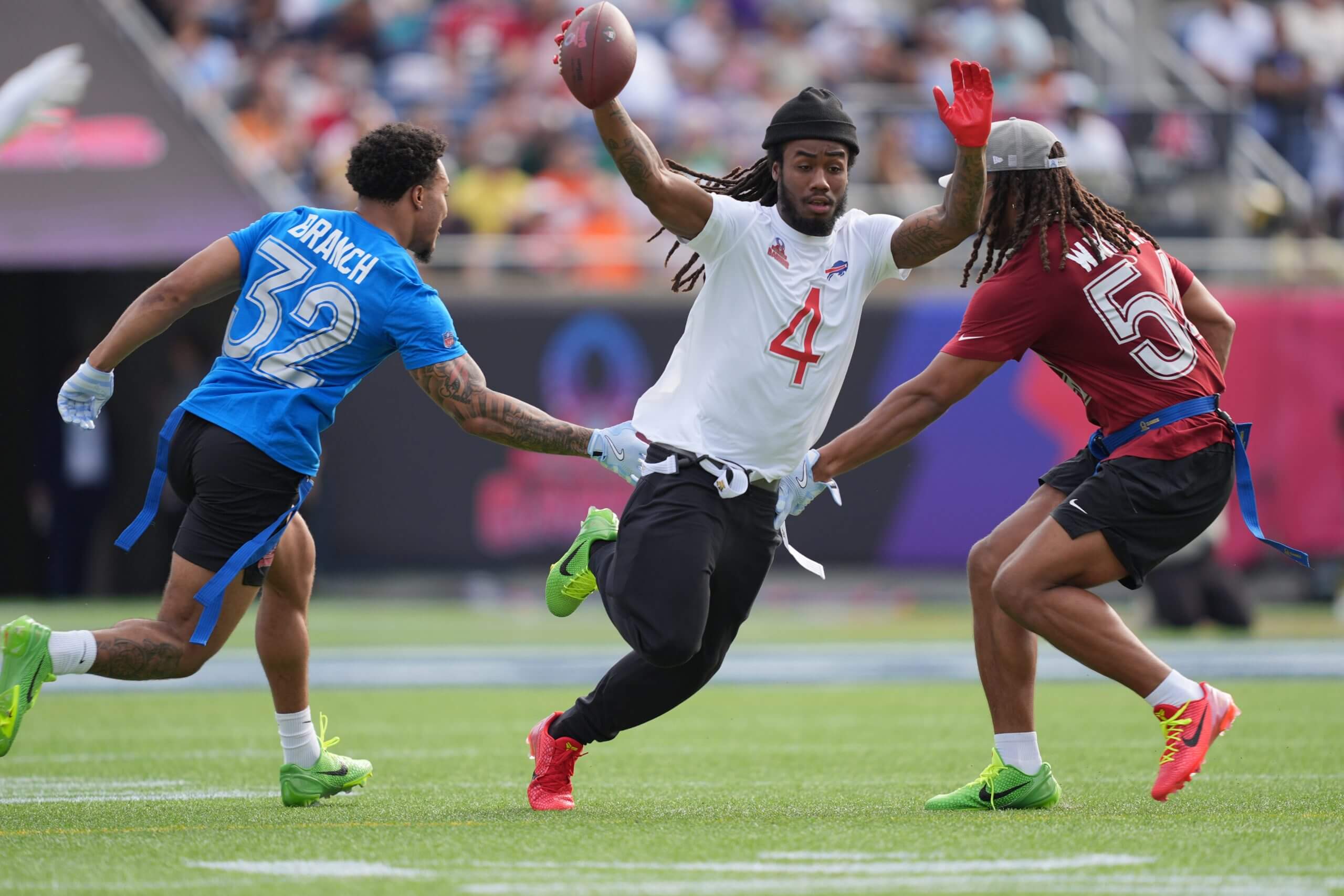
The NFL’s annual Pro Bowl, showcasing the league’s top players, was turned into a series of flag football games starting in 2023. More exhibitions featuring NFL players are coming. (Perry Knotts / Getty Images)
Even if you think a team of top NFL players would adjust just fine, there’s a deeper topic of conversation: How much do they deserve to swoop in like those vultures in Panama?
Ja’Deion High uses his PTO to play receiver for Team USA. As is the case for most of his teammates, he grinds at a real job. Raised on a ranch, he fed the livestock, repaired fences, tended fields, mucked stalls. He was a walk-on for Kliff Kingsbury at Texas Tech and caught passes from Mahomes, eventually earning a scholarship and an Arizona Cardinals tryout. Now, High wakes up at 5 a.m. to drive an 18-wheeler around the Lubbock area.
Before they found ways to monetize flag football, thanks to the sport’s explosive, nationwide growth as a varsity sport that can earn college scholarships, Doucette handled bags for Delta Airlines, landscaped and drove an Uber, while Smith worked at Floor & Decor and sold cars.
“It’s gotten a lot of hype here recently,” High said, “but people don’t really know what’s going into this sport to develop it. They make fun of it because ‘Oh, it’s just flag football,’ but nah. It goes back to the passion of the game. We really put everything into the sport.
“I would hope they would let the originators, the pioneers, the ones who have been in flag the longest and helped develop it, be a part of what’s to come. That would be an authentic start.”
Professionals, though, won’t have made all the anonymous sacrifices or swallowed those start-from-scratch inconveniences the amateurs did to establish the game. Pros have their daily schedules crafted by a staff of dozens. They don’t need to work regular jobs to pay the rent, worry about trainers or nutritionists or physical therapists, or scrounge around for hometown dudes to work out with.
But there’s a more practical reason flag pioneers are feeling territorial of VIPs encroaching on their smaller field. The planet already knows Team USA will dominate, without professional help. They probably can’t get appreciably better, yet could get worse with the wrong mix of newly acquainted teammates.
To illustrate the danger, think of the 2004 U.S. Olympic basketball squad.
A roster with Allen Iverson, Tim Duncan, Stephon Marbury, Amar’e Stoudemire, Dwyane Wade and a 19-year-old LeBron James managed the bronze medal in Athens, losing an exhibition to Italy by 17 points, then falling to Puerto Rico by 19, Lithuania by 4 and Argentina by 8. America’s stars groused about playing time and international officiating. They rejected the Olympic Village for accommodations on the Queen Mary 2 luxury ocean liner.
And if a reconstituted American flag football squad doesn’t claim the first flag football gold medal, and on its home soil, then it would be a global embarrassment.
“You’re not going to out-athlete these other countries,” Doucette said. “We know the USA is the most athletic country, but you can’t go into these tournaments thinking, ‘I’ll just throw jump balls the entire time.’ You can’t.
“People don’t understand.”
The Americas Continental Championship ended ingloriously. Another seasonable Panama thunderstorm struck, scattering everyone for limited cover. Players and officials huddled under the stands and the temporary canopy tents.
From the modest stadium’s vomitorium, Mexico’s women peered at the downpour in hopes of holding onto their two-touchdown lead over Canada and eventually were awarded the gold medal. Team USA’s men were forced to share the title with Mexico because their finale didn’t happen.
The Americans received half-credit despite dominating each game. Estadio Virgilio Tejeira Andrión had no lights, no scoreboards and no clocks for anyone other than the game officials to track what was happening, but whenever Team USA was on the field, circumstances were obvious.
The offense was dizzying, often deploying three-quarterback sets. Doucette, Smith and former Division-III Catholic University quarterback Nico Casares thatched backward passes and long bombs — as many as three throws on any given play — while also running pass patterns. Experienced defenders were bewildered.
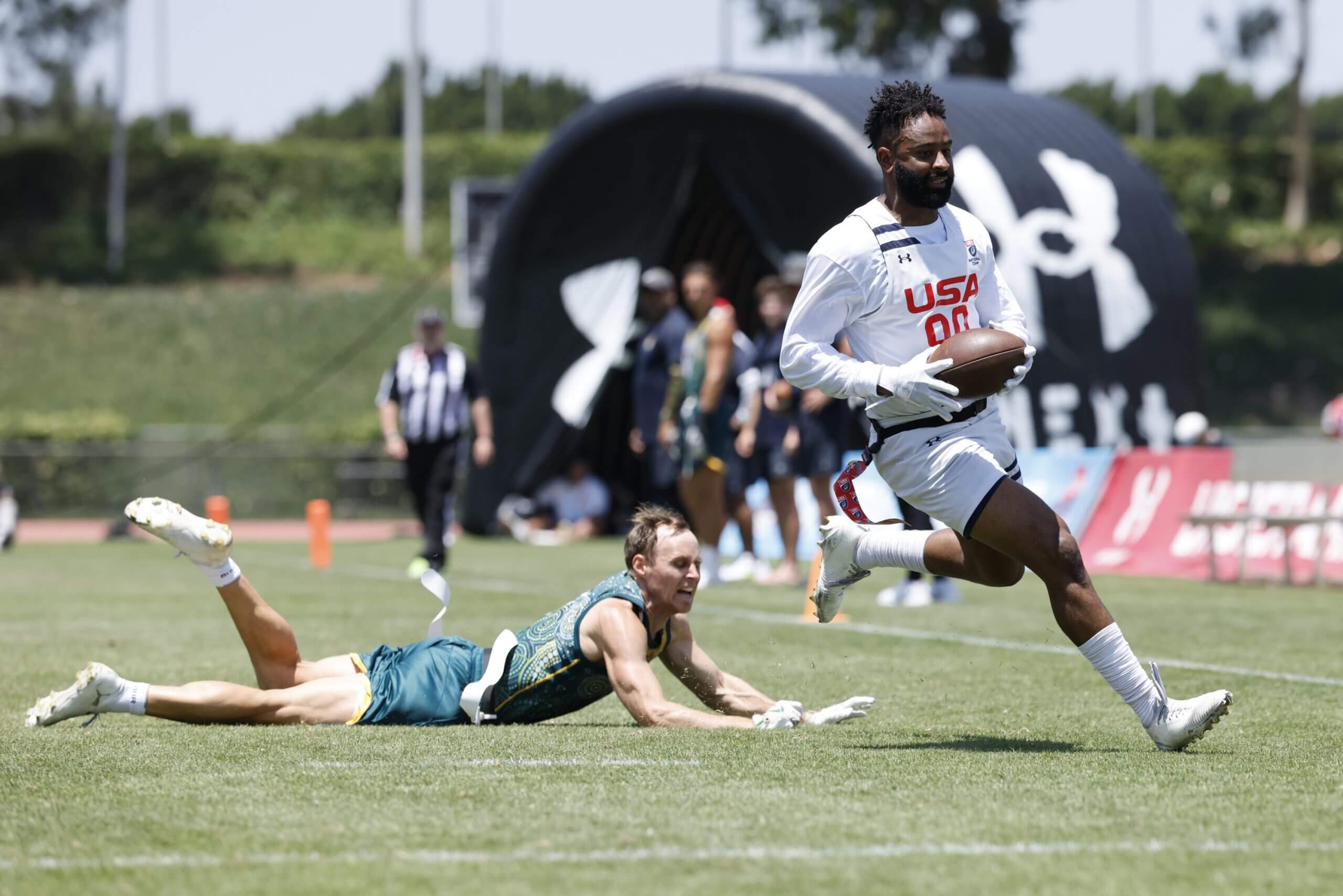
“I would hope they would let the originators, the pioneers … be a part of (the Olympics),” U.S. wide receiver Ja’Deion High (right) said. “That would be an authentic start.” (Carlin Stiehl / Los Angeles Times via Getty Images)
“This is a sophisticated, disciplined, new-age, innovative sport,” Hallenbeck said. “People are constantly innovating, and that’s what the sport deserves.
“You need to commit to learning what this sport is about so you can match the passion and investment of these trailblazers who have been involved so far and to be worthy of representing your country in the Olympics, which is the pinnacle of global sport.”
Smith was the tournament’s best player. He threw touchdowns, ran for touchdowns, caught touchdowns. Smith’s given name is Laderrick, but he has gone by Pablo since he was 7. That’s when a coach started comparing him to Pablo Sanchez (aka Secret Weapon) from the “Backyard Sports” video-game series.
Smith asserted nobody’s spot on the Olympic roster should be locked right now, not even his. But he noted the current players deserve more respect than they’ve gotten from media and fans who want to play fantasy GM.
“We don’t want everything stripped from us and just handed to them because they’re in the NFL,” Smith said. “We worked hard to get the game where it is today. So why don’t we get a chance just like everyone else? Go through the same steps we go through. That’s all we’re asking for.
“I really want to go against them. I’d love to go against them and show them this game is not what they think it is.”