
Welcome back to the #AskinJackson Cleveland Browns mailbag, where it’s not all rainbows, butterflies and extra draft picks. Browns fans are mad, understandably, and the questions reflect that. The team is 2-7, the offense is broken (again) and folks are scorned, sad and exhausted.
But Browns fans are darn loyal, and the response to our mailbag callout was strong. That’s appreciated.
Ideally, I’d give shorter answers in this space to make sure I can get to as many questions as possible. But there’s nothing simple or ideal about this situation. So, while I tried to choose wisely and be as brief as possible, it’s not like folks want to know about one specific linebacker or how the Browns will match up in the trenches with the Baltimore Ravens Sunday.
We knew this was going to be an awkward transition year, but it doesn’t feel like there’s much of a rebuild underway. It feels like quarterback plans and decisions have been consistently wrong and made on the fly, and it feels like a darn good defense has just been wasted.
The head coach won’t answer questions directly, and the general manager skipped his annual bye-week meeting with local reporters. There’s been nothing fun about this season, and there’s nothing simple about the next few months when it comes to big decisions on organizational structure and spending.
On to your questions, which have been edited for length and clarity.
Do the Browns go for maximum pain on the Deshaun Watson contract and suck up the largest possible hit next year that keeps the team under the cap, and accept another two- or three-win season in 2026 with a terrible roster full of rookie contracts and cheap space fillers? Kicking the can down the road has clearly not worked (and the bills will still eventually come due). — Matt J.
Matt, I actually posted three or four questions in one, and I appreciate your enthusiasm. But I pulled out that part and decided to start with it for a few reasons.
One, quite obviously, is that the failure of the Watson experiment (plus the draft picks surrendered to make it happen) is the biggest reason the Browns are where they are right now. There have been other, less expensive mistakes, and the current construction of the offense represents failures on multiple levels by the Cleveland front office. But the Browns seem headed for a second straight three-win season, and Watson’s current salary-cap number for 2026 is $80.7 million, per Over the Cap.
With the only real alternative being to continue to restructure the deal, keep Watson on the team and push big cap hits even further to the future to basically halve the 2026 number, it seems inevitable that the Browns will officially cut ties with a post-June 1 designation early next year, which would put his dead-money number for 2026 in the range of $70 million to $80 million after whatever insurance credit the team receives.
There’s some false information floating around the internet (imagine that!) that the Browns will get more than $40 million in cap relief through the injury insurance they purchased on Watson’s contract. Though NFL injury insurance is still a relatively new and mysterious concept, past examples suggest the team will receive a full cash refund via insurance, but only a small portion in cap relief. We don’t yet know the exact numbers, and the exact cap hit for 2026 depends on that insurance credit and how the existing void years on Watson’s deal are ultimately structured when the final transaction is processed.
It’s important to note here that we’re projecting well into the future and don’t yet know if the folks currently in charge of the Browns’ football operations will still be in those roles ahead of next season. But it does seem likely that the Browns swallowing an approximately $80 million cap hit for Watson plus other dead cap money (potentially for David Njoku, Joel Bitonio and others) will lead to 2026 being a year of Cleveland taking as much of its financial medicine as possible while attempting to employ many young players with low salaries and high-talent upside.
With the Browns still on the hook for around $135 million to Watson after this year, going the post-June 1 cut route would then leave around $50 million for 2027. The current structure of the deal calls for Watson to be on the team’s cap through 2029.
In addition to believing that Watson would be their savior, the Browns were willing to accelerate money on other contracts in 2023-24 because the cap continues to rise each year, so this was seen as a sound strategy. It works when accelerations are used on the right players. When they’re not, you pretty fairly stated it when you said the bills always come due.
The 2025 salary cap is $279.2 million, and Over the Cap estimates the 2026 cap at around $300 million. The Browns have long factored in those projected jumps as part of their planning, but they’re currently sitting at $321 million in cap liabilities for 2026.
Watson might be cleared to return to practice soon, but actually putting him on the field this year would mean the Browns are just reminding themselves again of how they got here — and how their Band-Aid attempts haven’t worked. It’s probably best to formally cut him next year and move on with something like the rookie-heavy strategy mentioned above. That means 2027 is the earliest possible year for the team to even think about being competitive again.
We can sum it up like this: Sunday will be the ninth straight Browns-Ravens matchup in which Cleveland has a different starting quarterback than it did in its previous game against Baltimore. In that span, only Watson has started against the Ravens twice. The Browns haven’t been swept by Baltimore since 2020, but in the bigger picture, they will never catch the Ravens with the likes of Dorian Thompson-Robinson, Bailey Zappe, Jameis Winston and Dillon Gabriel trotting out against the guys in purple and black.
With the surplus of picks in the 2026 draft, everyone seems to believe the Browns will utilize one of them on another QB. Is there a possibility, given the numerous success stories of reclamation projects throughout the league (Sam Darnold, Daniel Jones, Baker Mayfield, etc.), that they would pivot and target someone like that while using the aforementioned surplus of picks to build around them? The guy I had in mind was Mac Jones. — Brian J.
Let’s assume neither Gabriel nor Shedeur Sanders is the quarterback the Browns want to be their starter next season. Who can we look forward to? Fernando Mendoza may go No. 1, even though he’s not a consensus No. 1, since so many teams need a QB. So, Dante Moore? LaNorris Sellers? Are they gonna sign Mac Jones or something? — Ben G.
Two questions in one here, and the one answer starts with a clarification: Mac Jones signed a two-year deal with the San Francisco 49ers in the spring. The 49ers will probably trade Jones in February or March — and the Browns will be linked to that potential deal for many reasons, mostly that Jones’ current contract calls for a 2026 base salary of just $1.4 million. But probably eight to 10 teams will be looking for new quarterbacks next spring, so it’s too early to really connect any dots or concoct any trade fits.
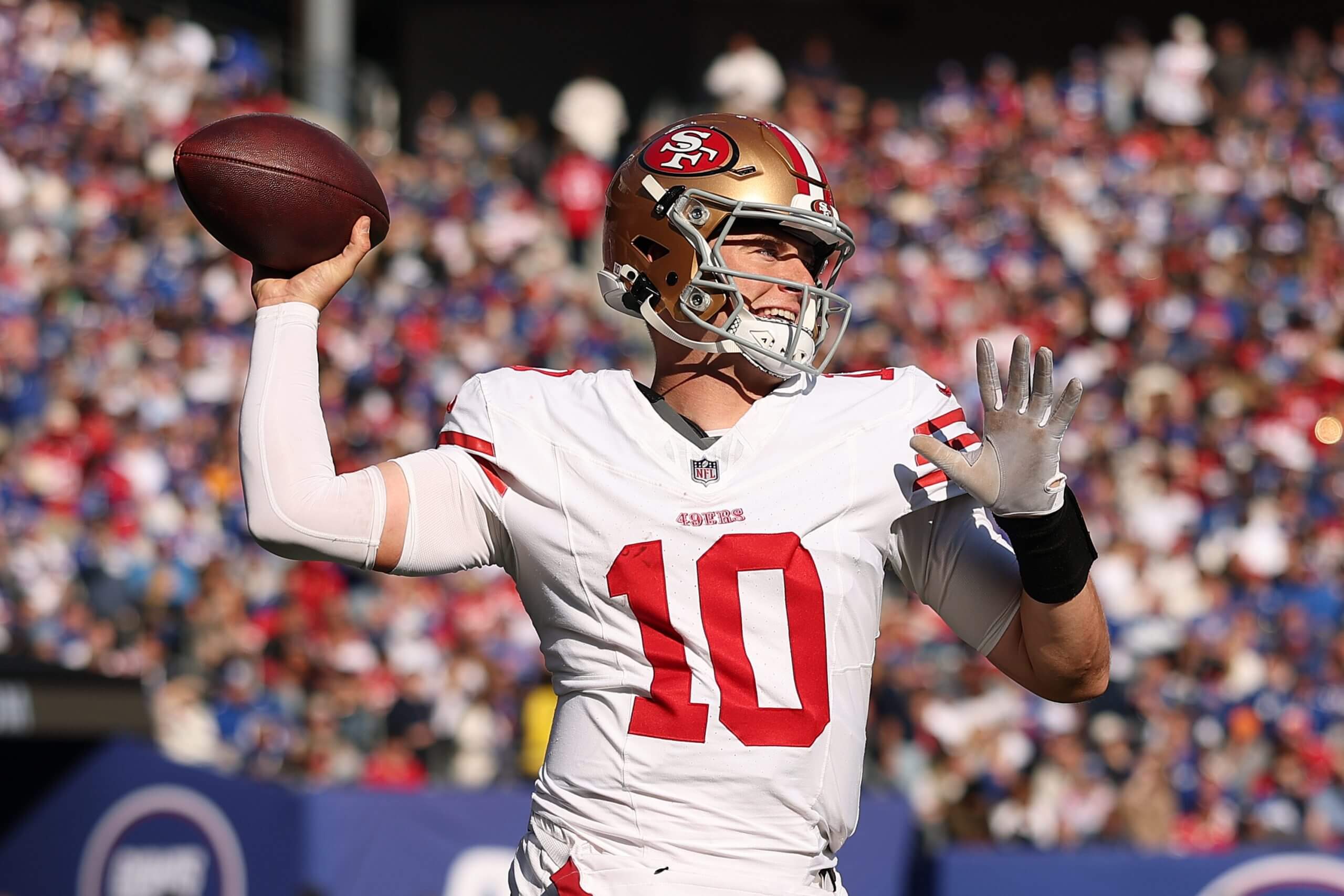
Mac Jones, who has played well for the 49ers in Brock Purdy’s absence, will be a hot commodity in the offseason. (Sarah Stier / Getty Images)
The potential free agent (and trade) class is uninspiring, to say the least. I can’t see the Browns signing up to be Kyler Murray’s next team, so either the Browns chase the dream with Anthony Richardson, try again with Kenny Pickett (or Joe Flacco, or Winston), or run the wishbone with Trey Lance or Justin Fields.
All of a sudden, Mac Jones seems like Josh Allen, doesn’t he?
In fairness to all involved, I’ll wait before providing any real answer on the draft class. Even the year-round draft experts don’t yet know how many underclassmen quarterbacks — Mendoza, Moore, Sellers and Ty Simpson all are in that bunch — will actually enter the 2026 draft. Almost none of the 2025 seniors have lived up to the preseason hype.
Whoever is leading the 2026 quarterback search for the Browns will eventually need to gather medical information, decide what the team truly values and weigh realistic options of the present (like Sanders and the 2026 draft class) versus players who might be available in 2027.
It’s time for the analytic charting project that led the Browns to Gabriel and Cody Kessler to be buried far, far in the ground (and preferably nowhere near Brook Park).
How many of the starting Cleveland offensive linemen are actually going to come back? Which ones should? — Brian R.
Of all the early guesses to make right now, this one at least follows somewhat of a predictable path. Wyatt Teller looms as the strongest candidate for a new deal and has been public with his intentions to sign one. Neither tackle could really be in the future plans, though maybe Cam Robinson returns next year in case a rookie left tackle isn’t immediately ready. Joel Bitonio has said he’s not making any decisions yet, but we’re assuming he’ll retire — and that the state of the team makes that decision easier.
Ethan Pocic is a maybe, but center is the one spot where the Browns have a temporary replacement on a rookie contract in Luke Wypler. Jack Conklin almost certainly moves on, because he could sign a one-year deal to play for a contender if he wants.
Dawand Jones has one more year on his rookie contract and figures to be penciled in as the 2026 right tackle unless a high draft pick ends up with that spot, but his injury history will force the team to think about a future without Jones.
Teven Jenkins is the top backup, but he’s also a pending free agent, and Zak Zinter is a right guard (Teller’s spot) who’s inactive on most game days. Cornelius Lucas likely will be released, while KT Leveston will compete for a backup spot.
Again, this is all subject to change. There are factors such as who’s picking the players, who’s coaching the team and whether any of the longest-tenured Browns in the group would be open to returning if Cleveland somehow landed a decent veteran QB. But for now, we’re going to assume 2026 will be more of a teardown year than this one has been.
This front office started its tenure by prioritizing the offensive line, but the 2025 season will end with the top six all without contracts for next year. Not drafting an offensive lineman in April was indefensible.
Can the Browns afford to draft their next quarterback with a GM and head coach who will be on the hot seat going into next season? The development of a rookie QB and a path for sustained success don’t always mesh with a GM and head coach looking to save their jobs. If that ends up costing said GM and head coach, the new regime will have a QB that isn’t “their” guy, which usually doesn’t go well. — Dan D.
Next season? Their seats have to be hot now. I know team owner Jimmy Haslam has made public comments that insinuate he supports GM Andrew Berry and head coach Kevin Stefanski. And, obviously, Haslam would prefer not to make a change. But any group that totals six wins (or maybe seven, at most) over two years is a group that might not get to stick around — and probably shouldn’t.
Berry’s current quarterback resume is Watson and Gabriel, who ranks at or near the bottom of the league in almost every quarterback metric. That should pretty much answer the back part of your question about whom to trust for evaluation and development.
We’re not talking about a normal franchise, unfortunately, so there’s no way to actually predict what the owner is thinking or planning to do. But in a healthy and functional franchise, the next “big swing” at quarterback would only be taken by folks with long-term job security and a real vision for returning this team to respectability.
We can all discuss (and argue) about what realistic expectations for 2025 should have been, and if this group was willing to punt another year away to position itself for the next two drafts. Though there’s probably no fully correct answer in that realm right now, the current product does not in any way indicate a clear path forward.
The “ideal world” part of this discussion went up in flames about the time it became clear that Watson wasn’t reading defenses or beating them with his legs. This thing is a mess, and it’s probably time for the Browns to move on from everyone who brought the Watson trade and subsequent moves to the owner’s desk.