

Editor’s note: This article is part of our GM Spotlight series, introducing readers to general managers who occupy a relatively new and increasingly important job for college football teams.
Twenty-two months ago, general manager Courtney Morgan was in Houston, pursuing a national championship for one team he had a hand in building (Washington) against his alma mater, Michigan, whose roster he also had a hand in constructing.
Four days later, he was in Tuscaloosa, joining Kalen DeBoer at Alabama as the two pursued a near-impossible task: following the greatest coach of all time, Nick Saban.
After a bumpy (by Alabama standards) first season, things are going well in Year 2 for DeBoer and Morgan, with the No. 4 Crimson Tide (8-1) in prime position to make the College Football Playoff and secure a first-round bye. Morgan, who is in his sixth season as a college football GM and second with Alabama, helped the Crimson Tide get to this point via retention, recruiting and acquiring quality transfers.
Retention is at the heart of it. Alabama did one of the best jobs of any team in the country in retaining key players. Twenty players who have started more than half of the Crimson Tide’s games this season were on the roster before this season, including many of the team’s biggest contributors.
Morgan, a former Michigan offensive lineman, has risen quickly through the personnel industry, working in player personnel at San Jose State before joining DeBoer as the GM at Fresno State in 2020, going to Michigan in 2021 before rejoining DeBoer at Washington in 2022.
Morgan has a diverse background that includes playing, training players and working for a sports agency. He started his college coaching career in 2012 in player development and recruiting at UCLA. But his passion for scouting talent dates back to his time as a high school recruit, when he and Nnamdi Asomugha used to pick up recruiting magazines and search for VHS highlight tapes of the prospects around the country so they could evaluate who was ranked higher than them as recruits.
“My whole life, it’s just been something I’ve always wanted to do,” Morgan said. “I’m actually living the dream.”
Note: This interview has been edited for length and clarity.
You guys were successful at retaining a lot of your roster heading into this season. How much of that was you looking at your team and saying, “What we have here is better than who we can get elsewhere?”
It was a lot of it. You have to have really in-depth conversations about your roster, your players and most importantly, understanding the people, the person. Is the answer to what we’re trying to solve already on our roster? (Or will we) risk taking a guy in the portal and paying more money? The teams that do a better job of evaluating their own roster, they’re gonna win.
I think it’s natural for people to always feel like the answer is outside of the building or you don’t have enough. But really, it’s the total opposite. You probably have more than other people in the country, but I think as coaches and people we’re always operating with a critical eye. It’s innate, you can’t help it. You’re always thinking about what you don’t have. So whoever evaluates their roster the best are the teams that are gonna be fiscally responsible in the portal.
If you look at our wide receiver room, we lost four, but we brought in three (transfer Isaiah Horton and freshmen Lotzeir Brooks and Derek Meadows), but it was the right three for what we do and our room has been totally upgraded.
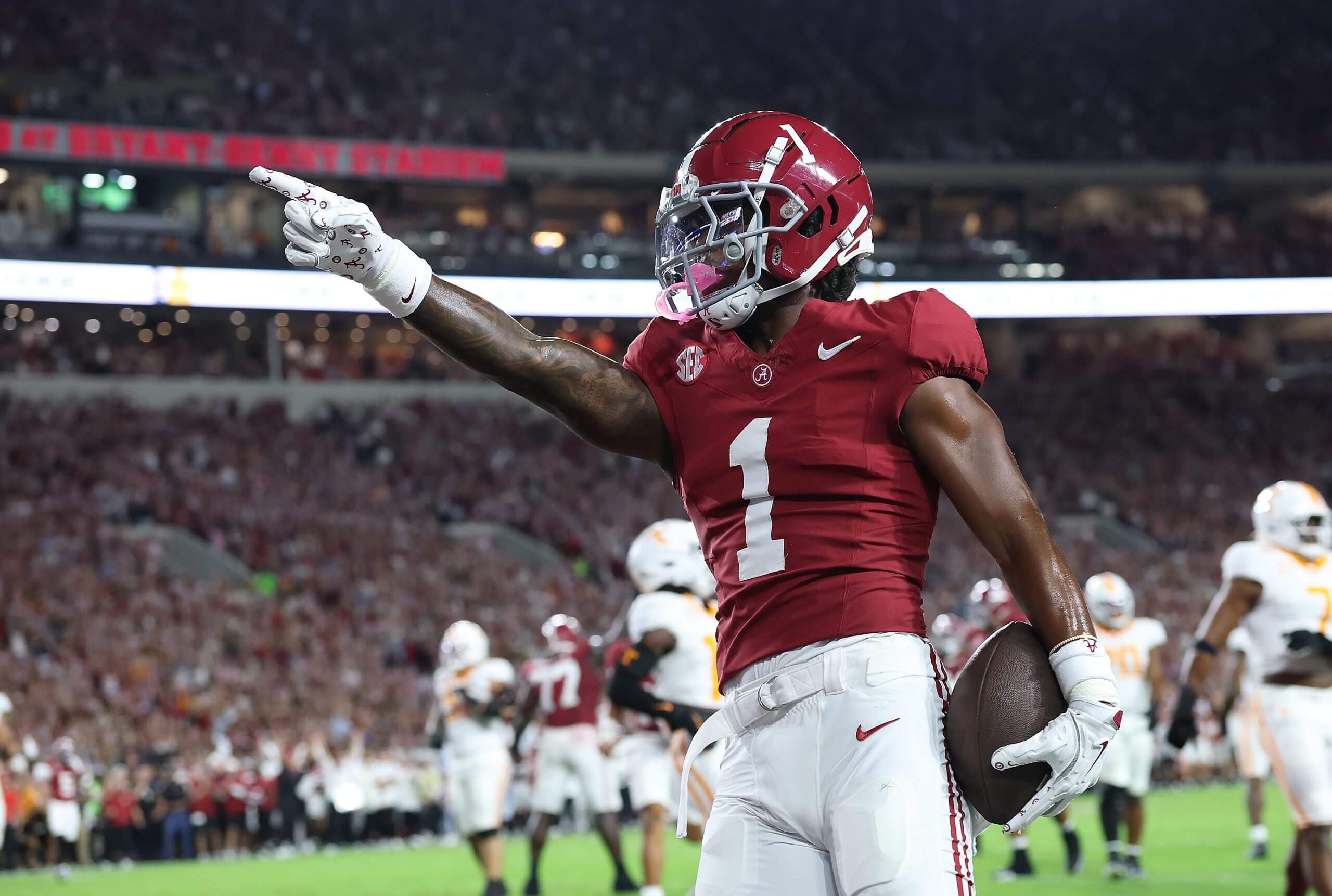
Miami transfer Isaiah Horton has 24 catches for 298 yards and five TDs. (Kevin C. Cox / Getty Images)
So when you go into the transfer portal, what are you looking for?
The biggest thing we do in the portal is we don’t take guys who don’t have production. I’ll make a list of 30 players at a position, but when you really start going through the list and evaluating it, there might be seven or eight with the production that we really think can make an impact on our team. Now, out of that seven or eight, do they have the physical traits to help us and compete at this level? That’s where the issue is.
There’s going to be times when you’re gonna have to spend a lot of money, but just make sure you spend it wisely. The best thing we did was figuring out, “OK, this is what we have, this is what we need to win a championship” and balancing it.
How much has the role of general manager changed from the time you first held the title, at Fresno State in 2020, to 2025 at Alabama?
It’s changed a ton. Now you’re looking at money, at investing in players. You have to do a thorough job of evaluating players. You’re gonna have some misses, but you can’t afford to miss. You’re trying to figure out where you’re going to allocate your money and making sure you’re investing in the right players.
It’s knowing that everyone can’t make top money and understanding who needs to be paid, contract structure, plans for the future. It’s not just acquiring the player, but how is this acquisition gonna affect us two years from now? Understanding high school versus portal and the holes in your roster — do we need a high school player here, or a transfer portal player here? — and understanding how those players fit into your system.
How did you develop a strategy on how to allocate money across the roster?
A lot of it is understanding the market. (For example,) you understand the market for an offensive tackle. Then you start looking at what we’re willing to pay. Is he worth it? You’ve got to understand how impactful this player is. It’s just like the NFL. What’s the value of the player? What’s our need at the position? Sometimes, the need of the position is going to increase the value of the player.
It’s understanding your roster. Sometimes you may need a left tackle so badly that you may overpay for a guy. I’ve leaned on a few people. Trent Baalke (former Jacksonville Jaguars GM) has been a great resource to me. But some of it is natural.
This is the first year teams have had full control of player compensation under revenue sharing. What has that been like, especially in the SEC where everybody’s competitive and you’re competing at a national level?
It’s been really smooth. I think the biggest thing we’re all trying to figure out is a third-party NIL piece. How does it extend our roster past the set revenue share (cap)? How do we get into the third-party NIL component and how can we be competitive in that space? The biggest thing you’re always trying to figure out is how to take money off the cap.
What do you think it’s going to cost for a championship roster next year and the year after as we move forward?
I’m not going to tell you our number, but … if you do it right, I think you can really get a championship roster built for $27 million.
You hear some coaches alleging that there are rosters that cost upward of $35 million or $40 million, or that we’re going to get there. Do you subscribe to that belief?
Yeah, I really think it’s going to get there.
You played offensive line in college and know it intimately. What do you look for when evaluating offensive linemen?
The first thing is how they look in their stance. A guy’s stance will tell you a lot about their mobility in their ankles, their knees and what type of flexibility they have. You can tell a stiff player by how they get in their stance. If you see a 6-6 kid in his stance and he’s dropped his butt and he can bend, that is a great starting point.
From there, I look at initial quickness. How fast is he moving off the ball? You can see it on tape, the quickness, the strike, the suddenness out of their stance. Third thing is can they play through their hips? Are they a waist-bender? And the biggest thing I look for is heavy hands. How heavy-handed are they? Can they stop big people? When they put their hands on people are they laying their hands or are they striking people?
Are they tough? The biggest word I use is “strain.” Doesn’t matter if it’s run or pass. Do they strain? It’s the amount of effort and the sense of urgency they play with. And I believe in strain for every position we evaluate. You also have to look at arm length, hand size.
What are your non-negotiables when evaluating a prospect?
We have four critical factors at every position that are non-negotiable: size for the position, flexibility, toughness and instincts. In this day and age, you want to have instinctive players because they’re going to get on the field faster. Now that you’re paying players, instincts matter because the development time is sped up. Coaches are expecting a lot more from players. … You might get a kid who’s a great athlete but he’s not that instinctive. The more instinctive players play early for you and those are the guys you want to invest in.
There’s less than a month until the early signing period (Dec. 3-5) and less than two months until the transfer portal opens (Jan. 2). So what is your day-to-day like now?
Evaluating our roster. Evaluating other schools’ rosters. Evaluating all the rosters (on teams whose) coaches have been fired and grading those rosters. Talking to agents, keeping a pulse on what’s going on in the industry. Looking at analytics on who the players are that are maybe at smaller schools but are really productive, that can help your program. Maintaining our current recruiting class, starting to deal with the admissions (department) to make sure our mid-year enrollees are on track. Evaluating 2027 (recruits) and making sure they’re getting on campus.
But really, it’s keeping a pulse on your own team. Getting a feel for who’s unhappy with their playing time. You’ve got to keep a pulse on your teams and other teams and what’s going on so you won’t be blindsided. And the biggest thing that I’m doing now is preparing for a retention plan, understanding what it’s going to take to keep the guys we need to keep and also understanding that some guys might be casualties if they feel they’re undervalued.
What do you think of the move to eliminate the spring portal window, having just one window and having it in January?
I love it, because at least you know at the end of the portal, your roster’s set. Now is it gonna be stressful? Yeah. I think people are gonna tell kids to get in the portal just to get in the portal.
Who would you say the biggest influences on you have been in the personnel industry?
Trent Baalke has helped me tremendously. David Blackburn (Washington Commanders director of player personnel). A guy who has really helped me understand players and evaluations is Josh Scobey, (senior personnel executive) for the Jacksonville Jaguars. I’ve had great football conversations with Josh. My ex-college teammate, Larry Foote, linebackers coach and (run game) coordinator with the Tampa Bay Buccaneers. I talk players with Foote all the time. Being around guys like Mike Macdonald when I was at Michigan, I learned a lot. (Pittsburgh Steelers scout) Mark Bruener has helped me a ton and is a great guy.
Are there other guys in college football personnel who you admire or talk to regularly?
I think (Texas GM) Brandon Harris has a great understanding of the business. I think (Ohio State GM Mark) Pantoni does a good job, obviously. (Texas Tech GM James) Blanchard has done a great job, even though he has the cheat code (laughs). I think Texas A&M (under GM Derek Miller) from afar has done a good job. That’s pretty much it. I don’t talk to a lot of guys. I’m pretty competitive, man. I don’t try to be everybody’s friend.
The GM Spotlight series is part of a partnership with T. Rowe Price. The Athletic maintains full editorial independence. Partners have no control over or input into the reporting or editing process and do not review stories before publication.