
It wasn’t so long ago that eyebrows were raised and questions were asked when NFL prospects chose to transfer schools during their collegiate careers:
What went wrong at the first stop? Why didn’t he stick it out and overcome? What does that say about his character?
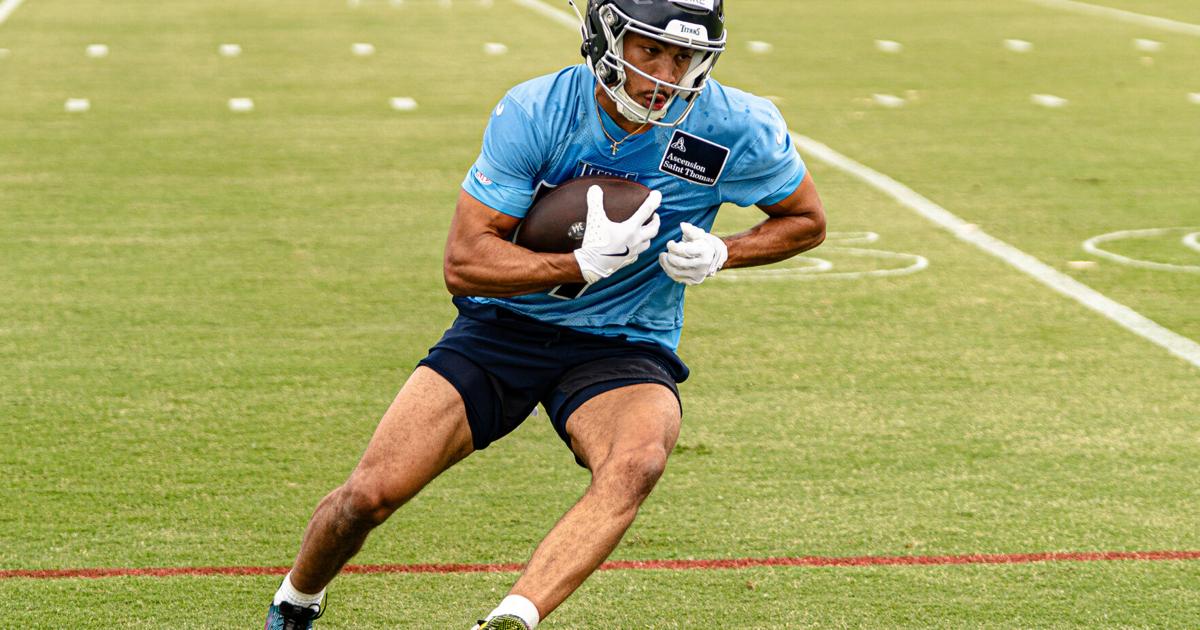
But the Titans’ 2025 draft class provides ample evidence that — in the age of the transfer portal and NIL money — the simple act of transferring schools is hardly viewed as a red flag anymore.
Four of the Titans’ nine selections last month — quarterback Cam Ward, edge rusher Femi Oladejo, wide receiver Chimere Dike and cornerback Marcus Harris — transferred at least once in college, with Ward and Harris switching schools twice.
In the team’s previous five drafts combined, they’d only selected four players who’d transferred schools on the Division I level: cornerback Jarvis Brownlee (2024), quarterback Will Levis (2023), quarterback Malik Willis (2022) and linebacker Chance Campbell (2022).
The increased total of drafted players who had transferred only makes sense given the national picture.
Of the 330 players invited to the 2025 NFL Combine, 126 (38.2 percent) had transferred schools at least once, per ESPN.
That’s a notable increase from 2024 (33 percent), a big jump from 2023 (21.6 percent) and a massive leap from 2022 (14.5 percent), when the impact of the 2021 NCAA rule allowing immediate eligibility for transfers switching schools was first felt.
NIL payments also became official in 2021, meaning schools — through their sponsors — could legally pay massive sums of money for the most talented transfers.
In fact, the three highest quarterback selections of the past two drafts — Ward, Caleb Williams (Oklahoma to USC) and Jayden Daniels (Arizona State to LSU) — were all transfers.
“The transfer things, in terms of impacting guys … I mean, that’s not really an issue anymore,” NFL Network analyst and former scout Daniel Jeremiah said during a conference call last year. “I know once upon a time you could say,`Oh, it didn’t work out here or there.’ It would come up in draft meetings.
“But I’m getting to the point now where I’m old enough to remember when I first started in [2003] … discussions in the draft about a player having tattoos. Think about how silly that is when we fast forward [from] 20 years ago. Some things become less and less important, and nobody really cares about the transfer thing anymore.”
What’s interesting now is that NFL teams are actually seeing benefits to players who make successful transfers.
Switching schools — and producing well at the next stop — means a player has successfully navigated a new coaching staff, new scheme, new teammates, new culture and new city.
In some cases, players have already shown an ability to maturely handle large sums of NIL money as well.
Those are the same kind of challenges a college player must make when he transitions to the NFL level.
“I do think there’s some auxiliary benefit to that, where they’ve changed locations, they’ve had to meet new teammates, they’ve had to learn new schemes at least once in their college career,” Titans coach Brian Callahan said in a recent press conference. “The idea that they’re moving from entirely one place to another … is a little bit less foreign when they come into these types of camps and interactions and newness.”
Ward hopes that’s the case for him this season.
He spent his first two seasons at the University of Incarnate Word, then played two years at Washington State, where he threw for over 3,000 yards and 20 touchdowns each season.
But his last stop was his best, as Ward elevated himself to the No. 1 overall selection after throwing for 4,313 yards and a national-best 39 touchdowns for Miami in 2024.
“I think [transferring] helps a lot because you’re able to go through different locker rooms,” Ward told media recently. “I’ve gone from west coast to east coast, back down into the south. So I’ve experienced a lot of stuff in my college journey. Experienced different head coaches, different styles.”
Oladejo played two seasons at Cal before spending his last two at UCLA, where in 2024 he moved from inside linebacker to edge rusher and produced his best numbers — 14 tackles for loss and 4.5 sacks.
Harris began at Oregon State, then transferred to Idaho, where he became an FCS All-American in his third season with the Vandals. His numbers weren’t quite as impressive in his final year at Cal, but he proved he could hold his ground against top-level competition.
Dike aced the transfer process, moving to Florida after spending four seasons at Wisconsin. After totaling only 19 catches with the Badgers in 2023, Dike hauled in 42 passes for 783 yards (18.6-yard average) and two touchdowns for the Gators in 2024.
Count Dike, who was named a captain in his lone season at Florida, as another transfer who believes the process of change will help him adjust to the NFL.
“I think so … new faces, new scheme, kind of having to earn your respect and prove yourself in a new organization,” Dike said in a press conference. “Obviously, this is the NFL, so it’s another step up and it’s a different ballgame. But having gone through that, I think there’s certain things I can definitely carry over.”
That said, there can be obvious benefits to sticking around — and overcoming challenges — as well.
Titans tight end Gunnar Helm, one of the team’s fourth-round draft picks this year, found himself in a situation at Texas where many might have transferred. The 33rd-ranked player nationally at his position coming out of high school, Helm totaled only 19 receptions over his first three seasons for the Longhorns.
But in part because of a renewed offseason dedication after his third year, Helm blossomed in 2024, catching 60 passes for 786 yards and seven touchdowns.
What made him stay?
“I kind of worked myself into a locker room guy, a culture guy,” Helm told media recently. “I like to pride myself on doing the right things around the facility and off the field. I liked being around that group [of players]. I really trusted and loved my coaches … [They] would tell me every day to trust the process, and while it got hard at some points, some guys don’t develop overnight. That’s always kind of lingered in the back of my mind. It’s not going to happen right away for everybody.”
Likewise, Sacramento State offensive lineman Jackson Slater — the Titans’ fifth-round pick — chose to stay at his FCS school for all four seasons, despite offers to play on the FBS level.
He appreciated his position coach, Kris Richardson.
“I wasn’t really looking to roll the dice on another coach,” Slater said in a press conference. “Also, having some sort of legacy and being a part of a lot of really good teams at Sacramento State was something I wanted, to kind of be a Hornet for my career. I think I made the right decision in hindsight, for sure.”
Different strokes for different folks.
The good news for an increasing number of college players, however, is that choosing to transfer schools is no longer considered the wrong move.
“Newness isn’t as unfamiliar for some of these guys,” Callahan said. “So they are more prepared for the change [to the NFL]. It’s not as foreign to them. So there’s probably some benefit to that.”