
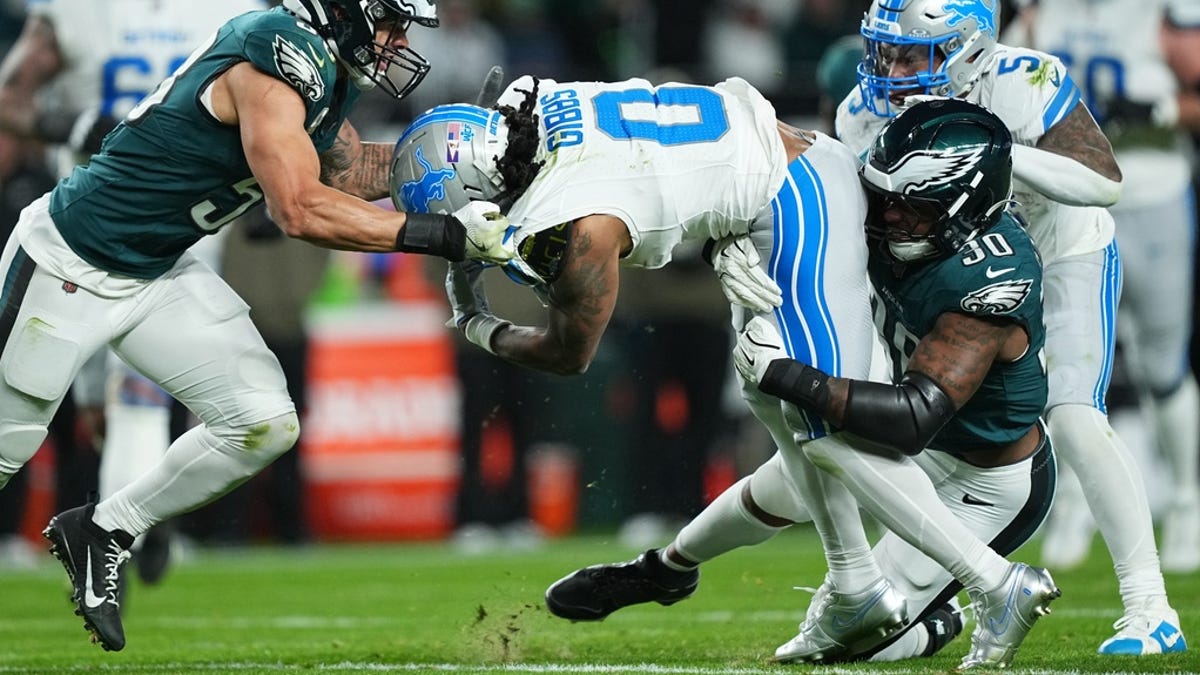
Philadelphia — A week after the Detroit Lions‘ offense kicked into gear, it found itself stuck in the mud at Lincoln Financial Field.
In a game that was supposed to be a litmus test for this team’s title hopes, the Lions came up short offensively on just about every big play against the reigning Super Bowl champions.
Detroit was held to its fewest point total since Week 7 of the 2023 season (a 38-6 loss at Baltimore), went 3-for-13 on third down and tied an NFL record, according to TruMedia data, by whiffing on all five of its fourth-down attempts as they were K.O.’d by the title defenders in a 16-9 loss on “Sunday Night Football.”
“We know the type of team we just faced. A good team and we had our chances. We didn’t get it done. They made the most of the opportunity. We didn’t,” Lions coach Dan Campbell said after the game.
The Lions (6-4) entered the day in first place in the NFC North and are now in third, on the outside looking in of the NFC playoff picture as the 8-seed. The Eagles are 8-2 and atop the NFC.
Detroit’s key cogs in the passing game — quarterback Jared Goff, wide receiver Amon-Ra St. Brown and the entire offensive line — all earned their fair share of the blame for Detroit’s shortcomings.
Could the protection have been better? Absolutely. The Eagles’ pass rush was humming on Sunday night, and it was most noticeable during a fourth-and-goal from the 4-yard line. Goff had a wide-open Brock Wright for a would-be touchdown, but with edge rusher Jaelan Phillips, the Eagles’ shiny deadline acquisition, barreling down on him after cleanly beating Penei Sewell, he made an ill-advised throw to St. Brown that fell incomplete.
Still, a number of the conversions just came down to poor execution — an underthrown pass here, a blatant drop there — as the Lions let the opportunity they’ve waited so long for slip right through their fingers. Goff targeted St. Brown seven times on third and fourth down, connecting on none of them. He targeted Jameson Williams once on fourth down; the pass was low, but catchable, and dropped.
The Lions turned the ball over on downs in Philadelphia territory three times in the second half.
“I mean, I feel like we moved the ball pretty decently at times throughout the game and got down there, stalled out a few times,” Goff said. “All the fourth downs weren’t good enough. You give a ton of credit to them, they’re a good-ass defense. I like to think if we were able to get a fourth down or two, it changes the game and even some of those third downs. But they played well, and we weren’t even close to up to snuff today.”
Goff set a career-low in completion rate (14-for-37, 37.8%) as he threw for 255 yards, a touchdown and an interception with a passer rating of 60.1. St. Brown had two catches for 42 yards on a whopping 12 targets, the lowest catch rate of his career. Williams had four catches for 88 yards and a 40-yard touchdown.
Campbell downplayed the offensive struggles, especially the connection between St. Brown and Goff.
“We were just a bit off. I mean, it was really kind of one of those days,” Campbell said. “I hate saying that, but it was just a little bit one of those days, and I mean, it’s a rarity that Goff and St. Brown don’t connect more than that. That’s just a rare thing because those guys have such a good connection. But again, man, we’re all involved in this. We all have a hand in it.”
The Lions’ defense held up its end of the bargain, holding the Eagles to 273 yards of offense and 3-for-13 on third down. It was repeatedly put in bad spots — the Eagles had three drive starts in Lions territory during the first half, including an early drive that started at Detroit’s 11-yard line after an interception by Cooper DeJean on the Lions’ opening series.
Goff’s pass was batted into the air by Jordan Davis before DeJean ran under it for the pick, the first of five pass breakups from Davis and Eagles defensive tackle Jalen Carter. Detroit’s defense held, limiting the Eagles — the NFL’s No. 1 red zone offense entering Sunday — to a field goal that made it 3-0 at 9:43 in the first quarter.
Running back Saquon Barkley, the reigning NFL Offensive Player of the Year, was held to 3.2 yards per carry (83 yards on 26 attempts).
“At the end of the day, man, we lost,” Lions cornerback Amik Robertson said. “So all the points and all that s— don’t matter. This game is about who can score the most when the clock hits zero in the fourth. We didn’t do that, so, as a team, we’ve just got to keep on building.”
Detroit miraculously had a chance to get back in the game on Philadelphia’s final possession. After cutting the deficit to 16-9, the Lions appeared to get a stop on third-and-8 with 1:47 remaining that would’ve given them the ball back, but the officials — who’d let handsy cornerback play go all night — threw a pass-interference flag on Lions cornerback Rock Ya-Sin. It was the first pass-interference call of the game on either team.
“I’m a seven-year vet. Going against an All-Pro receiver like A.J. Brown, he gets those calls, you know what I mean?” Ya-Sin said. “So, I just gotta do a better job. Just gotta do a better job of getting my head around maybe or attacking the ball, I just — refs made the call, it is what it is.”
To say that Sunday night was not Dan Campbell’s best coaching performance would be an understatement. He kept going for it on fourth down until perhaps the most important one of the game; with 5:10 remaining and the Lions down 10, Detroit surrendered its weapons and punted it away.
Trailing 3-0 with 11:22 left in the second quarter, the Lions ran a fake punt on a direct snap to linebacker Grant Stuard, who was stuffed up the middle for no gain and a turnover on downs, which netted the Eagles their second field goal of the night to take a 6-0 lead.
Philadelphia’s defense had its regular defensive personnel on the field for the fake, but gave the Lions the “look we wanted” — perhaps by design, according to Stuard.
“I think that we got the look that we wanted, and I think they thought that we thought that. Again, I haven’t seen the play on tape or anything like that, so I’m not really able to critique what went wrong,” Stuard said. “But they definitely were expecting it, even though they gave us a favorable look for the play. That’s tough. That’s tough.”
Later in the first half, Campbell let a precious opportunity slip away after the Lions gained some offensive momentum with a three-play scoring touchdown that culminated in a 40-yard touchdown pass to Jameson Williams.
Williams made an even bigger mistake before that, celebrating his score by hugging the goal post — a well-publicized no-no dating back to 2014 — and set the Lions 15 yards back on the extra point; Jake Bates missed the 47-yard attempt in windy conditions to keep the game tied at 6 apiece with 5:05 to go in the first half.
The Eagles marched the other way and made it first-and-goal at the 5-yard line of Detroit with a little more than 1:10 to go. The Lions had all three timeouts and could have, in theory, gotten the ball back with around a minute to go. Instead of using it as an opportunity to double-dip — Detroit was set to get the ball to start the third quarter — Campbell passively let Philadelphia bleed the clock over its next two plays.
After the Eagles scored with a “Tush Push” sneak by quarterback Jalen Hurts with 17 seconds left, the Lions kneeled it out, down 13-6, to close the half. Campbell said he thought about using his timeouts to grab an extra possession, but ultimately didn’t give a satisfying reason for sitting on them.
“I thought about it, I was like, ‘Maybe I’ll just go ahead and bang that right now,’” Campbell said. “But I knew we were getting it after halftime and really what I did, I just kind of waited. I was going to wait until we hit about under a minute and then at that point I just kind of let it go like, ‘Alright, we’ll get it back.’
“So absolutely, I talked about it, thought about it, and I just chose not to there. I said, ‘We will take it in the third quarter when we come out at halftime.’ So yeah, I did think about it.”
Of course, the Eagles deserve their credit, too. They were far and away the better team on Sunday night, which is perhaps a more difficult reality to grapple with than the one in which the Lions simply wasted their opportunities.
Philadelphia’s pass rush sure looks Super Bowl-caliber, and they made sure Goff felt the heat down-in, down-out. He was 0-for-10 with an interception (which was first batted into the air at the line of scrimmage) when pressured, according to Pro Football Focus live data.
Five of Goff’s passes were batted at the line of scrimmage.
And the Eagles’ run defense was as mean as ever. Jahmyr Gibbs was limited to 39 yards on 12 carries — but had a career-high 107 receiving yards — as David Montgomery carried it six times for 27 yards.
But as with many of the losses under offensive coordinator John Morton’s play-calling, it just never felt like the Lions found a rhythm.
“We have those games, but I think when it mattered most, there were plays to be had, and we didn’t make them,” St. Brown said. “Some plays got batted down, there’s a lot of different stuff that happened. But at the end of the day, we were in the game. We had a chance to win it. We came (up) short.”
The Lions gave themselves an opportunity when they stopped a pair of “Tush Pushes” to force a turnover on downs in Philadelphia territory with 2:57 to go. Detroit made it a one-score game with a 54-yard field goal from Jake Bates but couldn’t recover from the pass interference call on Ya-Sin during Philadelphia’s ensuing possession.
The Lions actually stopped the Eagles on all but one of their six “Tush Push” attempts; they forced a false start before two and outright stuffed three for no gain in the fourth quarter.
Had the Lions found a way to win the game, their ability to contain the NFL’s most successful play would have been front-page news.
Instead, it’s merely a footnote in another concerning loss.
nbianchi@detroitnews.com
@nolanbianchi