
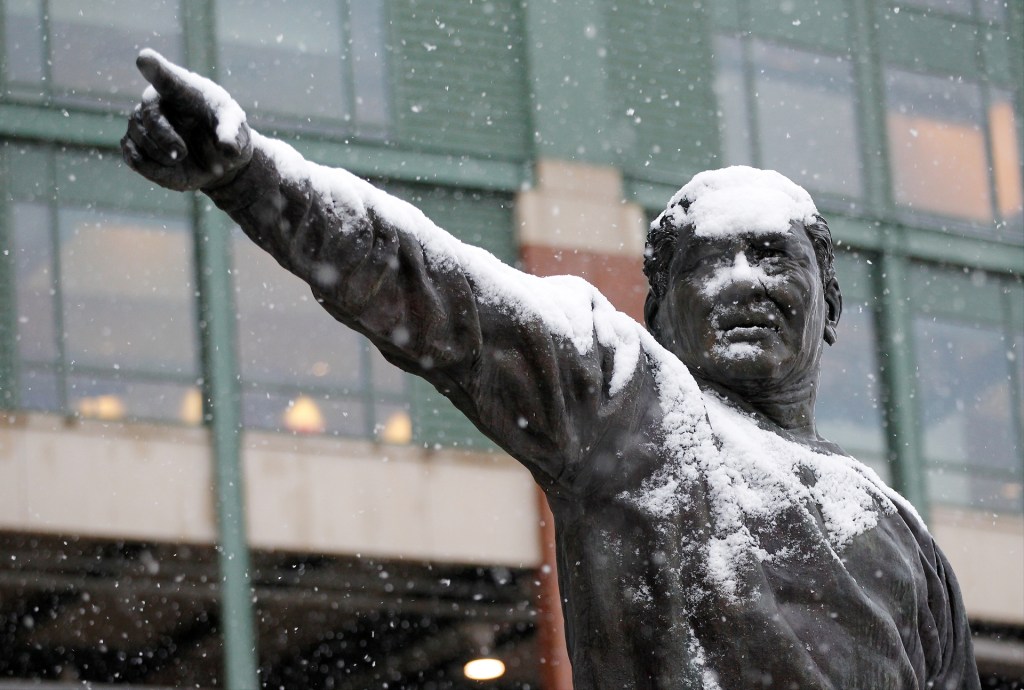
Only two weeks or so to go, two weeks until the Chicago Bears play the first of this football season’s two games against the Green Bay Packers. These will be the latest chapters in one of the sport’s greatest rivalries, stretching back to Nov. 27, 1921. That is the day of the first meeting of the Bears, then known as the Decatur Staleys, coached by George Halas, who also played in that game, and the Packers, coached by Earl Louis Lambeau, who also played in the game.
The game took place in Wrigley Field: Staleys 20-Packers 0.
Herb Gould was not there, of course, but he was a Chicago Sun-Times sportswriter for four decades, until retiring about a decade ago. During those years, he and his wife Liz regularly spent summer vacations in Door County, that heavily wooded Wisconsin peninsula jutting into Lake Michigan just north of Green Bay. Of course, he knew of the Packers’ history. But Lambeau? Not so much.
“When my wife Liz and I would be out walking or hiking, we would hear people calling their dogs, ‘Here Lambeau,’ ‘Come Lambeau,’” he says. “In time, I learned that he had moved to retire in Door County and that this is where he died. I also realized how little I really knew about this man, and so …”
He knows now, as the author of the deeply detailed and sensationally entertaining biography, “Lambeau: The Epic Life of Earl ‘Curly’ Lambeau, The Man Who Invented The Green Bay Packers” (Gonfalon Press).
At 617 pages, it displays Gould’s energy and curiosity as a researcher. But he was, for a time, a frustrated one. “By all accounts, Curly was a consummate liar,” he told me. “He would lie to your face and he was so good at it that you actually enjoyed it. It was difficult, therefore, to separate the man from the self-constricted myth.”
But Gould is able to give us a colorful portrait of the man who, in the wake of his death at 67 in 1965, compelled George Halas to say, “Without him, pro football simply wouldn’t exist.”
Gould would agree, writing, “In his prime, no one, not even George Halas, had Lambeau’s gift for spotting and developing players. When it came to public relations — to spreading the word about the fledgling NFL — Halas was skilled and dedicated, but Lambeau had a gift. Reporters sought him out in a way that made him the NFL’s most visible ambassador.”
So, what happened? How could such fame and importance fade?
“There is no simple explanation,” Gould writes. “Because the story … is complex. He was a brilliant and innovative sports executive, coach and athlete — a charismatic leader. But he also abused and deceived people who had put their trust in him. And while he was considered charming by women, he also had a troubled history as a womanizer.”
Born and raised in Green Bay, Lambeau was a talented athlete who went on to play for Knute Rockne at Notre Dame until an illness forced him to drop out. He returned to Green Bay where he and a pal founded a team they named the Packers, after the packing company that financed the effort. He was a player and coach, leading the team to championships in 1929, 1930 and 1931. After signing future Hall of Fame receiver Don Hutson in 1935, they won three more titles. He was an innovator, the first to enthusiastically and effectively use the forward pass.
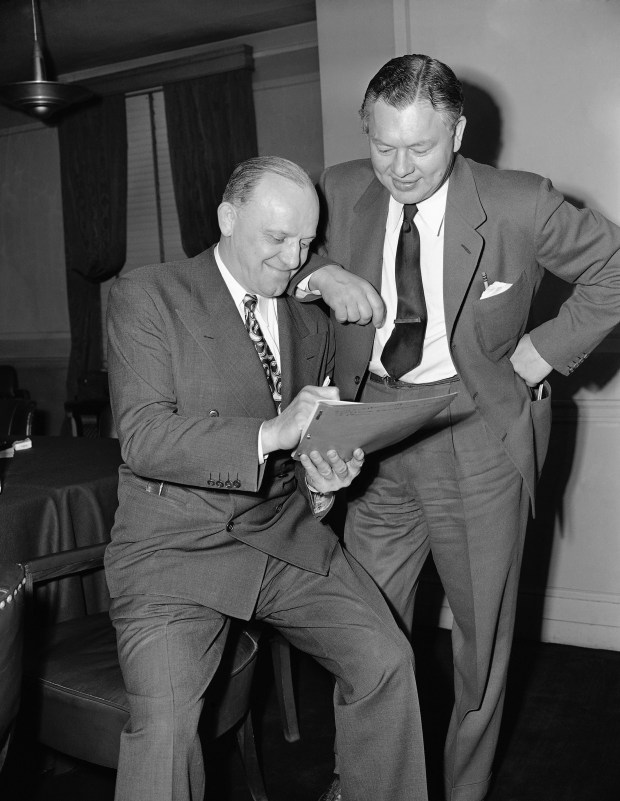 Chicago Bears owner George Halas, left, and Green Bay Packers coach Curly Lambeau on Jan. 23, 1947, at a meeting in Chicago. (Ed Maloney/AP)
He was also a character, and though he would continue professional coaching and win awards (as well as the admiration of Halas) into the 1950s, his later years did not benefit from the ever-increasing popularity and financial boom that came when NFL games began to be broadcast on television.
Told against the backdrop of the times and sensitive to human failings, Gould is a smooth and compelling writer. And the book is attracting praise, such as this from Dan Pompei, acclaimed writer for the Sun-Times and Tribune and currently the senior NFL writer for The Athletic: “(Lambeau) left a massive imprint on the NFL that remains today — yet there is so much we never knew about him. Thanks to Herb Gould, all that changes now.”
Gould and his wife spent most summer vacations in Door County, which has long been a welcoming place for creative people, such as the landscape architect and conservationist Jens Jensen, who designed more than 600 parks (among ours are Columbus, Garfield and Humboldt) and was an ardent preservationist and founder of The Clearing Folk School in the county’s Ellison Bay. That is where Chicago’s Norbert Blei was writer-in-residence for three decades.
Maybe it’s something in the water, for this is Gould’s third book, after “The Run Don’t Count,” a historical novel about the 1908 Chicago Cubs, and “Victory March,” about Notre Dame’s 1988 championship. And there’s another on the way.
Gould and his wife, a lifelong nurse, love their place in Sister Bay but do escape winters for the sun in Tucson. During the summers, though, Herb began covering baseball games of the Door County League for the weekly Door County Pulse newspaper.
“This is what baseball was in the heyday of the minor leagues,” he said. “Before television created giant fan bases radiating from big cities, every town had its team. People took pride in their local guys. That’s what this league is. As embedded as it is in local tradition, it has never seemed like a tourist attraction.”
Until that book is written, the Bears and Packers are on again. The record stands at 107-95-6, and as most Bears fans are painfully aware, 24-3 since 2011. Two weeks or so until the next chapter begins, with games Dec. 7 at Lambeau Field in Green Bay and Dec. 20 here.
Herb Gould, got a prediction?
“The Bears will beat the Packers 20-17 in Green Bay,” he says. “And the Packers will beat the Bears 20-17 in Chicago. … Scribes and touts always favor the home team. But this rivalry is unpredictable.”
rkogan@chicagotribune.com