

Barring a turnaround three times as miraculous as the Immaculate Reception and the Music City Miracle combined, the New York Jets will miss the playoffs for the 15th straight season in 2025.
As fans and analysts observe the Jets throughout the rest of the 2025 season, we will judge every play through a single lens: How does this affect their chances of making the playoffs in 2026?
In one particular way, the Jets have already put themselves on the right side of NFL history when it comes to maximizing their 2026 playoff chances.
The Jets have the makings of a team poised for a jump
While the Jets are 2-8, their overall body of work is more respectable than that of most teams in NFL history who sported this exact record through 10 games.
As a byproduct of their whopping five one-score losses (three of those by two points), the Jets’ point differential is -59, a much less egregious mark than your typical 2-8 team. In the Super Bowl era (since 1966), 136 teams have started 2-8, and their average point differential was -88. These Jets are more than four touchdowns better than that.
New York’s -59 point differential ranks 26th-best among the 136 teams to start 2-8 in the Super Bowl era, which means they’ve played better overall football (points-wise) than 81% of 2-8 teams in league history.
NY Jets film breakdown: Young silver linings emerge in Pats loss
For instance, compare them to the 2021 Jets, the first team coached by Robert Saleh. That Jets team also started 2-8, but they had an abominable point differential of -142, the 13th-worst mark in history for a 2-8 squad. That’s 83 points worse than this year’s Jets—nearly 12 touchdowns’ worth.
Should we build a 50-foot-tall bronze statue of Aaron Glenn outside of MetLife Stadium for this “achievement”? Absolutely not.
However, after digging deeper to find out whether the Jets’ standing in this metric carried any weight, I was surprised to learn how strongly this type of performance correlates with year-over-year improvement.
Among the top 30 teams all-time with the best point differentials at 2-8, all but three improved their records the following season. Even more startling is how substantially their records improved. Those 30 teams finished their seasons with an average of 4.0 wins after starting 2-8, but in the ensuing campaign, they averaged 7.8 wins—essentially double.
Here is a look at the top 30 teams all-time with the best point differentials at 2-8.
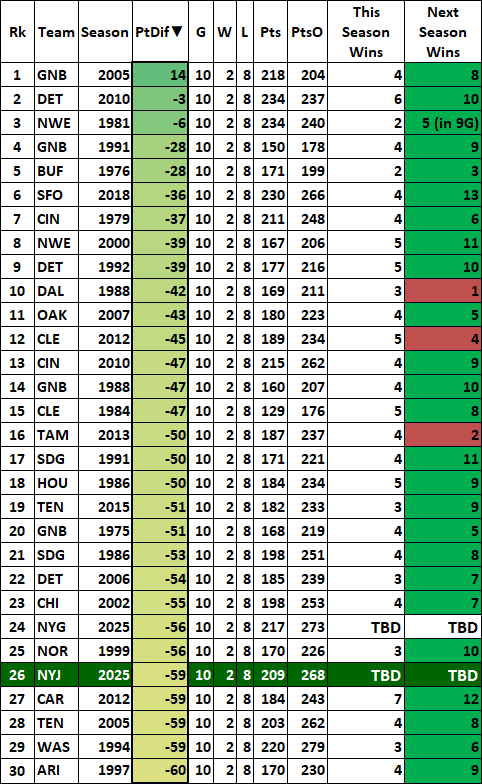
Excluding the 2025 Jets and Giants, 25 of the other 28 teams improved their records the following year, an incredible 89%. Perhaps even more eye-popping is the fact that 17 of the 28 teams (61%) won at least four more games, and 21 of 28 (75%) won at least three more games.
To understand what a three or four-win jump might mean for the Jets, we still have to see where they finish in the standings. Seven games remain for the Jets to confirm precisely what type of foundation they will be building off of.
It’s worth noting that these relatively respectable 2-8 teams have typically not been significantly better at winning games down the stretch, despite their point differentials suggesting they’re somewhat better than their records indicate. Those other 28 teams won an average of precisely two more games over the rest of the season, which is a slight improvement win-percentage-wise compared to a 2-8 start, but nothing particularly noteworthy.
If that trend holds for the Jets, they will finish with a 4-13 record. That type of record would leave Jets fans grasping at straws for optimism, as it would mean the team didn’t facilitate significant progress over its final seven games.
But if this trend is any indication, it might not matter how many wins the Jets collect this year. Perhaps they have already displayed enough respectability to lay the springboard for a leap.
How the Jets fit the mold of a breakout-poised team
Why did these 28 teams have such strong odds of taking large jumps the following season? It’s a large enough sample with consistent enough results to believe that the data is statistically significant, so it’s worth hypothesizing what commonalities these teams might share.
There are a few potential explanations, and each of them applies to this year’s Jets.
If a team starts 2-8, they aren’t going to the playoffs. Hence, the fact that those 28 teams finished with an average of 4.0 wins, and none won more than seven games.
This means that most of these teams netted top-notch draft position across all seven rounds. It’s also probable that they were flush with cap space, as they likely didn’t have a very expensive or experienced roster, given that they struggled enough at closing games to win just two of their first 10 contests.
Another contributing factor is how the team’s early-season records influenced their team-building decisions. Since they started 2-8, many of these teams were likely sellers at the trade deadline, converting expensive veterans into future draft picks and cap space. The record holds more weight in determining a team’s decisions, even if the point differential is a better indicator of their actual performance.
Yet, as displayed by their point differentials, the core roster talent of those squads was actually better than what is typically expected of a 2-8 team. Most of these teams had talent that would be more akin to a 3-7 or 4-6 team (the 2025 Jets currently have 3.6 Pythagorean wins).
Thus, you get the perfect formula for a much-improved season. These teams netted the roster-building resources of an awful team, but they were actually building off the foundation of a roster that, talent-wise, was probably a few wins better than its record.
The 2025-26 Jets are in a similar position.
Don’t get it twisted: The Jets, as currently constructed, aren’t any good. But they might be closer to a playoff-caliber team than one would think based on their 2-8 record.
Just compare them to the 2021 Jets team, which never amounted to a playoff team in Saleh’s four seasons after getting outscored by a shocking 194 points in Saleh’s debut season. That remains the third-worst mark in Jets history and was only 20 points better than Adam Gase’s 2020 squad.
In 2022, the Jets improved their point differential by a lofty 174 points, but since they were building off such a low foundation, they still had a -20 point differential after using their mountain of assets to facilitate that massive leap. Therefore, they won only seven games. While it was a three-win jump, the 7-10 record was ultimately the Jets’ peak under Saleh. It can all be traced back to the weak springboard he established in his debut season.
The 2025 Jets are on pace to finish with a -100 point differential, 94 points better than the 2021 Jets. Hypothetically, if they were to use their similarly impressive chest of roster-building assets to improve by an identical 174 points next season, they’d be a +74, which would likely anchor them to at least nine or 10 wins.
(Yes, the Jets are currently less talented on paper than they were pre-trade deadline, but it’s worth noting that they’re 2-1 with a -1.7 point differential without Sauce Gardner compared to 0-7 with a -9.1 point differential when he’s active, so their overall performance this year transcends the two stars they dealt, at least so far.)
That’s a completely hypothetical exercise, but it goes to show that there is real value to the Jets’ relatively respectable point differential in 2025, even if it hasn’t yielded victories in the short term.
If the Jets were performing every bit as poorly as their 2-8 record suggests, it would be harder to generate optimism about their ability to maximize their hoard of long-term assets. They would be nothing more than an incompetent organization with the assets that incompetent organizations are expected to have. That formula rarely works. The Jets have tried to make it work many times over the past 15 years, and it never did, because a bad organization just isn’t going to get it right no matter how many assets they have. All it means is they get more at-bats to strike out.
Premium assets will only take a team far if competent people are utilizing them. If a team nets its premium assets by way of performing abysmally on the field, it probably means the people leading that team are not competent.
A 2-8 record will never scream “competency” to a casual observer, but the record itself never tells the story. Peeks beneath the hood must be taken to glean where a team truly stands. In the case of the 2025 Jets, we have a team that appears to be a little further along than many realize when it comes to accumulating talent and staying competitive in games. That might seem like a celebration of mediocrity, but based on NFL history, it’s much more than that.
There is a strong chance that the Jets’ performance in 2025, for all of its warts, is precisely what the organization needs to facilitate a breakout season in 2026.
You just have to look past the “W” column to really see it.
Whether they intended it or not, the Jets have landed in the best position to build a team
In a way, it’s a stroke of luck rather than a brilliant plan.
The Jets didn’t “try” to start 2-8 while displaying a relatively promising core of talent. If a couple of fumbles bounced differently, they might be 4-6 right now. Sauce Gardner and Quinnen Williams would probably still be on the team, and the Jets would not have the boatload of draft picks and cap space that they netted by trading those players, nor the premium draft slots their 2-8 record is projected to land them.
Sometimes, though, a little bit of luck is necessary to get a team where it needs to be. Xavier Gipson’s Week 1 fumble was maddening at the time for Jets fans, but it could go down as the domino that kick-started the Jets’ road to their first successful rebuild in decades.
Through a combination of shrewd offseason moves to strengthen the roster (making them competitive enough to be in so many close games in the first place), dumb luck (losing most of those close games to strengthen their long-term flexibility), and bold trade-deadline decisions that doubled down on the team’s trajectory, the Jets have beautifully positioned themselves for the long term by maximizing their ability to add talent while simultaneously showing that they already have more talent than a team is “supposed” to have while owning this many assets.
Jets fans have been sold a false bill of goods many times before, so they aren’t going to buy into any promises of long-term optimism until the pizza is baked and set on the table in front of them. In the meantime, as it sizzles in the oven, fans should take solace in the fact that the recipe being used is far more tried-and-true than those relied upon by preceding chefs.