
Whether or not he makes points based in factual reality, whether or not he properly uses words according to their definition, and whether he looks like a normal human or a magical wizard visiting from a foreign planet, you have to give Cam Newton credit.
The man gets people talking.
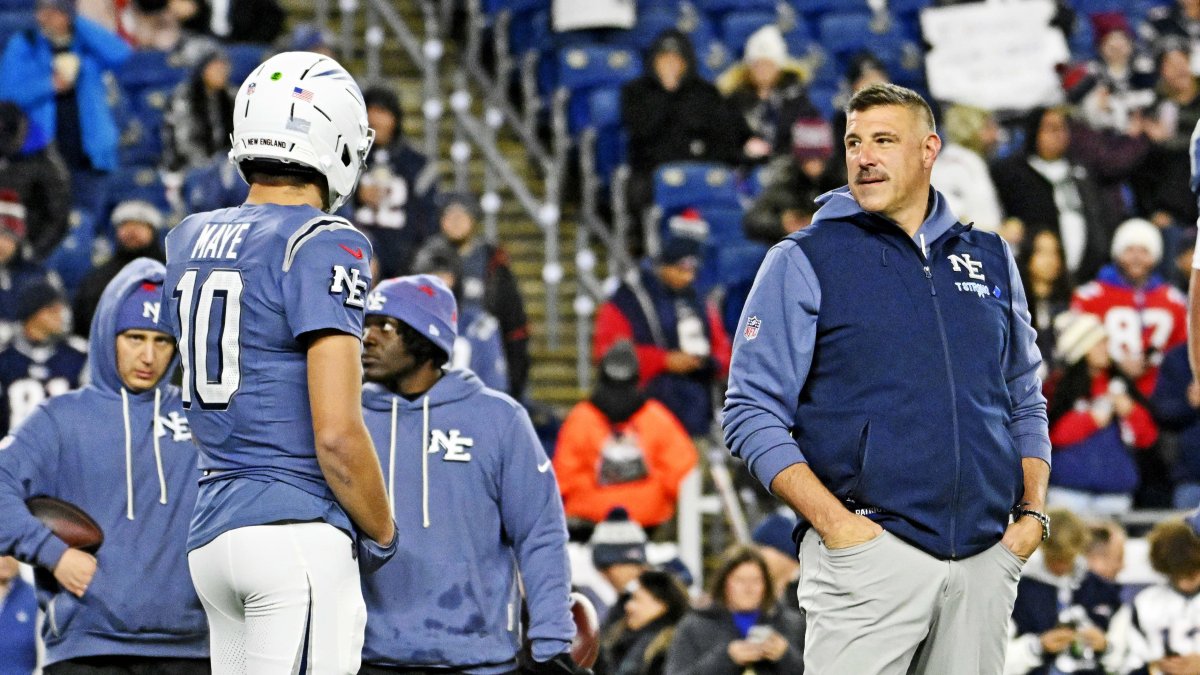
In his new career as a media talking head, the former NFL MVP has shown a clear understanding of that part of the business, as Newton is popping up in viral clips on a weekly basis for his takes on the NFL and the sports world at large. And not long after nonsensically arguing that Drake Maye isn’t a great deep ball thrower, Newton set his sights on Maye and the Patriots once again.
“If you keep playing sorry scrubs, then you’re going to have this falsetto of a mentality going into the playoffs, and it has one-and-done written all over it,” Newton said on First Take after the Patriots beat the Jets to improve to 9-2. “Give me the Indianapolis Colts.”
Putting aside the fact that the strength of victory (.361) of the 8-2 Colts is a whopping two points higher than that of the Patriots (.359), the point is one that’s sure to hover over everything the Patriots accomplish during this regular season.
Because make no mistake: That schedule is bad.
As things currently stand, the Patriots are due to play at least 11 games teams that will finish the year with sub-.500 records. The number could increase based on how the Ravens (5-5), Panthers (6-5) and Steelers (6-4) finish their seasons.
Defenders of the Patriots can of course rightfully point out that they’ve beaten the 7-3 Bills and 6-4 Buccaneers, or that they’ve won a number of their games against bad teams in blowout fashion.
Yet outside of that, the question raised by Newton — and surely many others in the coming weeks — is more about how that soft schedule will prepare the Patriots for playoff games in January.
Logically, one would believe that a battle-tested team that fought through the best of the NFL all year would be best-suited to make a run at the Super Bowl. Recent history, though, tells a bit of a different tale.
Strength of schedule, strength of victory in Super Bowl participants
There’s no exact science for any of this, but in terms of keeping it simple, these are the two numbers we need to focus on: Strength of schedule and strength of victory. They are exactly what they say they are.
Strength of schedule is the combined winning percentage of a team’s opponents, and strength of victory is the combined winning percentage of all the teams that one team has beaten. Simple stuff.
If you beat a bunch of good teams, your strength of victory will be higher than a team that only stacks up victories against the dregs of the NFL. (The Jets, for example, have a .250 strength of victory, having only beaten the 3-7 Bengals and 2-8 Browns.)
For the purpose of this exercise, we’ll look at Super Bowl participants going back to the start of Dynasty 2.0 for the Patriots in the 2014 season, giving us 11 years of data.
The general question: How often have the teams with either the best strength of victory or hardest strength of schedule made or won the Super Bowl? On the other side, how often have the teams with the lowest numbers made or won a Super Bowl?
The best of the best
Every year, one team faces the hardest schedule and/or beats the best teams. Rarely, though, does that team win the Super Bowl.
Of the 11 seasons analyzed, only three Super Bowl winners had the best strength of victory among playoff teams in their conference. Those teams were the Patriots in 2014 and 2018 and the 2015 Broncos. The 2014 Seahawks, who lost in the Super Bowl to New England, had the best strength of victory among NFL playoff teams that season.
The 2018 Patriots also had the second-hardest schedule (.482 SOS) in the AFC.
The 2019 49ers, who lost in the Super Bowl to the Chiefs, had the best strength of victory and second-hardest strength of schedule in the NFC.
The 2015 Broncos had the best strength of victory among all playoff teams at .479 and the second-hardest strength of schedule in the AFC playoffs.
Other than that, though, the “best of the best” hasn’t carried that through the postseason.
The best of the rest?
The instances of teams with lowers strengths of victory and easier strengths of schedule beating “better” teams in the playoffs are numerous.
The 2023 Chiefs had the second-lowest SOV and third-worst SOS among AFC playoff teams en route to a championship. The ’22 Chiefs had a .428 SOV and .481 SOS, while the Ravens had a .529 SOV, a .543 SOS and a first-round bye. The Chiefs still beat the Ravens in the AFC title game.
The Super Bowl following the 2021 season featured the Rams (second-lowest SOV among NFC playoff teams) and Bengals (third-lowest SOV, easiest SOS among AFC playoff teams).
The 2017 Eagles had the lowest SOS and SOV among NFC playoff teams, and they beat the Patriots, who had the second-best SOV and SOS in the AFC playoff field. Those 2017 Eagles also won a playoff game against the Falcons, who had the hardest SOS among all playoff teams at .543.
The 2016 Patriots had the easiest strength of schedule (.439) among all NFL playoff teams, just as the NFC-champion Panthers a year before them did at .441.
The point? Given the war of attrition that is an NFL season, being the most “battle-tested” team may actually prove to be a detriment to a team winning a Super Bowl. The quality of opponents faced and beaten in the regular season does not seem to have a direct relation to teams’ abilities to win in the postseason.
The caveat
While teams with easy records and unimpressive strengths of victories have made and won Super Bowls, this must be said: The 2025 Patriots’ numbers are abnormally low.
Zero Super Bowl participants in the specified timeframe had a strength of schedule lower than .439. The Patriots’ strength of schedule is currently at .366 … and can still go down before the end of the year.
Similarly, only one team — Tom Brady’s Buccaneers in 2020 — reached the Super Bowl with a sub-.500 strength of victory. The Bucs clocked in at .392, while the Patriots are currently at .359.
By that measure, it would be out of the ordinary for the Patriots to make the Super Bowl. Then again, the 2007 Giants had a .375 strength of victory and ended up beating an undefeated Patriots team in the Super Bowl.
That is to say, sports — as always — remain unpredictable.
As of this date, the Patriots have beaten bad teams, and the Patriots have beaten good teams. While talking heads will need to fill the airwaves and social media space with grand conclusions based on those results, history would suggest that little if any of those details will have much bearing on the wins and losses that will come in the playoffs.