
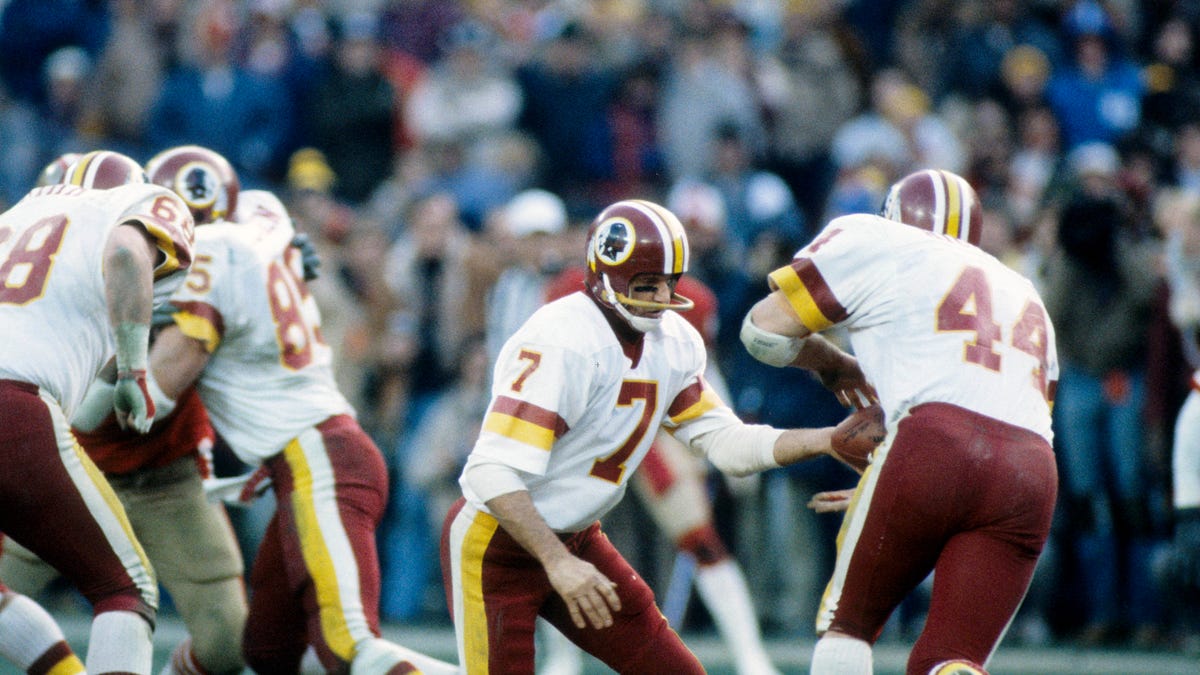
Nov. 18/1985 – Washington Redskins QB Joe Theisman played his last game in the NFL after a nasty leg injury after being sacked by Lawerence Taylor. pic.twitter.com/Tr0c4fGM5L
— Today In History (@TodayThatWas) November 18, 2025
November 18, 1985, RFK Stadium, Monday Night Football.
It was already a bizarre season because the Washington Redskins were struggling. It was the 11th game of the season, and Washington’s record was mysteriously only 5-5. You see, Joe Gibbs’ 1982 team had won the NFC and Super Bowl XVII. His 1983 team had won the NFC and lost in Super Bowl XVIII. His 1984 team had won the NFC East with an 11-5 record. Thus, for three straight seasons, the Redskins were atop the NFC East, but this 1985 team was struggling.
In particular, Joe Theismann was struggling. He had begun starting some Redskins games during the 1976 season, sharing time with Billy Kilmer. But by the 1978 season, the job was his, and the only few games he had missed were due to injury. But since the arrival of Gibbs (1981), Theismann had started every game.
On this Monday night, a nationally televised ABC game, the 7-3 New York Giants were in town, coached by Bill Parcells; led by Lawrence Taylor, Harry Carson, Phil Simms and Joe Morris. It was 53 degrees at kickoff, a must-win for Washington if they were going to again qualify for the playoffs. Keep in mind that the NFL had 28 teams in 1985, with three division winners and two wild-card teams, for a five-team conference playoff bracket.
Tied 7-7, having just begun the second quarter, Washington had a first-and-10 at its own 46-yard line. Theismann handed off to John Riggins, who then stopped, turned around, and pitched back to Theismann. However, the Giants’ Carson had penetration, and Theismann, unable to throw downfield, stepped away from Carson, thus allowing a second Giant, Taylor, to tackle him from the side.
What happened next has been remembered by so many, like myself. Strangely, Taylor hopped back up onto his feet, turned toward the Washington sideline, and feverishly motioned with his right arm for the trainers to rush to the field. When he turned back toward Theismann, he instantly brought both hands to his helmet, as if in disbelief. At that moment, we all knew, something dreadful had transpired.
Offensive lineman No. 73 Mark May remained by Theismann’s side the entire time medical personnel attended to Theismann. Taylor, as well, remained only a few yards away, observing what occurred. Theismann was carted off the field, and the diagnosis was made public the following day. Theismann (age 36) had both the tibia and fibula — the major bones of the lower leg — broken, and the jagged edges of bone tore through the skin.
Suddenly, without warning, Theismann’s NFL career was done, having started 124 games with Washington enjoying a 77-47 record in those games. He had been the 1983 NFL MVP, a Super Bowl XVII champion, and an eight-year starter. Yet, in one play, it was all finished, gone.
Jay Schroeder, who had yet to start an NFL game, came on in relief and led Washington to a 23-21 win that night.
“All our guys and all our coaches dedicated the game to Joe,” Gibbs said. “And it was a tough thing to see that guy on the field. We dedicated the game ball to him, and it was a sad thing for us. I just think it was one of the greatest efforts I’ve ever seen by a group of guys.”
For those of us who were watching live that night, it has always remained a compelling, robust memory. It has served as a reminder to us of how dangerous the NFL is for players. Even more, it illustrated vividly how unexpectedly our lives can be instantly changed.