
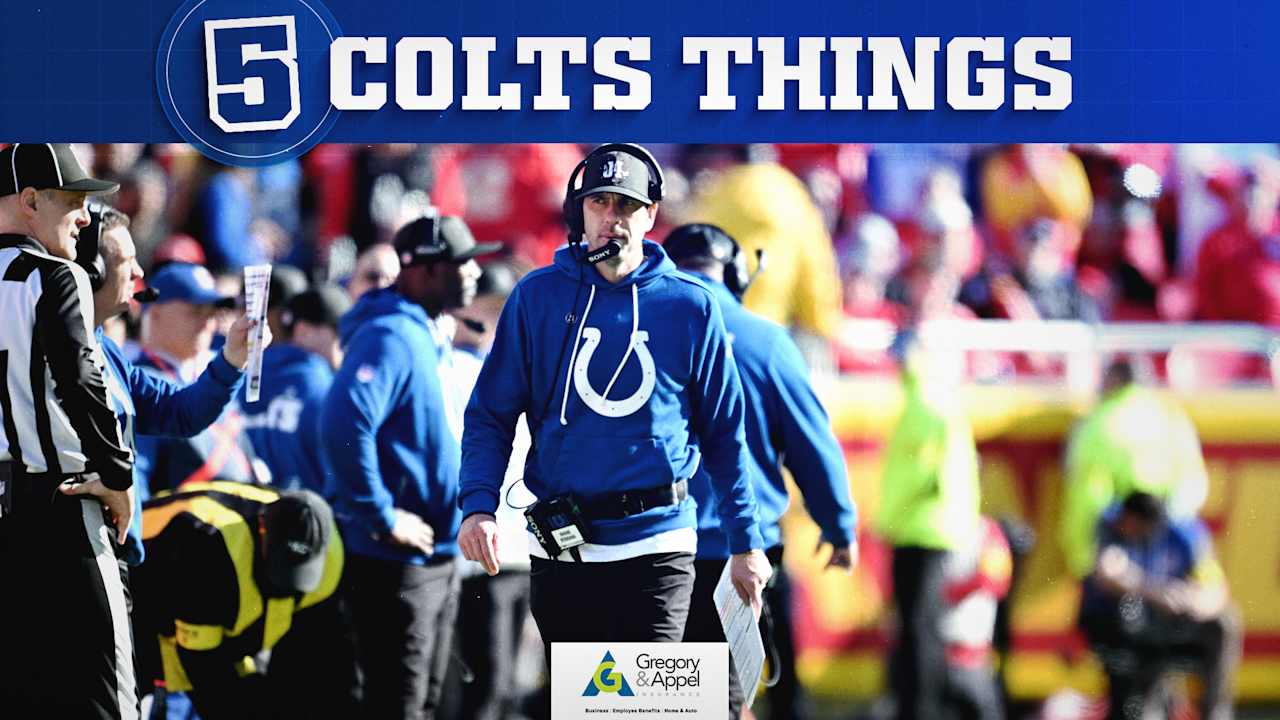
1. Shane Steichen on Monday dissected his playcalls in the fourth quarter and overtime.
The Colts held the ball with a 20-9 lead early in the fourth quarter after linebacker Zaire Franklin knocked the ball out of running back Kareem Hunt’s hands, with cornerback Charvarius Ward Sr. falling on the loose ball at the Colts’ six-yard line. Nothing the Colts had done on their previous six possessions – on which they averaged six yards and +.204 EPA per play – suggested a late-game lull was looming.
Yet the Colts went three-and-out on four consecutive possessions, which allowed the Chiefs to ultimately tie the game to end regulation and then win it in overtime. The blow-by-blow:
First drive (14:48 4th quarter):
First and 10: Jonathan Taylor -2 yard rush
Second and 12: Daniel Jones incomplete pass intended for Josh Downs, had to throw hot around blitzing (and leaping) cornerback
Third and 12: Jones backs up in collapsing pocket, incomplete pass intended for Downs under pressure
Second drive (8:31 4th quarter):
First and 10: Play-action pass to Michael Pittman Jr. on an out-breaking route; ball is knocked out of Pittman’s hands by safety Bryan Cook for an incompletion
Second and 10: Play-action screen to Taylor for a seven-yard gain
Third and 3: Chiefs send a six-man pressure; linebacker Nick Bolton runs free through A-gap, Jones throws incomplete over the middle to Pittman
Third drive (5:45 4th quarter):
First and 10: Jones drops back with a good pocket and looks toward Tyler Warren on an out-breaking route just past the first down marker. Defensive back Chamarri Conner passes off a vertical route from Pittman to Cook, then breaks on Jones’ throw to Warren and collides with Tranquill, with both defenders nearly intercepting the pass.
Second and 10: Warren runs a quick out to the flat, but Cook closes quickly from his perch at safety and forces an incompletion.
Third and 10: Kansas City brings another blitz, which is picked up well by the Colts’ protection. Jones picks out Pittman over the middle for a six-yard gain, leading to a punt.
Fourth drive (9:55 overtime):
First and 10: Quick RPO throw – against a seven-man box with a slot blitzer – to Drew Ogletree for four yards
Second and 6: Under center run to Taylor, who fights through contact for a gain of five
Third and 1: Taylor dropped for a loss of two (more on these runs in thing No. 2), leading to a punt
On Monday, Steichen was asked about his play-calling decisions, namely in having running back Jonathan Taylor touch the ball on three of the Colts’ final dozen plays.
“The three and outs obviously were unacceptable, and that’s on me,” Steichen said.
More specifically, Steichen pointed to the final drive of the fourth quarter – on which Jones threw on straight drop-backs (no play action or RPOs) three times – as an area he looked back on in the hours after the game.
“I think that last drive in the fourth quarter was the biggest one where he probably could’ve popped a run on first down,” Steichen said. “You throw it on first down, now you’re at second and 10, and then you throw it again. It’s not third and 10, and you try to get a third and 10 against a team that brings pressure – obviously we were short there on the third down. So that last drive in the fourth quarter, I thought I could’ve done a better job for sure.”
But something to consider here – the Colts had issues running the ball on first down leading up to the one time they did it here, which resulted in a loss of two yards.
2. The Colts’ run game struggled on first down and in some key moments.
The Colts entered Week 12 averaging a league-high .116 EPA per play on first down rushing attempts, and their 5.6 yards per rush average on first downs was second in the NFL. Those numbers were built not necessarily on efficiency – the Colts’ rushing success rate on first down was 23.4 percent, 18th in the NFL – but on explosiveness. Of the Colts’ 128 first down rushing attempts heading into Sunday, 18 of them generated 10 or more yards (14.1 percent, third-best in NFL); seven of those gained 20 or more yards.
Against the Chiefs, running back Jonathan Taylor carried seven times on first down and gained 14 yards; he was tackled for a loss on three of those seven runs. Taylor’s longest rush on first down was eight yards, which he hit on the first play of the game and then again just before the two-minute warning in the first half.
Meanwhile, entering the fourth quarter, Jones had completed six of eight passes for 47 yards on first down – not explosive, but efficient enough to keep the Colts consistently ahead of the chains.
Taylor, in the fourth quarter and overtime, was stuffed on two of his three rushing attempts.
“We had some linebacker run-throughs is what it looked like on a few of those,” Steichen said. “We got to go back and look at those and get those cleaned up. And that starts with me.”
After Zaire Franklin’s forced fumble was recovered by cornerback Charvarius Ward Sr. at the Colts’ six-yard line, Taylor was dropped for a two-yard loss on first down when linebackers Drue Tranquill and Nick Bolton came flying into the backfield; on a third-and-one in overtime, Tranquill again flew into the backfield and dropped Taylor for a loss.
The last rush here wound up being the last time the Colts had the ball. They got into a shotgun set, believing the Chiefs might alert for a pass on third-and-short – prior to Week 12, the Colts had called 12 dropbacks versus 14 rushes on third-and-one and third-and-two plays this season. The inside zone run to Taylor was blown up by defensive tackle Chris Jones stunting inside, which opened a lane for Tranquill to fly downhill and tackle Taylor.
“Credit to those guys, they did a good job up front,” Steichen said. “We didn’t get to the second level. And credit them for making the play.”