
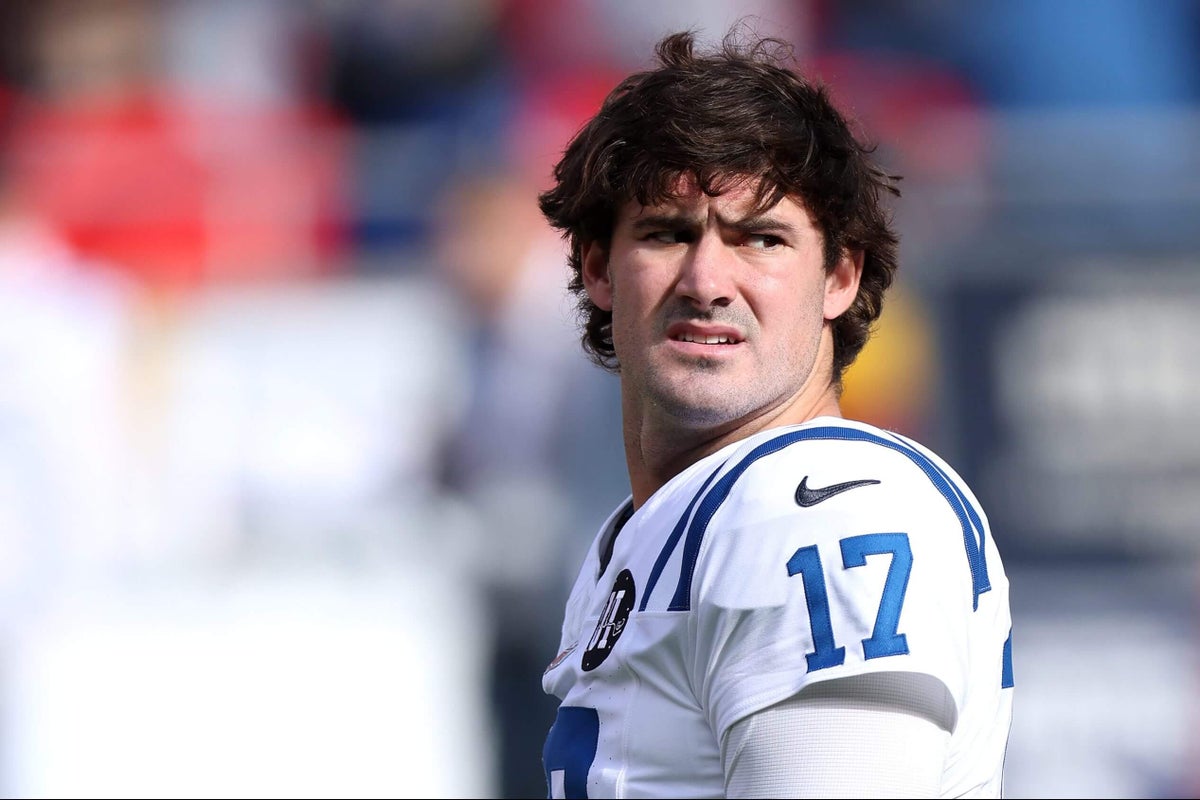
They were two throws made by the same passer, but the outcomes were very different.
The first one came in the second quarter on Sunday. Indianapolis Colts quarterback Daniel Jones dropped back to pass in the short red zone and surveyed the field. As the pocket began to collapse around him, with a pair of Kansas City defensive linemen closing in for a potential sack, Jones didn’t flinch. He stood tall, kept his eyes up and ripped a rocket across the middle of the field to tight end Drew Ogletree, who made a 4-yard, toe-tapping touchdown catch in the back of the end zone. It was one of Jones’ best throws of the season, and it came against arguably their toughest opponent to date.
1ST CAREER TOUCHDOWN FOR TREE ‼️
📺 CBS pic.twitter.com/hDSjuttnTJ
— Indianapolis Colts (@Colts) November 23, 2025
But just as quickly as Jones reminded the Colts of how much their QB fortunes have changed, his performance in the game’s biggest moments was a reminder of the quarterback he used to be and — perhaps to some degree — still is. One throw he surely wishes he could have back came in the fourth quarter; facing a third-and-3 from Indy’s 40-yard line, Jones tried to connect with wide receiver Michael Pittman Jr. on a short crossing route over the middle of the field. But with the Chiefs blitzing defense bearing down on him, he rushed the throw and missed a diving Pittman in a gotta-have-it situation.
“I thought he played pretty good ball,” Colts coach Shane Steichen said of Jones after the loss in Kansas City. “I would have to go back and look at it.”
Following that game, what I think Indianapolis should go back and look at are the rules for using the franchise tag. The Athletic’s NFL insider Dianna Russini reported recently that the Colts are expected to have “contract talks with Jones’ representatives this offseason to keep him as their starting quarterback moving forward.”
However, Jones’ outings as of late have made what appeared to be a no-brainer decision to lock him in as Indy’s QB of the future a bit more nuanced.
Let’s start here: Jones will be in a Colts uniform next year and rightfully so. There is no way they’d be 8-3 in 2025 without him, especially considering that their previous starting quarterback, Anthony Richardson Sr., completed just 47.7 percent of his passes last year, which was the lowest mark in franchise history. Jones’ 69.1 completion percentage this year, on the other hand, would be the highest mark in team history if he upholds it for the full campaign.
But when taking a deeper look under the hood, Jones’ production, or lack thereof, is trending in the wrong direction. Through the first eight games of the season, he ranked No. 1 in the NFL in EPA/dropback at 0.307, per TruMedia. He was playing better than reigning MVP Josh Allen, potential Hall of Famer Matthew Stafford and arguably the best QB of this generation, Patrick Mahomes. From Weeks 9-12, however, Jones ranks 29th in EPA per drop back at -0.137, trailing the likes of Davis Mills, Bryce Young and Jacoby Brissett during that span.
What’s more, Jones has really struggled against the blitz lately after torching aggressive defenses earlier this year. Through his first eight games of the season, Jones’ EPA against the blitz ranked second in the NFL at 0.45 despite being blitzed at the third-highest rate (33.8 percent). Since Week 9, while teams have continued to blitz Jones at the fifth-highest rate in the league (32.3 percent), his EPA has plummeted to -0.30 (28th). In other words, Jones has come back down to earth … or he’s simply reverting to his mean. Before Jones even landed with the Colts, he appeared in 70 games for the New York Giants and held an EPA of -0.10 against the blitz.
Of course, the offensive line and skill position players Jones has around him now are more talented than what he had in New York. But countering the blitz has never been his strong suit, and if Jones and the Colts are unable to find a solution for dealing with extra pressure, it’s worth questioning how much Indianapolis should invest in him long term, which is where the franchise tag could come in handy.
Colts GM Chris Ballard once described the franchise tag as “a tool we have” when discussing contract negotiations with Pittman Jr. during the 2024 offseason. Indianapolis eventually tagged Pittman, which would have paid him a fully guaranteed $21.8 million in 2024, before coming to an agreement on a three-year, $70 million deal with $46 million guaranteed.
The projected franchise tag for quarterbacks in the 2026 season is a fully guaranteed $46.1 million, per OverTheCap, and there are some pros and cons. One of the biggest cons is that if Indianapolis tagged Jones, his full salary would count against the team’s 2026 cap and limit its flexibility to tweak the rest of the roster around him. Keep in mind, wide receiver Alec Pierce, right tackle Braden Smith and strong safety Nick Cross, among others, are also playing out contract years.
But on the flip side, the biggest pro for the franchise tag would be the Colts having at least one more season to evaluate Jones, and unlike when the Giants faced this same decision a few years ago, Indianapolis doesn’t have another franchise pillar to consider. The Giants chose between tagging Jones and running back Saquon Barkley, and they ultimately chose the latter. Jones eventually inked a four-year, 160 million deal with $82 million guaranteed that New York quickly regretted. The player Jones emerged as during the Giants’ playoff run in 2022 was not proven to be sustainable (though, to be fair, it wasn’t all his fault given the well-documented issues in New York), and he was eventually released last year.
The Colts are in a position to be more patient, which might seem like a crazy thing to say, since they just traded away their next two first-round picks in an all-in trade for star cornerback Sauce Gardner, which has only become possible because Jones was playing at such a high level. But now that he’s tapered off a bit, it doesn’t mean Indianapolis has to immediately double down and agree to a multiyear contract extension with Jones. Such a contract would likely land somewhere in the Baker Mayfield or Sam Darnold range of reclamation QBs (three years, $100 million).
“Everything I’ve seen out of Daniel Jones, he’s a man that handles adversity well,” Colts offensive coordinator Jim Bob Cooter said of Jones’ recent struggles. “He’s very consistent. He’s very dependable. The nature of this business is adversity, getting through it, coming out the other side.”
The other side currently has Houston’s No. 1 ranked scoring defense coming to town Sunday, along with a slew of other stingy defenses as the Colts’ schedule stiffens up over the final stretch of the season. How Jones responds should not only inform the team’s immediate future but also the front office’s big-picture decisions beyond it.