
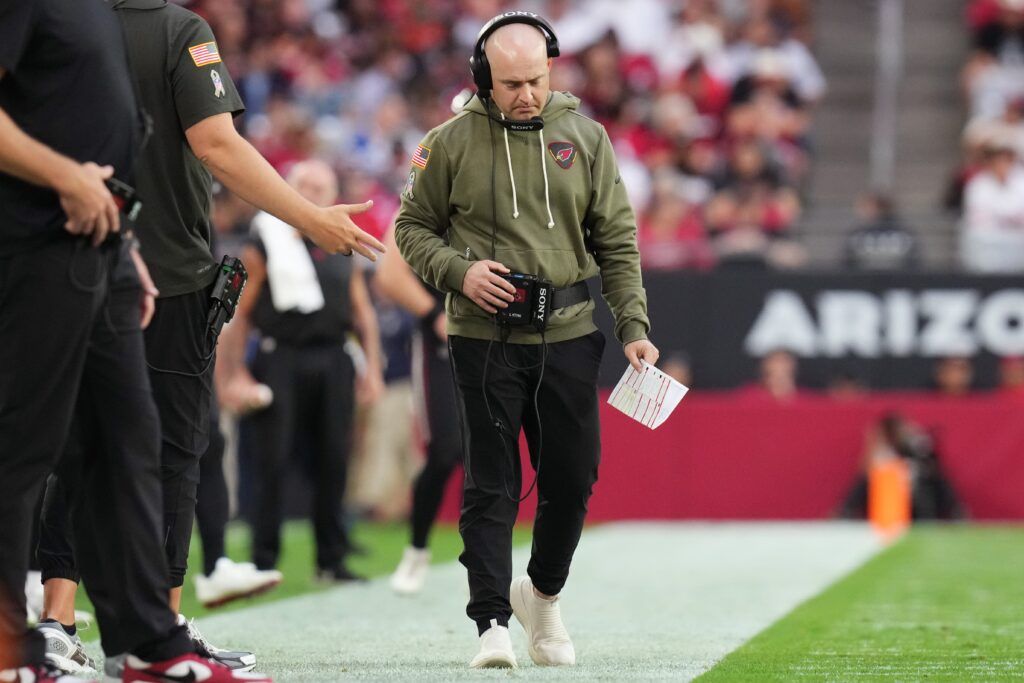
The Arizona Cardinals’ loss to the Jacksonville Jaguars was another close loss and the sixth one-possession loss of the season.
It basically came down to two crucial plays at the end of regulation and the end of overtime. The Cardinals didn’t capitalize on either play, and the Jaguars won. On Tuesday, Cardinals offensive coordinator Drew Petzing explained his mindset on both plays.
What Was Drew Petzing Thinking?
The Cardinals had two crucial plays in their loss to the Jaguars, and both times, they didn’t make the play when they needed to.
The first one came at the end of regulation when receiver Michael Wilson caught a 31-yard pass to get the Cardinals down to the Jaguars’ 11-yard line.
There were 35 seconds left in the game when the play started, and the Cardinals didn’t get their next play off until there were 11 seconds remaining. That left six seconds left, and Arizona opted for a game-tying field goal, rather than another shot at the end zone.
Petzing explained his mindset on the play and why the Cardinals attempted only one, instead of two, shots to the end zone for the win.
“Six seconds left for me outside the 10-yard line, I think gets a little hairy, just personally. With any amount of time left, there’s kind of a yard line where you say, ‘Inside of that yard line, we’re good. Outside of that yard line, we’re playing with fire,’” Petzing said. “The last thing you want to do is not get a kick off in that situation. Your No. 1 goal as an offense in that situation is to make sure we kick the ball before the game ends.
“So, as you get closer to that line, and you’re not at the yard line that you’ve deemed in your mind, I think you got to stay true to that. No matter what your emotions may tell you in that moment. I think that’s the first thing. We’re going for the win; we have to play smart, though.”
Petzing explained he normally accounts for about 20-22 seconds for an explosive play like that before the next play gets off. That’s why he didn’t call for a spike after the explosive play.
He intended for about 13-15 seconds to remain for two plays to get off. Instead, 12 seconds remained, and he didn’t feel comfortable with one more play to get off in six seconds.
“That was the difference between probably getting another chance at the end zone and only having that one shot. But I do like kind of the chaos of the situation – I think benefits us,” Petzing said. “It creates more one-on-ones. It doesn’t allow them necessarily to get into a pressure check or an end-of-game call where we can kind of dictate … what looks we have or what we need to get into.
“It felt like we kind of had an opportunity to get a one-on-one to Mike or Trey, to one of our best players out there in that moment, but would’ve liked to see about 3 or 4 more seconds on the clock.”
The other play came on 4th and 4 with the game on the line in overtime. The Cardinals were down by three points and needed a field goal to tie or a touchdown to win, and had the ball just past midfield.
The play ended up being, basically, a jump ball 40 yards downfield to receiver Xavier Weaver.
“As it pertains to the last play in overtime, it was what, fourth and four – I didn’t call Hail Mary. It’s not just a chuck it to the end zone,” Petzing said. “We’re going to call plays and depending on what coverage they play, that’s going to dictate where the ball goes. I mean, there are guys underneath, there are guys running short route based on where they’re being played and where their safeties were – that’s where the ball probably should have gone.
“It was a great opportunity to go win the game in that moment, which I was excited to see that ball go up. Lot of contact and didn’t come down with it, and that’s the reality of the game. But I think that’s true with a lot of third downs.”
The play design does actually make sense when you go back and watch it. However, the decisions within the play can be questioned.
READ MORE: Week 13 NFL Power Rankings: Eagles Fall After Loss to Cowboys, Steelers Tumble
Both Wilson and McBride were double-teamed, but receiver Greg Dortch was open in the flat and had just one guy to beat to get the first down.
Both plays proved to be the difference in the Cardinals’ loss, and now Arizona sits at 3-8 with three straight losses.
To make matters worse, Sunday’s performance was graded as Arizona’s worst of the season, offensively, according to PFSN’s Offense Impact. The Cardinals earned a D+, which is their second D+ grade of the year alongside Week 11 against the Seattle Seahawks.
The Cardinals will go back to the drawing board this week to try to correct those small details that make all the difference on Sundays.