
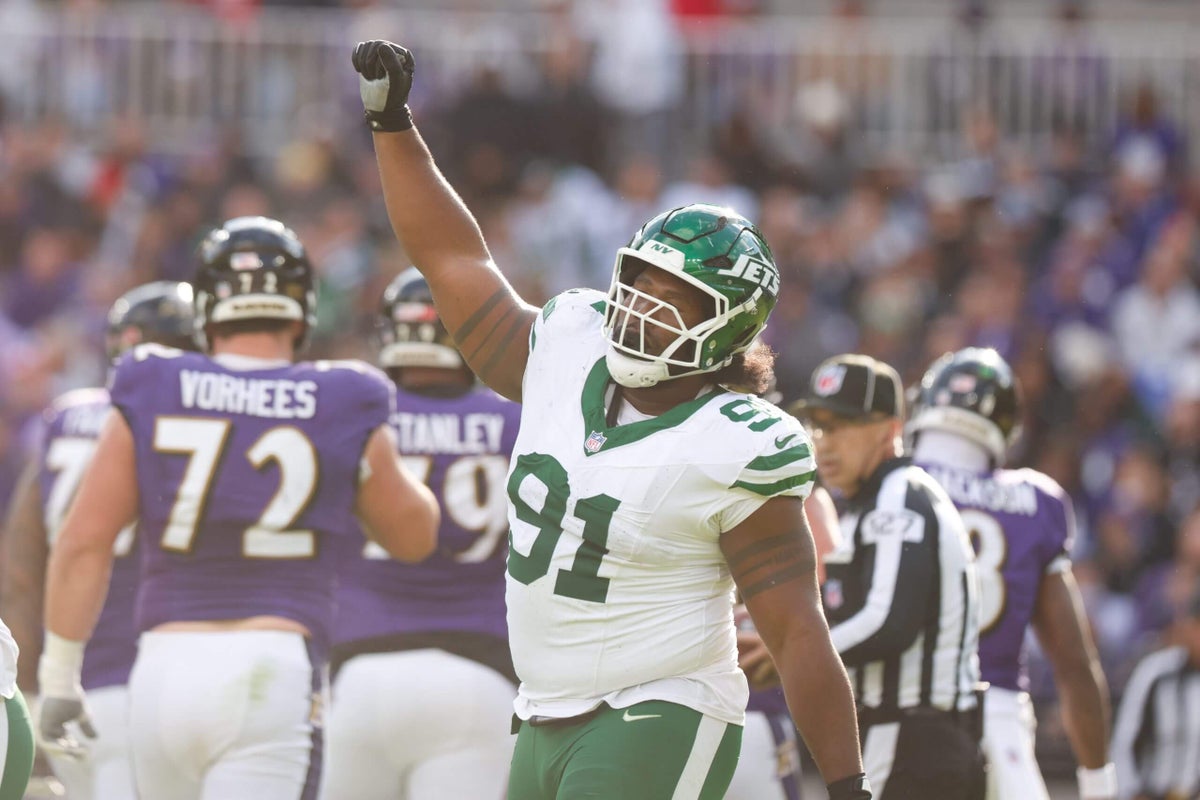
When Harrison Phillips stood up in front of the entire roster at the team hotel in Cincinnati, the New York Jets were still winless.
He wasn’t around for Aaron Glenn’s first speech to the team, or the many addresses that followed over the spring and early summer. Last August, Phillips was walking in blind aside from a conversation he had with Minnesota Vikings coach Kevin O’Connell after the trade. O’Connell raved about Glenn and where the Jets were headed.
Then the losing started, often in heart-breaking fashion, in ways befitting those “Same Old Jets.” So on Oct. 25, the night before a game against the Cincinnati Bengals, Phillips, now a leader on a young team, took it upon himself to impart a message on an organization that has for so long been mired in losing.
“You have to have the mentality to play the long game,” Phillips said. “I said to them: You might’ve beat me yesterday, you might beat me today, and hell, you might beat me tomorrow. But you won’t beat me in the end. You have to have the power to be unstoppable.
“But the issue with that message is sometimes you feel like there’s a lack of depth perception, you’re keeping a goal far away from yourself to where you might never accomplish that and you just perpetuate the fact that you’re never going to get there.”
That Saturday night, Phillips emphasized all the games when the Jets were a play or two away from winning.
“We have the mental toughness to play the long game,” he said, “but have the maturity to recognize that it’s not as far away as you think.”
The day after Phillips’ speech, the Jets got their first win under Glenn.
The Jets are 2-9. They’ve moved on to 2026; the results of these final six games of 2025 don’t matter. Since the losses started piling up, Glenn has been preaching that there is light at the end of the tunnel, even if it sometimes feels like you’d need binoculars to see it — the players need to buy into that message.
Many in the Jets organization, especially Glenn, remain optimistic about the future. There are some legitimate reasons to believe the Jets can turn things around in 2026 and beyond.
For the first part of a two-part series reflecting on Glenn’s first year and looking forward to the future, we’ll look at the reasons to be optimistic that the Jets really are building something — a “foundation,” Glenn calls it — that will eventually lead to winning.
On Friday, we’ll look at the glass as half-empty. Here’s the glass half-full:
1. Staying on message — and still fighting
The last time the Jets started 0-7, they started 0-13. Adam Gase was a flailing leader, and the chaos was constant in 2020. Glenn’s Jets have been far from perfect in terms of preventing distractions — who can forget when the owner publicly trashed the starting quarterback — but the noise has mostly quieted over time (outside of some of Glenn’s news conference nonsense). This doesn’t feel like the same sort of dysfunctional franchise it has been in the recent past (though there’s certainly still time for that …).
The Jets responded to trading their two best defensive players at the deadline by beating the Cleveland Browns. They went into halftime with a lead against a Baltimore Ravens team likely headed for the playoffs, and would have kept it closer if not for an ill-timed Breece Hall fumble.
More than either of those games: There have been no signs of a fracturing locker room or a roster turning on its coach. Is there 100 percent buy-in? Probably not — but few teams get 100 percent buy-in. (The Eagles are 8-3 and feel like they could combust at any moment.)
“(Glenn’s) core foundation rules haven’t wavered, haven’t changed, no matter what the score is, no matter how the week goes, who is the next opponent, he hasn’t moved from what he thinks and believes in,” linebacker Quincy Williams said. “Belief comes with trust. If I have a coach that’s changing his mind just because it’s not going his way, then I can’t believe or trust that.”
Said center Josh Myers: “I have so much respect for him and the way he’s handled everything, his leadership, his leadership style, how he’s responded to everything. It’s a good culture that he’s instilling. I think positive things are coming, for sure.”
2. Coaching progress — and pushing the right buttons
As for the actual coaching side of things, Glenn has shown some signs of improvement as the season has progressed. If it felt like he was learning on the job early in the season, he seems to have a better grasp on in-game decision-making, lineup changes and holding players accountable at the right times.
The low point for Glenn came when the Jets confusingly let the clock run out before halftime during a loss to the Denver Broncos in London. Glenn has said the last four minutes of each half belong to the coach. In the first seven weeks of the season, they had the worst offensive EPA and second-worst defensive EPA in the last four minutes of the first half. Since then, they rank 27th and 17th — progress.
As for the accountability, Glenn cut punt returner Xavier Gipson after a costly Week 1 fumble. He similarly cut Isaiah Williams after a Week 4 fumble, though he brought him back to the practice squad and Williams has since fought his way back to the roster and scored a touchdown against the Browns. The Jets benched Quincy Williams before the Browns game, and he responded with his three best games of the season. Even his decision to bench Justin Fields — Glenn wanted him in the first place and voraciously defended him during training camp — is notable.
3. A shrewd general manager
In the early going, GM Darren Mougey has done a nice job of working the margins, getting creative and cultivating assets. The Jets opted not to go on a spending spree in free agency, but a few of those moves have worked out (the most expensive one went terribly, which we will cover Friday). Cornerback Brandon Stephens has settled in nicely. Kicker Nick Folk and punter Austin McNamara have arguably been the team’s MVPs. Center Josh Myers has started all 11 games on a $3 million cap hit. In the draft, Mougey hit a home run with right tackle Armand Membou. Tight end Mason Taylor, cornerback Azareye’h Thomas and safety Malachi Moore are already starters.
But Mougey’s best work as GM has come on the trade market — and that’s not even factoring in the haul he got in trading away Sauce Gardner and Williams.
Mougey got Phillips (and a seventh-round pick) in exchange for a couple of sixth-rounders. He got defensive tackle Jowon Briggs by swapping a sixth for a seventh. He got cornerback Jarvis Brownlee for a late-round pick swap. All three of those players look like keepers, and all will be back in 2026 at reasonable rates. Wide receivers John Metchie and Adonai Mitchell — throw-ins from the Michael Carter and Gardner trades — have flashed potential, too, and both should be back next year.
4. The offensive line
Remarkably, the Jets’ starting offensive line has been the same since Week 1. They lost Alijah Vera-Tucker before the season, but in his absence, Joe Tippmann (originally their center) has settled in nicely at right guard. Left tackle Olu Fashanu has played well since an up-and-down start. But really, Membou is the centerpiece — he looks like a future Pro Bowler and frankly should get more consideration for Offensive Rookie of the Year. On true dropbacks this season, Membou has only allowed eight total pressures on 151 snaps, which ranks eighth among all tackles. Before Week 12, Membou ranked sixth among offensive tackles in run-block win rate, too.
“I can’t say enough good things about him,” Myers said. “He’s been so quiet over there all year, which is exactly what you want out of your tackle. He’s grown a lot, he’s smart, he can so clearly handle everything being thrown at him. He’s been really impressive.”
Membou, Fashanu and Tippmann are under contract in 2026. Myers, Vera-Tucker and left guard John Simpson will be free agents — though one or two of them could return. Plugging the next quarterback behind a solid offensive line (PFF ranks the Jets 18th in pass blocking and 16th in run blocking) is a good thing.
5. Special teams
This might be the best special teams unit in the NFL, certainly over the last few weeks. And the Jets are doing it with a coordinator, Chris Banjo, who just retired from playing in 2023 and is new to coaching.
Folk has yet to miss a field goal (20 of 20) or extra point (15 of 15). McNamara is PFF’s second-highest rated punter. Kene Nwangwu is PFF’s No. 1-rated kick returner, scored a touchdown against the Browns and is averaging 35.3 yards per return. Isaiah Williams is the NFL’s fifth-best punt returner — second-best since he was cut after Week 4. Williams and McNamara are under contract for 2026, and the Jets will surely be interested in bringing back both Nwangwu and Folk, too.
6. Defensive tackles emerge
Neither Phillips nor Briggs will measure up to Quinnen Williams’ talent or production, but both have come along nicely and developed into a nice duo. Phillips has thrived as a run stopper — PFF ranks him ninth in run stopping among defensive tackles (minimum 250 snaps). Briggs, just 24 and in his second year, has flashed as a pass rusher. Over the last three weeks, Briggs is tied for third among all defensive tackles in pressures (14). He has three sacks, too, including one against the Ravens.
They are flanked by two talented defensive ends — Jermaine Johnson and Will McDonald — who will both be back in 2026. This could be the Jets’ starting group in 2026 unless they add a defensive lineman early in the draft.
7. Rushing attack
There’s something to be said about every opponent knowing the Jets are going to run the ball a lot, and still finding ways to produce on the ground. That hasn’t happened every week, but at their best, the Jets have been able to run the ball at will. They rank seventh in rushing, sixth in rushing first downs and have the ninth-lowest rate of rushes for zero or negative yards (16.9 percent).
Hall is running it better than he has since his rookie season and is on pace for his first 1,000-yard rushing season. He crossed the 1,000-scrimmage yards mark for the third straight season against the Ravens — and the Jets will likely do what it takes to re-sign Hall this offseason before he hits free agency, even if it takes a franchise tag.
Even after a game in which Hall had a costly fumble, Glenn still emphasized that, “He’s my guy.”
“He’s a helluva player for us,” Glenn said. “He’s going to make a lot of plays for us. I know that. I’m behind that player 100 percent.”
8. Close losses
This is the ultimate glass half-full/half-empty point to make — we’ll revisit it from the other side on Friday. But it is notable that five of the Jets’ nine losses were by fewer than 10 points. The Ravens game was closer than the final score would indicate, and they only trailed the New England Patriots by a touchdown entering the fourth quarter. The Jets are a young team, one of the youngest in the NFL. Rookies or second-year players are starting at tight end, right tackle, left tackle, wide receiver, defensive tackle, cornerback and safety. The Jets have the most snaps played by players in their first or second year in the NFL (6,010), according to TruMedia — more than 500 snaps more than the team with the second-most (Tennessee Titans).
The hope is that those players will learn from these battles now — and be better prepared to come out on the winning side of them next year. That was the formula Glenn and Dan Campbell used with the Detroit Lions; close losses in 2022 turned into close wins in 2023, and then they were off to the races.
“Everybody wants to win now, but you can’t lose sight of what you’re trying to build,” Glenn said. “We’re trying to build things the right way to make sure that we sustain the winning that we’re going to do once this thing gets to where it’s going to get to.”