
Here’s a look back at what happened in the Chicago area on Nov. 28, according to the Tribune’s archives.
Is an important event missing from this date? Email us.
Weather records (from the National Weather Service, Chicago)
High temperature: 69 degrees (1905)
Low temperature: Zero degrees (1887)
Precipitation: 1.56 inches (1968)
Snowfall: 3.4 inches (1940)
 Chicago’s first auto race is about to start in Jackson Park on Thanksgiving Day, Nov. 28, 1895. (Chicago Times-Herald)
1895: A Duryea “motocycle” won the first organized automobile race in the United States. The 55-mile route started in Chicago’s Jackson Park — amid snow and slush — and ended in Evanston. Of the seven competitors, only two crossed the finish line. The other five, according to the Tribune, “were lost — wandering aimlessly about the streets of Chicago or lying wrecked in some gutter along the way.”
The runner-up claimed the winner pushed his machine up a hill to reach the finish line. The unnamed winner — who crossed the finish line in 10 hours, 17 minutes — denied the claim. “No records, but various parts of the mechanism, were broken,” the Tribune reported.
The judges didn’t stay to watch the last competitor cross the finish line at 2 a.m. the next day — just two reporters witnessed it.
1920: The NFL’s oldest rivalry began. The Chicago Bears, then known as the Decatur Staleys, faced the Racine Cardinals — named after Racine Avenue where their home venue was Normal Park and not for the city in Wisconsin — for the first time. Paddy Driscoll kicked the deciding extra point in the Cardinals’ win and kept the Bears in poor field position all afternoon with his precision punts.
 Chicago Cardinals fullback Ernie Nevers’ letter to a reporter includes a sketch of the key plays that helped him score six touchdowns and four extra points against the Chicago Bears on Nov. 28, 1929. The 40 total points remains an NFL record and the letter and sketch are displayed at the Pro Football Hall of Fame in Canton, Ohio. (Phil Thompson/Chicago Tribune)
1929: The Cardinals had reason to offer thanks this Thanksgiving Day. They had coaxed future Hall of Famer Ernie Nevers, the former Stanford star, back into pro ball as a player-coach. And Nevers scored all of the Cards’ points in a 40-6 Comiskey Park thrashing of the archrival crosstown Bears. Gaining much of his yardage behind the blocking of tackle Duke Slater, later a judge in Chicago, and guard Walt Kiesling, later also inducted into the Pro Football Hall of Fame, Nevers scored an NFL record of six TDs, which has since been tied. He also kicked four PATs for a 40-point total that still stands as the league one-game record.
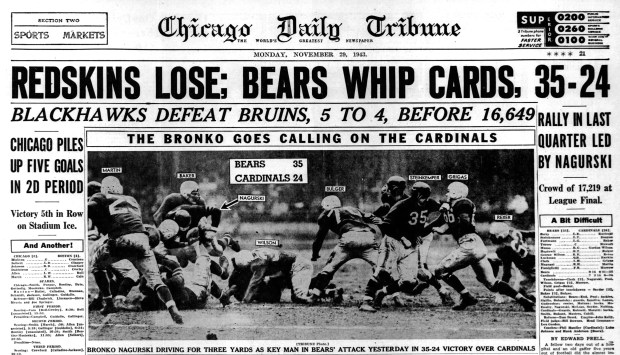 Future Hall of Famer Bronko Nagurski returned to the Chicago Bears for the 1943 season and rallied his team during the fourth quarter to beat the Chicago Cardinals 35-24 on Nov. 28, 1943, at Comiskey Park in Chicago. (Chicago Tribune)
1943: After a six-year absence from the game, 34-year-old Bronko Nagurski was brought back for the 1943 season and played tackle, but in the final game, with the Bears losing by 10 to the Cardinals and needing a win to clinch their division, they moved Nagurski to his old position of fullback and the rest is legend. In the fourth quarter alone, Nagurski carried 16 times for 84 yards and a touchdown as the Bears rallied to win 35-24.
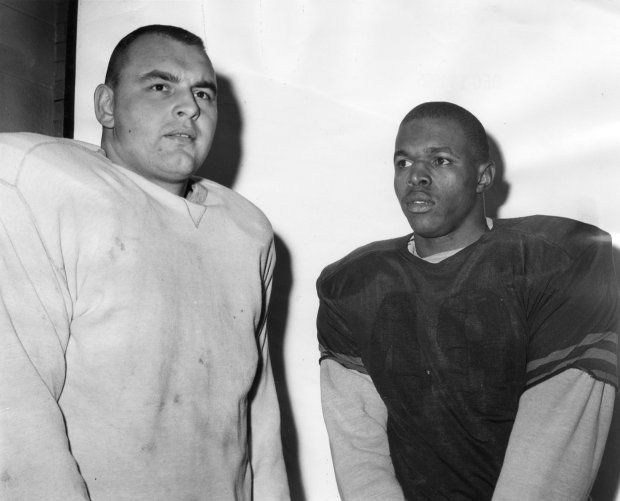 Defensive and offensive rookies of the year Dick Butkus, left, and Gale Sayers at Wrigley Field on Dec. 16, 1965. (Chicago Tribune historical photo)
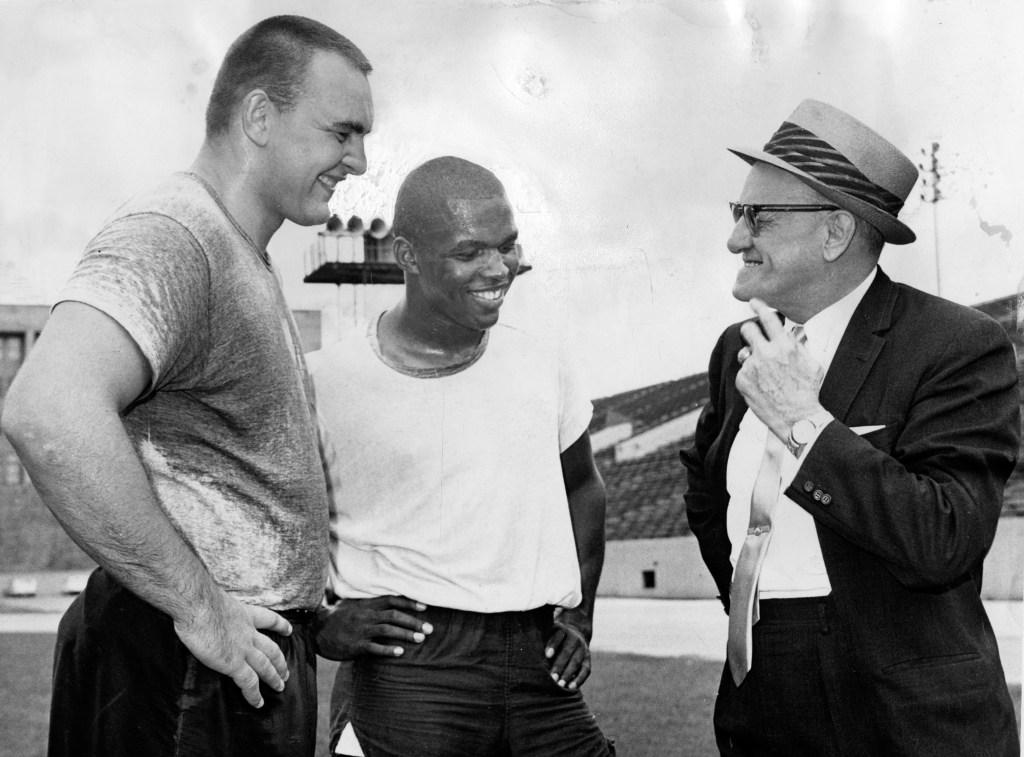
1964: The selection of Dick Butkus and Gale Sayers by the Chicago Bears in the first round of the 1965 NFL draft remains the only time a team has selected two future Hall of Fame players in the first round of one draft.
The Bears acquired the No. 3 pick from the Steelers and used it on Butkus, a Chicagoan and a wildly popular choice whose name remains synonymous with Bears folklore. Yet, the All-American center and linebacker from Illinois was conflicted — and there was a tug-of-war for him between the Bears and the American Football League’s Denver Broncos.
“I hate to make a decision — you see, I don’t want to hurt anybody,” Butkus said. “Chicago’s my home and all things being equal, I probably would prefer to play with the Bears, but there are other things to be considered.”
Days later, Butkus signed with the Bears.
“I didn’t really like Denver’s approach. There’s more to it than just money and that’s all Denver wanted to talk about,” he said. “The only thing really on my mind right now is that I want to get back and get caught up with my schooling. I’ve been missing out too much.” (Butkus was a physical education major.)
Sayers, who was drafted fourth, also had doubt about signing with the Bears. He was also picked by the Kansas City Chiefs in the rival AFL.
“I’m happy to be a Bear,” Sayers told reporters after signing a contract with Halas. “I just got back from New York, where I was invited over to (Kansas City team owner Lamar) Hunt’s hotel. When millionaires start opening the door for me, I get suspicious.”
Neither Hall of Famer expressed jealousy or animosity toward the other.
“I met him early on in the All-Star games before we even got to the Bears,” Butkus said. “And I like to think we are good friends ever since. So there was never any animosity between offense and defense.”
In his autobiography, Sayers said of Butkus: “We remain great friends and have so many shared memories.”
The Rolling Stones in Chicago: A timeline of the band’s 55-year fascination with the city’s blues
1965: The Rolling Stones played their third Chicago concert at the Arie Crown Theater in less than 13 months, this time with the band’s first No. 1 U.S. hit, “(I Can’t Get No) Satisfaction,” closing the show.
Want more vintage Chicago?
Subscribe to the free Vintage Chicago Tribune newsletter, join our Chicagoland history Facebook group, stay current with Today in Chicago History and follow us on Instagram for more from Chicago’s past.
Have an idea for Vintage Chicago Tribune? Share it with Kori Rumore and Marianne Mather at krumore@chicagotribune.com and mmather@chicagotribune.com