
When the 2024 Arizona Cardinals entered their bye week, it felt as if the entire organization was on the right track. They were 6-4, without off-field drama and with a young core finding its rhythm. Guided by Jonathan Gannon and Monti Ossenfort, the entire rebuild was ahead of schedule.
That was just over a calendar year ago.
Since then, the Cardinals are 5-13. By record, only six teams have been worse. Five have made a change at head coach.
But the Cardinals’ point differential tells another story. In that same span, they’ve been outscored by just 32 points. That’s not great, but it’s not awful, like their 5-13 mark.
The explanation is simple: In one-score games, the Cardinals are 2-9. If they were just average in those contests, they could have pushed for a playoff spot last year and be sitting around .500 this year. There would be no loud calls for seismic organizational change.
People are also reading…
Elegant no more: Rare Southern Arizona bird gets new name
Local vendors, goods to be featured in new Tucson shop
New work rules put SNAP benefits in peril for many in AZ
Former Sweet Tomatoes building near Tucson Mall to be revived
Territorial Cup: Arizona Wildcats take down ASU to finish regular season with 9 wins
Arizona commission will sue to block political party’s name change
Driver, 72, arrested in deadly Tucson crash
More than a ride: Cyclists brave wind, turmoil in 42nd El Tour de Tucson
These local restaurants are serving up delicious turkey dinners this Thanksgiving 🍗
Longtime University of Arizona sports historian and statistician dies | Greg Hansen
With plans for Maui in 2026, Arizona basketball resisting Players Era jackpots so far
The ultimate list of Tucson holiday events: Music, ballet, festivals, food and more
Territorial Cup: Point spread, over/under for Arizona vs. ASU
28 things to do in Tucson this Thanksgiving weekend, November 28-30! 🦃🍁
Arizona Wildcats enter College Football Playoff rankings for the first time since 2023
Instead, Gannon is often left sounding like he did after the Cardinals’ Week 12 loss to the Jacksonville Jaguars, when he lamented that his team was “a couple plays away from winning a game” and that he “loved the fight” and all of those familiar refrains.
And more often than not, the Cardinals’ close-game wounds have been partially self-inflicted — as they were against Jacksonville.
Trailing by three points with no timeouts at the end of regulation, the Cardinals hit a big completion to Michael Wilson to get down to the 11-yard line. Their offense arrived at the line of scrimmage with 19 seconds remaining. They could have easily gotten a spike off with 15 or 16 seconds on the clock — plenty of time for two shots at the end zone.
Instead, they eschewed a spike and didn’t get their next play off until 11 seconds remained.
“I do like the chaos of that situation,” offensive coordinator Drew Petzing said. “I think it benefits us. It creates more one-on-ones, it doesn’t allow them to get into a pressure check or an end-of-game call.”

Arizona Cardinals offensive coordinator Drew Petzing, left, talks with Cardinals quarterback Kyler Murray during practice at training camp, Aug. 2, 2025, in Glendale.
Ross D. Franklin, Associated Press
The Jaguars, though, saw it coming all the way. The play had no chance. And by the time the ball hit the turf, only six seconds remained. After just one shot at the end zone, they had to settle for a field goal.
“If you clock it there with that much time, you probably get two plays,” Gannon acknowledged. “And we only got off one.”
On its face, it was at least a justifiable decision. Plus, there was an execution element. Petzing said he would have liked the offense to get set three or four seconds faster, which would have allowed them to get two plays off even without a spike. That rests on both players and coaches, and Petzing said it was a focus in the building this week.
But for the Cardinals, this is a familiar story — a murky late-game decision in which they take the wrong path, helping send themselves to a defeat that they might have been able to avoid.
It’s a trend that began immediately after that bye week a year ago.
The next game, in Minnesota, the Cardinals had a fourth-and-goal from the Vikings’ 4-yard line with three minutes to play. A touchdown would have effectively sealed the game. Instead, Gannon settled for a field goal to go up six — a move that dropped their win probability from 88.1% to 80.1%, per ESPN.
“Wanted to make them score a touchdown to beat us there,” Gannon said after the game.
The Vikings did just that, driving for a game-winning score.
Three weeks later, in Carolina, the Cardinals struggled with their late-game mechanics again. After a Kyler Murray scramble ended at the 39-yard line with 16 seconds left, Gannon didn’t use his final timeout until two seconds remained — passing up the chance to get into closer field goal range.
Chad Ryland bailed the Cardinals out that time, but there was no savior in overtime. The Cardinals managed to use both their timeouts in the span of three plays, leaving them with none on a crucial third-down delay of game.
Again, that mismanagement helped cost them a win.
Then, there was the snafu against the Titans this season, when Petzing inexplicably dialed up a run on third-and-8, handing possession back to Tennessee for a walk-off field goal drive. Gannon later acknowledged that neither he nor Petzing liked the play call — and yet Gannon opted not to use a timeout.
“That’s something I could’ve done a little bit better,” Gannon said.
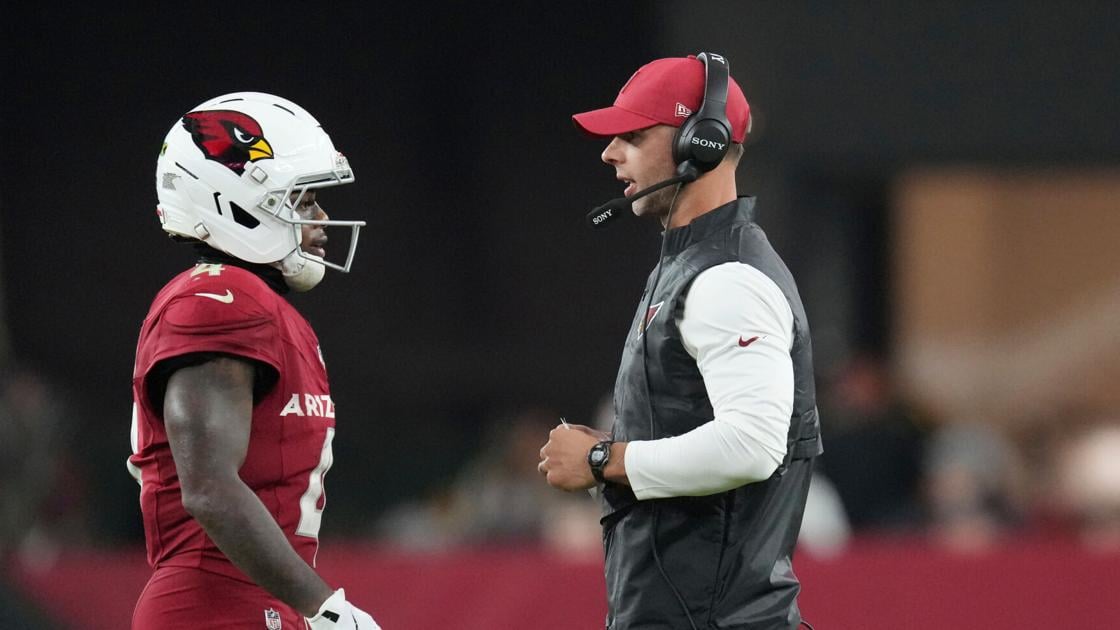
Arizona Cardinals head coach Jonathan Gannon, right, talks with Cardinals wide receiver Greg Dortch during the second half against the Jacksonville Jaguars, Nov. 23, 2025, in Glendale.
Ross D. Franklin, Associated Press
Of course, none of those four losses came down to one decision or one person. The players, after all, are the ones who have to execute between the white lines.
Take, for example, Wilson’s brief celebration after his big catch late in regulation against the Jaguars. From afar, that might look like the symptom of a poorly coached team. But Wilson set the record straight.
“We talk about that every week,” Wilson said. “JG talks about, you catch an explosive, if we don’t have a timeout, you run the ball back into the ref. It’s just a … a bad moment from me. I gotta just get up, hand the ball to the ref.”
Gannon, meanwhile, does not believe that the Cardinals have developed a trend of poor decision-making.
“We definitely have messed some things up over the last three years but I think we hit more than we miss,” Gannon said. “I truthfully believe that. And that’s completely on me. That’s my responsibility. So that’s why I put a lot of time into that.”
Regardless of the culprit, the Cardinals’ 2-9 record in one-score games has become a problem. And it helps explain why this team is where it is — in a position it never envisioned itself, near the cellar of the NFL.
Up next
What: Arizona Cardinals (3-8) at Tampa Bay Buccaneers (6-5)
When: 11 a.m. Sunday
Watch: Fox
Listen: 1450-AM
Get in the game with our Prep Sports Newsletter
Sent weekly directly to your inbox!