
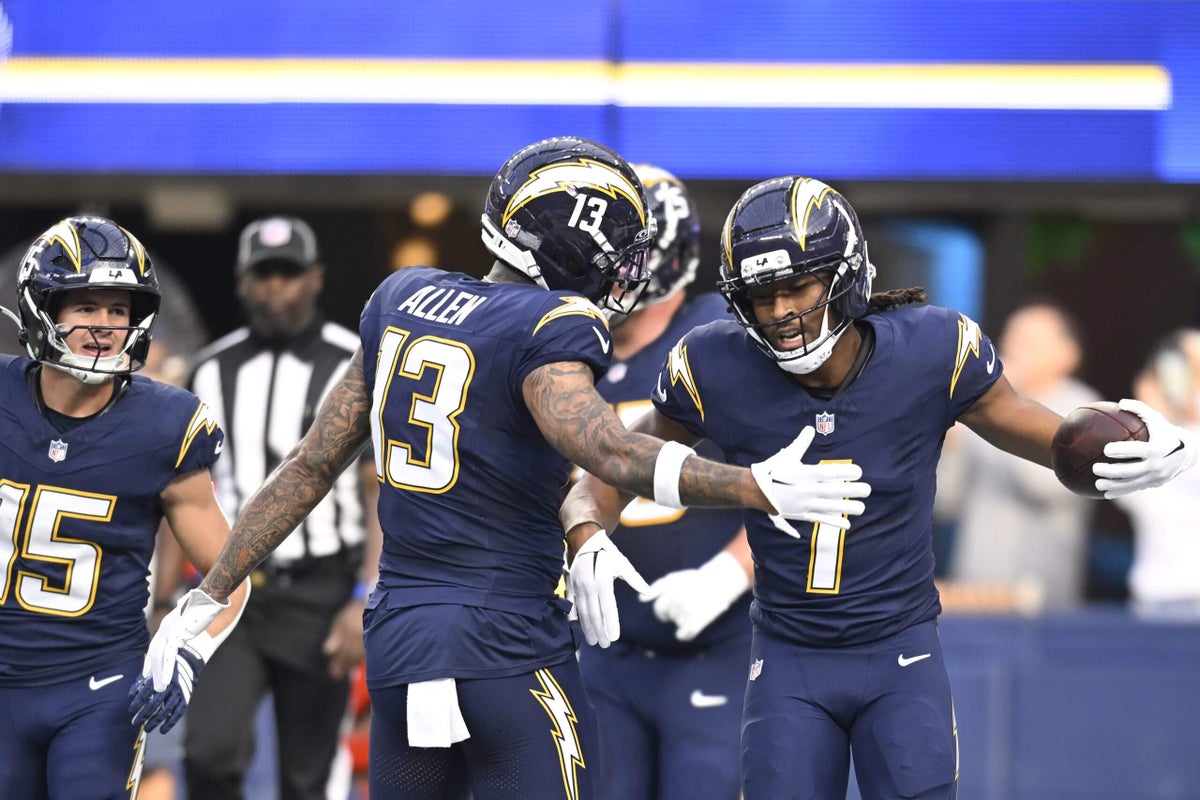
INGLEWOOD, Calif. — The Los Angeles Chargers emerged from their bye week, made adjustments and won convincingly against a bad Las Vegas Raiders team.
The Chargers looked improved in Sunday’s 31-14 victory — certainly in comparison to the last time they took the field. The blowout loss in Week 11 to the Jacksonville Jaguars was the worst of this team. The Chargers did not show up for that game. It felt like the grind of the previous four months had caught up to them. They took two weeks to rest and recover. Then they put forth a necessary performance coming out of the bye to improve to 8-4. The Chargers hold the fifth seed in the AFC playoff race.
What is real and what is not will come into focus over the next five weeks.
“I just love the way the entire team responded in this game,” coach Jim Harbaugh said.
It was not a perfect response. But it met the threshold of what was required. The Chargers had to win this game to give themselves a cushion for a truly brutal home stretch. Now the fabric of this team will be tested.
The Chargers will be in wait-and-see mode with quarterback Justin Herbert this week. Herbert broke a bone in his hand in the first quarter Sunday, Harbaugh announced. He is scheduled to undergo surgery Monday. Herbert, who returned to Sunday’s game after missing eight plays, is hopeful to play in Week 14 against the Philadelphia Eagles, who are in first place in the NFC East.
The Chargers then go on the road in Week 15 for a December game at Arrowhead Stadium against the Kansas City Chiefs, who will be desperate to avoid missing the playoffs for the first time since 2014. The Chargers play on the road again in Week 16 against the surging Dallas Cowboys. In Week 17, they return home to play the Houston Texans in a rematch of last season’s wild-card round. The Texans have won four in a row. The Chargers close the season at the division-leading Denver Broncos.
“Those last five games, we got to come with it, because all those teams are playoff-caliber teams,” safety Derwin James Jr. said.
The Chargers should have run away with Sunday’s game in the first half. They squandered two opportunities in the second quarter. On the first drive, Herbert threw an interception from the Las Vegas 2-yard line. Herbert has now thrown 10 interceptions this season. He was the victim of some flukey interceptions early in the year. But his last five picks have been the result of poor decisions or missed throws. That includes Sunday’s interception. It was third down. Herbert took points off the board with an ill-advised attempt to the left corner of the end zone. Cornerback Kyu Blu Kelly jumped the pass.
The Chargers got the ball back two plays later on an interception from safety Tony Jefferson. They took over inside the Raiders red zone. On the next set of downs, the Chargers faced a fourth-and-1. Offensive coordinator Greg Roman called a shotgun handoff to running back Kimani Vidal, who was stuffed. The Chargers were only playing out of shotgun and pistol formations on offense because of Herbert’s hand injury.
These two failed red zone trips fed into a slow start overall. The Chargers defense allowed a touchdown on the ensuing possession, busting a coverage in the red zone. Tight end Brock Bowers was free for one of his two scores on the day. The teams entered halftime tied at 7.
The Chargers, though, pulled away in the second half. And there were very encouraging facets of this stretch of play, including how some of the bye-week adjustments manifested.
On offense, Roman stuck with the run game. That kept the Raiders’ pass rushers, including Maxx Crosby, off balance. It also limited the pass-protection snaps for the Chargers offensive line. The linemen, including Jamaree Salyer as a new starter at left tackle, were able to play downhill and demonstrate their physicality as a result. As right tackle Trey Pipkins III said, the Chargers showed on “a recommitment to establishing ourself on the ground.”
Roman called designed rushes on 55.2 percent of offensive plays Sunday, a season high, according to TruMedia. He called designed rushes on 56.3 percent of offensive plays in the first 28 minutes of the game, before the score got out of hand, also a season high. Roman called seven designed rushes on the opening drive. He got to it early. He stayed with it for the game.
The result: 126 yards and a touchdown on 25 carries from Vidal; 54 yards and a touchdown on 11 carries from Jaret Patterson. Vidal’s 59-yard touchdown on the opening drive of the second half gave the Chargers a lead they maintained for the remainder of the game. Salyer was a lead blocker on the play, pulling to the outside left to clear a hole.
“It made a difference today,” Herbert said of Salyer at left tackle. “We ran the ball really well today.”
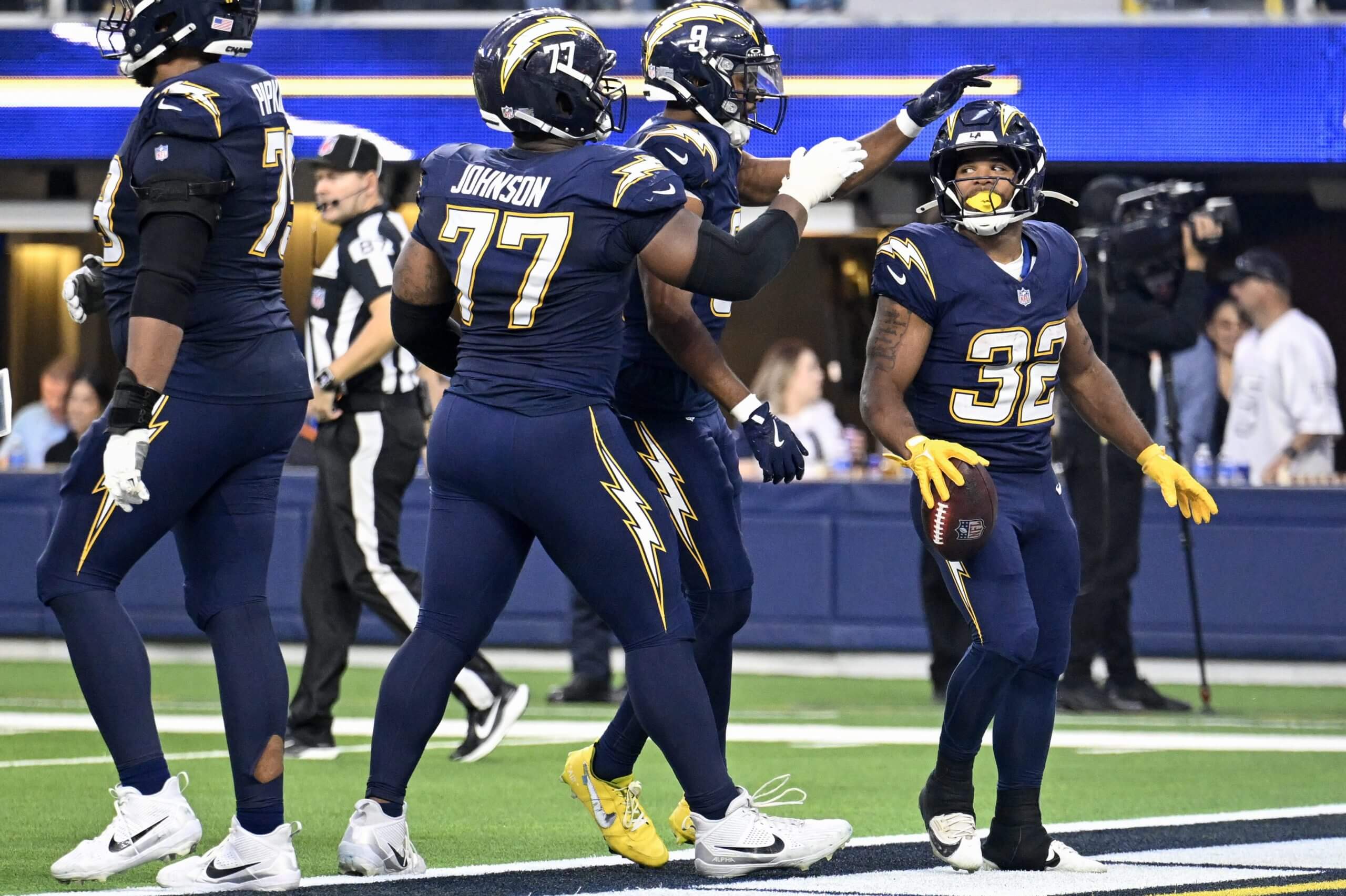
Jaret Patterson was part of a strong rushing attack for the Chargers. (John McCoy / Getty Images)
On defense, the Chargers made several successful adjustments. Two of those were geared toward devoting more resources to defending the run. The Chargers moved off-ball linebacker Daiyan Henley down to the line of scrimmage on several plays, aligning him outside the edge rusher to create a five-man front along the line of scrimmage. They also rotated a safety down into the box before the snap on several plays.
In previous games, the Chargers had stayed true to their two-high-safety structure. Safeties would have to fly down from deep alignments to cover their run responsibilities. On Sunday, coaches gave the safeties the option to rotate into the box pre-snap if they got a run tell pre-snap.
Devoting these resources to the box and to the line of scrimmage produced results. Running back Ashton Jeanty, the No. 6 pick in April, finished with 31 yards on 15 carries. The Chargers allowed .18 yards before contact per rush, their lowest average of the season, according to TruMedia. They had a defensive rushing success rate of 82.4 percent, their second-best mark of the season.
“Gave them some different looks,” James said of the run defense, “and it was improved.”
The Chargers pass rush then came alive. Tuli Tuipulotu led the way with two sacks. Tuipulotu had a massive game. He also had two tackles for loss in the run game, including a fourth-and-1 stop. And he had a batted pass in the first quarter. The rush worked as a cohesive unit. Khalil Mack was creating consistent push, as well. Coordinator Jesse Minter dialed up some timely blitzes. The Chargers sacked Raiders quarterback Geno Smith five times.
“The front, I thought, played extremely well,” Harbaugh said.
One other adjustment on defense: The Chargers got Jefferson back in the rotation. Jefferson lost his spot after suffering a hamstring injury in Week 8. He recovered but was a healthy scratch in Week 11 against the Jaguars. Jefferson was active Sunday, and he came down with that interception in the first quarter. Donte Jackson deflected the initial pass before Jefferson swooped in and caught the tipped ball, just barely getting both his feet in bounds along the right sideline.
“Just using my instincts,” Jefferson said.
They are elite instincts, and they are best served on the field, as the Chargers realized during the bye.
The adjustments worked, but the quality of the opponent must be factored into the assessment.
The Chargers are going to have to earn their way into the playoffs. As it should be.
They could make it. They could not. Either way, we will learn exactly what this team is.
“We’re preparing ourselves for a long road,” Henley said. “It’s playoffs time right now. We’re in the playoffs. We’re playing teams that are playoff-worthy. … So we have to be able to win right now versus these teams to show that we can win in the future.”