
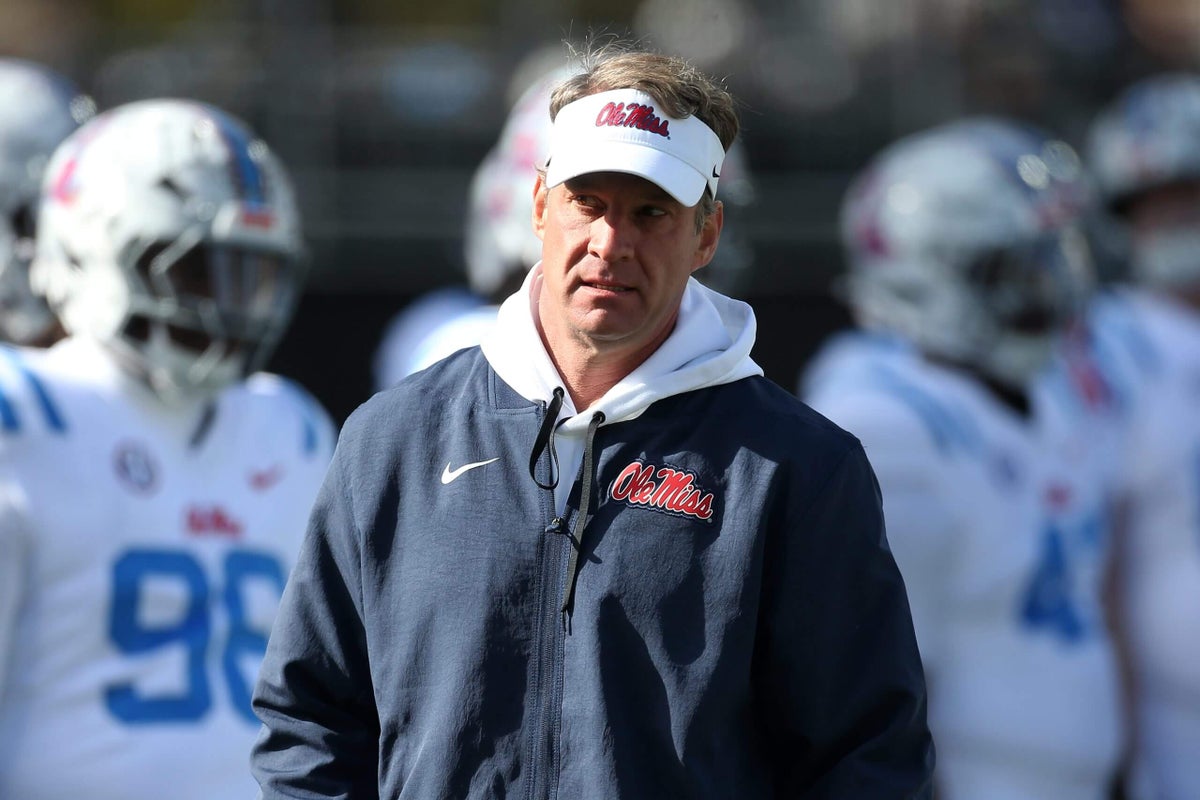
By Ralph D. Russo, Justin Williams, Antonio Morales and Christopher Kamrani
Lane Kiffin is leaving Ole Miss, an 11-1 team on the verge of a College Football Playoff bid, to become the coach at SEC rival LSU.
Here are six initial questions and takeaways on Kiffin’s unprecedented move after weeks of speculation about interest in jobs at LSU and Florida.
1. Will Kiffin leaving impact Ole Miss’ CFP positioning?
Simply put, Kiffin leaving should have no effect on how the selection committee evaluates Ole Miss, which will move forward under defensive coordinator Pete Golding.
Teams five through eight in the final CFP rankings, released Dec. 7, host first-round games Dec. 19 and 20. The Rebels were seventh in last Tuesday’s CFP rankings, one spot ahead of Oklahoma (10-2), a team Ole Miss beat in the regular season.
On the field, there isn’t much reason to believe the committee would drop the Rebels two spots after they moved to 11-1 with a convincing victory against Mississippi State on Friday, especially because their only loss was to Georgia.
Could the selection committee determine that the Rebels without Kiffin aren’t as good as they are with him and dock them a few spots in the rankings? Selection committee chairman Hunter Yurachek was asked this last week, and while he gave the standard answer about the committee evaluating everything, he also noted the committee can’t evaluate Ole Miss without Kiffin until it sees the Rebels play without their coach.
With hopes of an SEC title game appearance gone thanks to Alabama’s Iron Bowl win, the committee has nothing left to evaluate. — Ralph D. Russo
2. Can Ole Miss win the national title?
The offense, led by standout tailback Kewan Lacy and Ferris State transfer quarterback Trinidad Chambliss, gives the Rebels a chance against anyone, but the defense probably prevents it from winning four games against Playoff-level competition.
Ole Miss ranks 40th in yards per play allowed at 5.2. Of the past nine national champions, none ranked lower than 29th — and that was 2019 LSU, which had the best offense we’ve ever seen. Eight of the past nine national champions have finished in the top 15 in scoring defense. Again, 2019 LSU (31st) was the lone exception. Ole Miss ranks 25th right now. The Rebels also rank 75th nationally in yards per rush allowed (4.33).
Ole Miss has a shot, but unless its offense is humming at 2019 LSU levels, it seems like it’ll be pretty difficult for the Rebels to win the national championship. Making things tougher, Kiffin is basically the mastermind behind the offense and he won’t be there. The Athletic’s model gives the Rebels a 4 percent chance of a title run, the eighth-best odds, and that doesn’t factor in the coaching change. — Antonio Morales
3. Is Kiffin worth all this fuss?
Unless he wins a national championship at LSU, then no — at least not the fuss that he’s produced over the past few weeks. It’s sort of like a five-star prospect who has a dramatic recruiting process. It’s worth the squeeze if Kiffin actually delivers. But will he?
The 50-year-old Kiffin undeniably elevated Ole Miss as a program. He won 50 games over the past five seasons in Oxford. This was his fourth 10-win season with the Rebels. Ole Miss posted just three 10-win seasons in the 50 years before Kiffin arrived. So he’s achieved a high level of consistency that no other Rebels coach did in the modern era of college football. Why wouldn’t Kiffin be able to do that in Baton Rouge? He’s also been at the forefront of this era of player movement with his ability to evaluate, land and get the most out of a transfer-heavy roster.
Can Kiffin handle the annual expectations that come with being the head coach of LSU? That’s not to say there aren’t high expectations at Ole Miss, but Tigers fans expect to be competing for national championships every season.
Kiffin had sky-high expectations in 2024 with a roster that was built to make a Playoff appearance and had more talent than this year’s roster. The Rebels lost to a bad Kentucky team and a Florida squad that wasn’t as good as Ole Miss and missed out on the Playoff. In 2012, Kiffin led a USC team that was preseason No. 1 and finished 7-6 and unranked.
Credit goes to Kiffin for exceeding expectations this year. But by leaving Ole Miss early, he’s still yet to coach in a Playoff game. He’s going to be expected to be in the Playoff every season moving forward. And it’s clear this week that Kiffin was taking in all the noise around him. It’s a lot louder in Baton Rouge than Oxford. — Morales
4. Is anyone in charge of college football?
The messiness of Kiffin’s exit from Ole Miss is a uniquely college sports problem. There’s no comparable scenario in the NFL or other professional leagues, and it all stems from the inherent fact that no one is (or has ever been) at the wheel of collegiate athletics.
That doesn’t absolve Kiffin. Whether you feel the decision is right, wrong or indifferent, it was his to make. But the fact that he even had the option to not-so-quietly negotiate a future with Ole Miss and two other schools — all in the same conference! — in the thick of a postseason push is nonsensical, and a direct result of how college football is “governed.” It’s ridiculous that Ole Miss is put in this position, but there was nothing preventing LSU and Florida from courting Kiffin. For an industry that has gone to great, congressional lengths to restrict player movement and compensation, it’s done nothing to regulate the coaching market. This whole saga is a direct result.
Kiffin’s situation isn’t wholly original — Group of 5 coaches have taken power-conference jobs on similar timelines for years, including North Texas’ Eric Morris accepting the Oklahoma State job this past week and Florida pivoting to Tulane’s Jon Sumrall on Sunday. But in just the second year of the 12-team Playoff, we already have an unprecedented departure within the sport from a national title contender to a conference rival.
Most thought the carousel would have to acquiesce to the Playoff schedule. Instead, it superseded it. Kiffin is the first example, but until something changes, he won’t be the last. — Justin Williams
— Lane Kiffin (@Lane_Kiffin) November 30, 2025
5. Is Kiffin a villain again — and is that good for college football?
College football has a new(?) Black Hat. Kiffin has always been a trolling provocateur, but the past few seasons at Ole Miss have seen him rehab that image into a more likable, empathetic persona — this year especially, which included a flattering, hour-long ESPN special. And with one momentous decision, he instantly spoiled all of that goodwill.
Kiffin hightailing it out of Oxford in the midst of a Playoff run makes him the sport’s newest, biggest villain. And it’s great for college football.
The fact that so many outside of Baton Rouge are ready to prey on his downfall just means Kiffin and the Tigers have become appointment viewing. Every on-field loss and off-field misstep will be reveled in. Every recruiting battle will have fans (and opposing coaches) spamming recruits about Kiffin’s lack of loyalty. Every quote about “commitment” and “buying in” and “finishing strong” will be endlessly mocked.
None of this guarantees failure, either. There are plenty of recruits and fans, casuals and die-hards alike, who will gravitate to Kiffin’s heel turn. Especially if he wins. Kiffin can lean into the Joker, world-burning, us-against-them mentality. It might pay off. It might crash and burn. Either way, we’ll be watching. — Williams
6. Why are Kiffin’s exits always so messy?
The Lane Train stops for no station that isn’t on the Lane Train agenda that day. And if you don’t have a ticket? Good luck trying to get on.
It would be easy to point to the social media era and the accessibility of information and the various bends on fact or fiction. Because, yes, he’s maybe the trollingest self-aware sports figure at the moment in college football. But Kiffin was making headlines as a fascinating persona back in the MySpace days as the youngest head coach in NFL history. Then came the Tennessee debacle. And when you have a new sports adjective basically named after you? “Getting tarmac’d” is always going to be synonymous with Kiffin’s firing from his dream job at USC.
He rubs people the wrong way. He is brash. He is quite tan. He does yoga every day. He looks better at 50 than some do at 30. He also gets credit for being outspoken about his bout with alcoholism in his search for sobriety. Kiffin’s path is interesting to dissect because you should be able to argue that he wasn’t qualified or prepared to be an NFL head coach at 31. Or take over at a pressure-cooker like Tennessee. Or return to USC, where he was part of its last great era, and try to get the program back there.
Kiffin’s quixotic behavior just weeks after proclaiming after a win over Florida that he wanted to remember “the good old days” is a reminder that he is unapologetic in embracing such a villainous role. Famed Oakland Raiders coach Al Davis once said he felt conned by Kiffin, also calling him a “professional liar.”
He’s had some Hall of Fame messy exits. The one at Ole Miss — where he displayed a new level of selfishness and self-centered behavior — takes the cake. — Christopher Kamrani