

No need to check the vision Baltimore Ravens fans — so many of them have expressed that they are seeing with perfect 20/20.
When looking at why this team has capsized and is barely afloat at the top of a weak AFC North at 6-6, I’ve seen plenty of online commentary that fans simply knew going into this season that Eric DeCosta had not built an adequate roster to contend again.
Come on. Tell the truth.
Many of us agreed that the Ravens’ roster was actually good, maybe even the best in the NFL, before the season started. To me, the real question is: “How did so many of us not see this team for what it has become?”
In The Banner’s predictions on Sept. 4, five of the six Banner experts picked the Ravens to win the Super Bowl. I wrote at the time that “given how tightly the Ravens have constructed their roster, I see few glaring weaknesses: a little uncertainty at linebacker, so-so guards and a rookie kicker. The strengths are much more robust, as we saw from the best offense in football last year, and a defense that has restocked with the necessary talent.”
It’s funny how that assessment hints at what would go wrong this year, but was far overconfident in the Ravens’ returning strengths from last season’s 12-5 run and divisional round appearance.
If I could paint all of the shortcomings of this front office with an extremely broad brush, I would characterize many of them as mistakes of overconfidence. We take for granted — as fans, as coaches, as players and even as general managers — that NFL trajectories get better with experience and continuity, but the 2025 Ravens are proof that is not always the case.
What could DeCosta and the front office have done to make this roster significantly better when more options were available? As much heat as he and everyone else in Owings Mills is getting, once you remove hindsight from some of these decisions, the Ravens seemed due for a slide no matter what they did differently. Even the wrong choices DeCosta made have some defensible logic behind them:
Running it back with the offensive line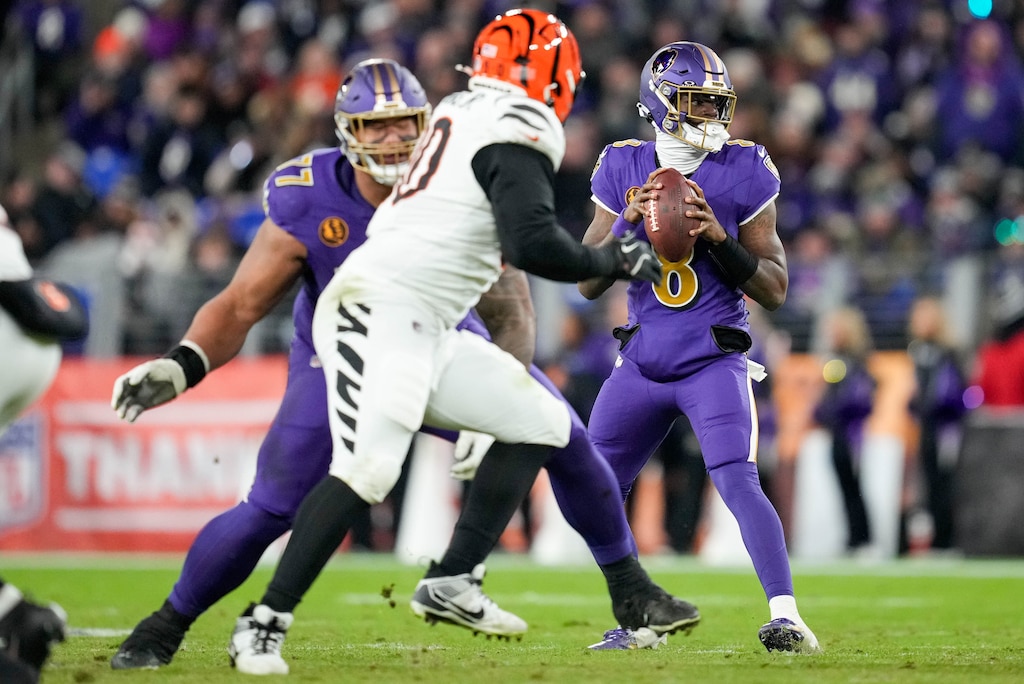
Ravens quarterback Lamar Jackson (8) drops back to pass in the fourth quarter against the Cincinnati Bengals as Daniel Faalele blocks. (Ulysses Muñoz/The Banner)
It seems obvious the Ravens should have spent more on the offensive line, especially in the interior where Daniel Faalele and Andrew Vorhees are consistently the lowest-graded blockers on the team, according to Pro Football Focus. Rookie Emery Jones Jr. rotated in at left guard against the Bengals to get a look outside the regular starting five.
As much as interior guard was an obvious weakness, however, I’m not sure how many good options the front office had. Reviewing some of the best free agent guards yields guys who were either out of the Ravens’ price range, who haven’t been very good, or sometimes both. Mekhi Becton has been terrible with the Chargers, for example, and Teven Jenkins hasn’t really played for the Browns. One somewhat obvious solution could have been figuring out a way to sign old friend Kevin Zeitler, who latched on to the Titans for a one-year, $9 million deal, but that was probably a little rich for the Ravens.
Signing Ronnie Stanley to an extension was risky, but honestly a good deal for what the free agent market was shaping up to be. Stanley has taken a step back from last season, but isn’t dramatically underperforming that contract. The Ravens probably expected Roger Rosengarten to be better than he’s been this year.
Faalele taking a step back and Vorhees not being ready was more predictable, but the lower levels of the guard market didn’t really blow minds in the offseason, making a roll of the dice on continuity a little easier to understand. It’s also hard to argue with the decision to let Patrick Mekari go, given that PFF grades him below both Faalele and Vorhees this season.
The bad pool of talent available doesn’t absolve DeCosta of the line being so weak inside, but it makes the context a little easier to understand why the Ravens might have felt their best option was returning a group from an offense that led the NFL in both yards per passing attempt and yards per rushing attempt last year. This season, they’re No. 23 in run block win rate, and the weekly lowlight clips of ugly blocking have been tearing up social media after every game.
Toothless pass rush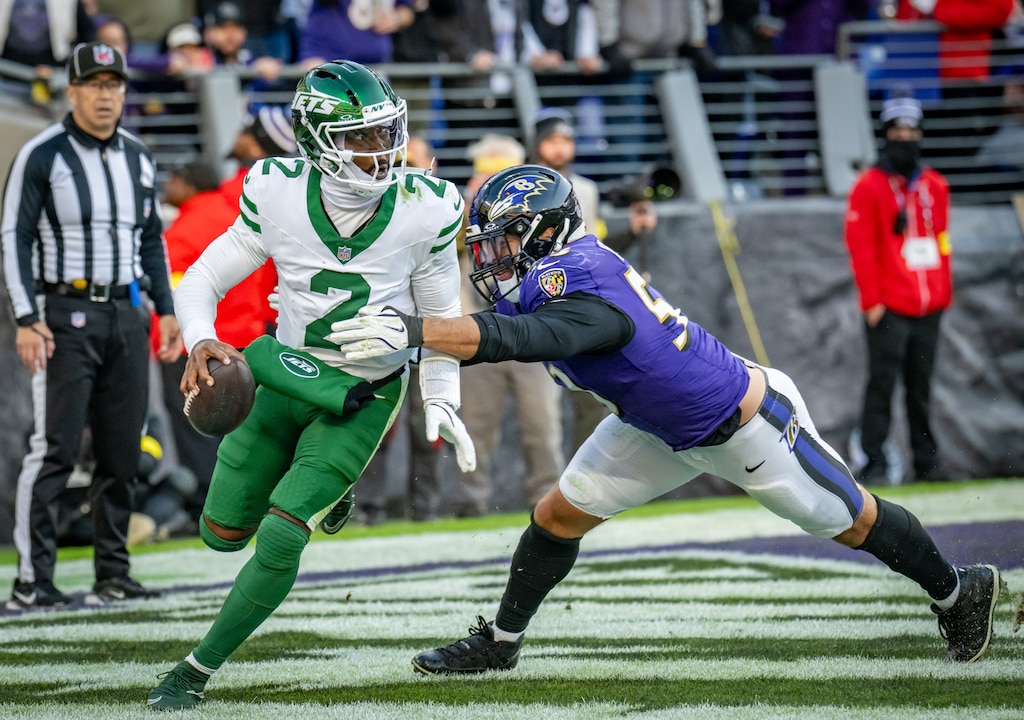
Ravens outside linebacker Kyle Van Noy (53) pressures New York Jets quarterback Tyrod Taylor (2) in the end zone during the fourth quarter. (Jerry Jackson/The Banner)
My singular focus on this issue for two years made me feel like the boy who cried “wolf.” After the trade deadlines in 2023 and 2024, I wrote that the Ravens should have traded for a pass rusher. Both seasons, they finished in the top 2 in sacks. What, was I going to kvetch a third time that they needed more help there?
I guess that would have been prudent.
This season, they’re fourth from last with just 19 sacks through 12 games. Chuck Smith’s magic — coaxing career years from veterans like Jadeveon Clowney and Kyle Van Noy — has seemingly dried up. The Ravens are just 23rd in pass rush win rate, according to ESPN, winning on 34% of passing downs, and no Ravens edge is among the top half of PFF’s edge rusher grades (all Ravens edges have a pass rushing grade under 63, which is below league average).
The glue guy in the previous two years was Nnamdi Madubuike, who was an All-Pro in 2023 and still solid last season. His ability to take up two blockers and even get sacks himself has been sorely missed, and it seems clear now that he made those around him look a lot better. Travis Jones can take double-teams, but his pass rushing isn’t at the same level as Madubuike.
Again, it’s tricky to say what Baltimore’s options could have been. There are somewhat affordable options who have higher pass rushing grades than the Ravens, but also haven’t racked up sacks: Dallas’ Dante Fowler Jr. (1-year, $6 million, three sacks), Philadelphia’s Josh Uche (1 year, $2 million, one sack) or Houston’s Derek Barnett (1 year, $4 million, two sacks). Even if DeCosta snagged them, they might be in the same boat as the group the Ravens landed on. None of them have produced at a significantly higher level than Dre’Mont Jones, who came in a trade before the deadline.
Something worth wondering, however: If the Ravens had moved on from Odafe Oweh earlier, could they have drawn a bigger return? Alohi Gilman has fit in well as the third safety, but with Oweh coming off 10 sacks last year, it might have made more sense at some juncture to have sold high in the offseason if the Ravens weren’t ever willing to pay him after his rookie deal expired. Perhaps Baltimore hoped they could squeeze one more quality season out of him, but the setup with Oweh was risky, and he didn’t even give them a sack before he was dealt. He has four in L.A.
Paying big for the wrong backup quarterback
Ravens quarterback Cooper Rush (15) scrambles away from pressure by the Kansas City Chiefs on Sept. 28. (Reed Hoffmann/AP)
I have to admit that when the Ravens first signed Cooper Rush, I liked the idea of it. In the 2024 preseason, I railed against the idea that Josh Johnson was good enough to be Lamar Jackson’s backup. It just wound up never mattering. When Rush signed a $6.2 million deal with the Ravens, it seemed like the team was actually serious about spending real money to insulate the offense from a short-term injury to Jackson with a guy who played a bunch last season.
Everything turned sideways when Rush started playing in the spring. He was arguably one of the most-discussed players among media members for all the wrong reasons. He didn’t have a great arm. He didn’t have great mobility. In preseason games, he turned the ball over. It made me long (unbelievably) for the days of steady, unspectacular Josh Johnson.
In retrospect, it’s wild that the Ravens ever considered Rush to be higher on the depth chart than Tyler Huntley, because it was clear for months that Rush wasn’t doing all that well. Putting him in games only confirmed it. While there were many other factors going against him, the fact that Huntley was able to beat the Bears as a starter makes me wonder if the Ravens could have gotten the Rams if they had simply had the courage to make the change sooner.
There’s a lot of people who can share the blame on playing and backing Rush, especially the coaches who felt he was the best option. But DeCosta definitely deserves a big part of that accountability, especially if the money spent on Rush could have been much better used elsewhere on this roster.
Searching for (and finally finding) secondary answers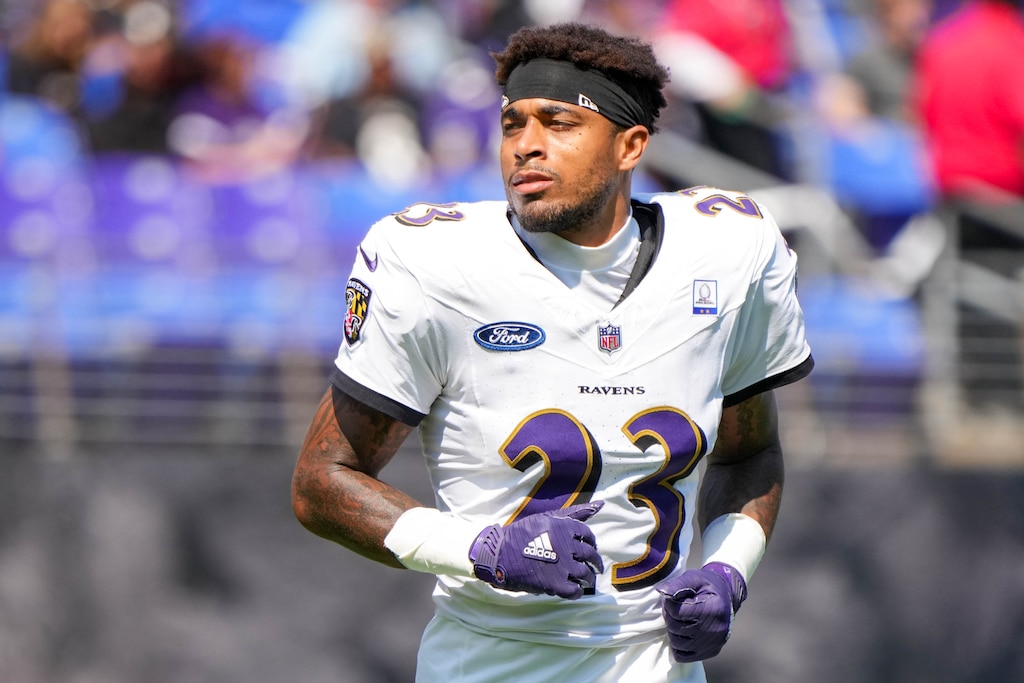
Cornerback Jaire Alexander jogs to the next drill during the Ravens’ training camp practice at M&T Bank Stadium on Aug. 3. (Ulysses Muñoz/The Banner)
Here’s where DeCosta’s “mistakes” get especially fuzzy. What was the roster’s biggest weakness for much of last year? Safety. The Ravens drafted Malaki Starks in the first round and resigned Ar’Darius Washington, who helped stabilize the secondary once he became a full-time starter. How could DeCosta have known Washington would get injured this spring?
One of the imperatives this offseason was to upgrade from corner Brandon Stephens. How could he have guessed that a play for the former All-Pro Jaire Alexander — who did play pretty well in camp before getting hurt — would have resulted in just 61 snaps across two games?
He made some bold and defensible moves. Some of them didn’t work out. It’s hard to fault the Ravens’ front office for that in the very ugly defensive start to the season.
It is also the secondary where the front office has made some of its best moves, too. Chidobe Awuzie is arguably the unsung free agent signing of the offseason, and right now he’s the fourth-highest PFF-graded corner in all of football. Trading for Gilman spurred an almost immediate turnaround for the defense, which couldn’t stop a runaway shopping cart to start the year. DeCosta also locked up Kyle Hamilton as the NFL’s highest-paid safety, which I would argue Hamilton has successfully earned so far.
The Ravens allowed more than 400 yards in three of their first five games, but haven’t allowed it since trading for Gilman in their last seven contests. They’ve allowed just eight total touchdowns in the last seven games despite an offense that is really not doing them many favors.
Passing game arsenal that has not launched
Ravens wide receiver Rashod Bateman catches the ball in the end zone in the second quarter against the Detroit Lions. (Jessica Gallagher/The Banner)
It’s hard to expect great things out of receivers when the quarterback is hurt and playing below his sky-high standard. But in the accounting of moves, it has to be said that two of the biggest decisions for the Ravens were in the receiving corps — an extension for Rashod Bateman and adding DeAndre Hopkins in free agency — and neither is shining too brightly right now.
Bateman has been banged up, but he’s averaging fewer than 20 receiving yards per game. Hopkins has made spectacular catches, but also has been underutilized for just 17 receptions, 257 yards two touchdowns in 12 games. Given how Jackson has been throwing even since returning from injury, it’s hard to expect all that much more than this, but it feels like some pretty decent tools are gathering dust in the shed.
It’s worth noting here, however, that DeCosta didn’t kowtow to what many fans wanted after the Buffalo playoff game and held onto Mark Andrews. That has been fortunate. Andrews is the has the second most receiving yards on the team and leads with five touchdowns. It’s been all the more needed because Isaiah Likely hasn’t taken the leap many hoped after getting injured in camp. Andrews has become the franchise’s all-time receptions, yards and touchdowns leader — and having him in the fold has been a pretty good outcome for everyone so far.
Special teams shifts
Ravens linebacker Jake Hummel (35) looks to defend during a preseason NFL football game against the Dallas Cowboys on Aug. 16. (Matt Patterson/AP)
Whether the Ravens ever want to admit it, their hand was forced to cut Justin Tucker, the leading scorer in franchise history. Rookie Tyler Loop is 22 for 24, only missing from beyond 50 yards, and he’s missed just one PAT. His kickoffs aside, he’s been a solid first-year addition at the biggest special teams question mark the Ravens had.
Along with Jordan Stout’s career year as a punter, you have to give some credit to the special-teams units. The Ravens replaced a lot of their dependable vets on coverage, but signing Jake Hummel as a resident ace and getting a lot out of guys like Keyon Martin and Keondre Jackson has helped them become a very solid coverage group.
You’d still like to see LaJohntay Wester take one back (instead of a muff that was costly) or Keaton Mitchell rip off a big return, but the potential of the Ravens returners feels strong.
An uncertain future
Ravens quarterback Lamar Jackson (8) drops back looking for a receiver down field against the Cincinnati Bengals. (Jerry Jackson/The Banner)
One of the biggest questions about the Ravens’ future is shaping up to be a little murkier than we might have expected. It was a little unsettling going into the season without a contract extension and possible restructure for Lamar Jackson, but not wholly unusual.
Now with Jackson’s play cratering, it’s actually worth wondering whether this dip can affect his future or what the team is willing to do to keep him a Raven for life. Normally, the move is as simple as “now we give our quarterback a little more money than the last one who signed a big deal.” If Jackson can’t get back to his typical standard, that picture might start getting fuzzy.
After nailing the 2022 draft class, DeCosta’s record is not quite as hot in recent years. Outside of first-rounders like Zay Flowers and Nate Wiggins, middle round picks that should be stepping up (Trenton Simpson, Adisa Isaac, Devontez Walker) are not making much impact. This year, Starks and Teddye Buchanan have been effective, while the jury is still out on Mike Green and Emery Jones Jr. The Ravens have less room to fail than other teams in the draft because of their tight salary cap situation.
If this Ravens season continues to dive, there will be plenty of uncomfortable conversations in the Castle about what went wrong and who is to blame. Looking back on what decisions were made with different options available, I don’t think DeCosta deserves quite as much of the heat as fans might be willing to heap on him.
But at the same time, the buck stops with the Ravens GM, and missing the playoffs after shooting for the Super Bowl this year would be a bitter disappointment. Even if he can defend some of the decisions he made this season, DeCosta will have his fingerprints on that disappointment, too.