
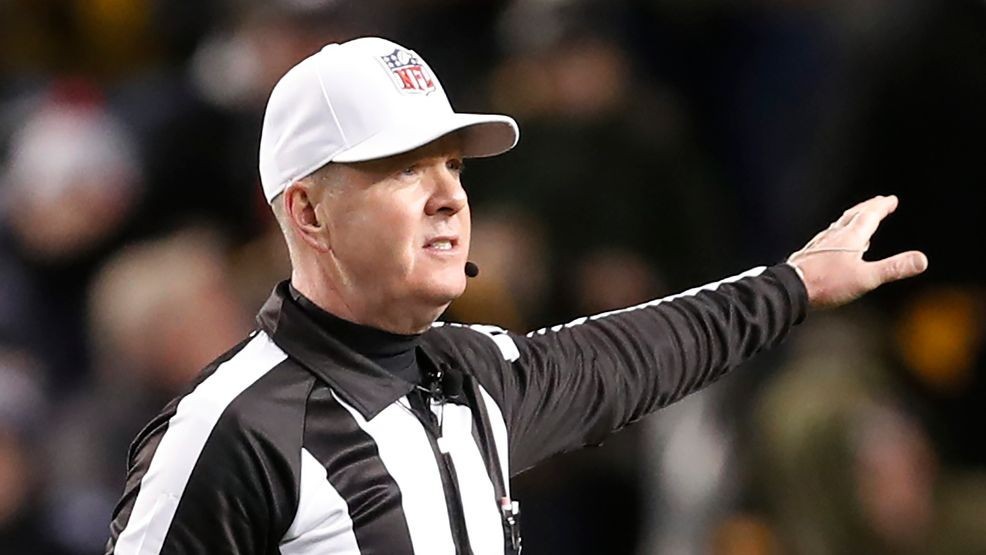
HUNT VALLEY, Md. (TNND) — Professional football fans of many teams are crying foul at the NFL’s referees after this past weekend, blasting calls from a possibly botched extra point kick to a mishandled coin toss.
Sports analysts and former coaches are calling out the league as a whole and questioning whether legalizing sports gambling has led to more inconsistencies and discrepancies between what the referees see and what the fans see.
Even some coaches and players – while remaining mum about calls to avoid any league fines – are admitting confusion.
Perhaps the most controversial play calling came out of Sunday’s Houston Texans-Indianapolis Colts game. The Texans came out on top, winning 20-16.
But Colts fans are claiming the outcome could have been different if it weren’t for multiple questionable calls.
On the ninth play of the fourth quarter, the Texans faced a third-and-15 at the Colts’ 25-yard line. The game was tied 13-13 with 14:51 left in the game.
Defensive back Kenny Moore II was flagged for pass interference, but the replay showed little evidence to support that, and fans say it looked more like the receiver, Xavier Hutchinson, fell down.
The call gave the Texans a big first down, and they scored three plays later.
Referee Clay Martin told a pool reporter after the game, “The calling official had an arm grab at the top of the route. When you look back, the ball was in the air, and when you see the ball in the air, that makes it pass interference.”
After the game, Colts Coach Shane Steichen said, “It was tough. Obviously, they made the call. That was the officials’ call. I’m not going to get into detail on it, but I think a lot of people saw it.”
Colts safety Camryn Bynum was also diplomatic, but said he thought the play was “super clean.”
“I had a clear view at it, but we can’t let the games be in the hands of the refs,” he said. “We have to make sure that there’s no room for error, but I know what I saw with my eyes and I know it was 100% clean, but that doesn’t matter. Obviously, we hate it and we’re mad at those calls, but at the end of the day, there’s 50 other plays, 60 other plays that we could have made to win the game. Obviously, that’s a crucial time in the game, but there’s so many other times where we weren’t perfect and that’s what we have to look at as a defense. We can’t play the victim and put the game in any ref’s hands.”
On the same play, analysts said it looked like the Texans got away with a delay of the game. Steichen appeared irate over the call.
As the game wrapped up, fans and announcers questioned more calls – like an extra point that was called good when many questioned if it truly was, and what appeared to be a hold by a Texans linebacker with 1:49 left in the game that could have given the Colts a first down.
Martin explained the missed kick called “good” by saying it wasn’t reviewable.
“The calling official had the ball above the upright and completely inside the outside edge of the uprights and so he ruled a successful try,” he said in the pool report. “Since the ball was above the upright, it’s not reviewable.”
The Texans-Colts game alone had a prominent NBC Sports announcer sounding off. A different pass interference call in the third quarter had Chris Simms calling for “common sense,” because the pass appeared to be completely uncatchable and landed out of bounds.
“This is so bad,” Simms said. “We need common sense in the NFL at the referees. The ball lands by the yellow dotted line. The hot dog vendor had a better chance at catching that than Alec Pierce. That is ridiculous. Ridonkulous.”
The outcome of the huge AFC South matchup now has the Texans 7-5 and the Colts 8-4, tying for first place with the Jacksonville Jaguars.
Another game rife with referee criticism was the thrilling Sunday Night Football matchup between the Denver Broncos and the Washington Commanders that ended in a failed two-point conversion attempt in overtime. The Broncos ended up winning 27-26, bringing their record to 10-2, while the Commanders dropped to 3-9.
Two penalties in a row called against the Commanders on the final drive of regulation left the NBC broadcasting crew questioning the referees’ calls.
The first was at the Denver 49-yard line with less than two minutes in the game. The officials flagged Commanders wide receiver Terry McLaurin for a false start on first down, but announcers Mike Tirico and Chris Collinsworth said he was set.
“That’s not a foul. It’s really not,” Collinsworth said.
“Unless that’s the wrong number,” Tirico said.
“No, it’s right in front of the official, who blew it dead,” Collinsworth said. “You could see him running in. And yes, there was a moment where he got set, but I don’t think at this point in the game that’s a foul.”
The Commanders got a first-and-15 out of it, and on the very next play, Commanders quarterback Marcus Mariota was flagged for intentional grounding on a pass the announcers said appeared to be over the head of McLaurin.
“So, this is absolutely not grounding, guys,” said analyst Terry McAuley, a former NFL referee. “He throws it over the head of No. 17, who is outside the numbers. By rule, that is not intentional grounding.”
The officiating left the Commanders with second-and-25 on the final drive, forcing a field goal try instead of a potential game-winning touchdown.
Then, the officials mishandled the coin toss for overtime.
The Commanders won the toss and chose to kick the ball and told the officials which way they wanted to kick. They’re not supposed to have that option; by rule, the Broncos should have had the option to pick the direction since they lost the toss.
Pro Football Talk pointed out it’s not the first time this has been mistaken by NFL officials, citing similar incorrect handling for the Panthers, Giants and Colts in previous weeks.
The decision about whether to kick or receive after winning the coin toss is more complex thanks to the NFL’s new overtime rules this season, but not necessarily which way to kick.
As Pro Football Talk writers put it, “This isn’t like missing a holding penalty, the type of call that is impossible to completely eliminate. This is about NFL referees understanding the basic mechanics of how to run the game. Mistakes like this should never happen. And yet they’ve been happening, over and over again.”
There’s plenty to unpack from those two games alone, but there were several more questionable calls over the weekend that fans, announcers and analysts are criticizing, not necessarily for being game-changers but certainly for shifting momentum.
One was a fumble call in the Baltimore Ravens-Cincinnati Bengals game, which the Bengals won 29-14. At the end of the first half, Ravens quarterback Lamar Jackson dropped back on first-and-10 and lost the football on a pump fake. The Bengals recovered it.
Analysts argued Jackson was mid-throw, so it should have been ruled an incompletion. Baltimore lost three other fumbles in the game.
Ravens receiver Zay Flowers got flagged for offensive pass interference on a 36-yard touchdown. Fans slammed the call, arguing Dallas Cowboys receivers CeeDee Lamb and George Pickens made similar moves over the weekend but weren’t flagged.
In fact, the Cowboys’ opponent, the Kansas City Chiefs, got flagged in those plays. The calls may not have changed the Cowboys’ victory 31-28, but fans say both Lamb and Pickens initiated contact, despite the PI calls made against the Chiefs.
There was even a play where Pickens removed his helmet while lying down on the turf after picking up a first down. Analysts point out according to the NFL rulebook, he should have been hit with an unsportsmanlike conduct penalty for doing that, but Pickens wasn’t penalized.
There was also more pass interference drama in the Black Friday Chicago Bears-Philadelphia Eagles matchup, in which the Bears came out on top, 24-15.
One was called against Eagles receiver A.J. Brown, and fans questioned the legitimacy of the call, which wiped out a 12-yard gain on a third-and-9 play that would have given Philadelphia the ball at their 48-yard line.
Another call was questioned by the announcers early in the fourth quarter. Eagles quarterback Jalen Hurts slightly underthrew a pass to receiver DeVonta Smith, but it was catchable. Chicago linebacker Amen Ogbongbemiga pushed Smith away from the ball.
Announcer Al Michaels agreed with the lack of PI, but McAuley chimed in and said, “I would have supported defensive pass interference on that one. He doesn’t really get his head turned. He’s got his arm wrapped around him. He’s early. I would have supported it.”
NFL referees face a tall task and ferocious fans, and it may have been a rough weekend that can only be chalked up to human error or cumbersome procedural rules.
Still, some of the biggest names in professional football are calling for change.
Tony Dungy, a former football safety and Super Bowl champion NFL head coach, sounded off on X all weekend about the officiating.
“When you watch NFL football all day long, you just come to the conclusion our officials don’t know what pass interference is,” he wrote. “We tried making it reviewable a couple of years ago and that didn’t help. But these are monster penalties that are not called consistently at all.”
Dungy went on to slam the play-calling in the Colts-Texans game.
“Blatant disregard of the rule when legs get tangled. And on top of that, they missed a delay of the game before the ball was snapped,” he said. “NFL has to do something about this.”
Dungy also responded to a user comment claiming the referee credibility issue went from “bad to worse with legalized gambling.”
Dungy wrote, “Yes, the level of money that is bet legally now makes it worse. People wonder why some calls get changed and others don’t. And when they lose money because of it, you have problems.”
There is no evidence that referees are fixing any games or that anyone is rigging games, no matter what gamblers might claim. But, with enough calls reflecting the opposite of what fans see, the $20 billion+ per year money machine we all know as the NFL remains under the microscope.