
There are seasons in the NFL when the tape becomes an indictment — an unflinching, unvarnished documentation of structural flaws, personnel gaps, and schematic imbalances that no amount of weekly optimism can gloss over.
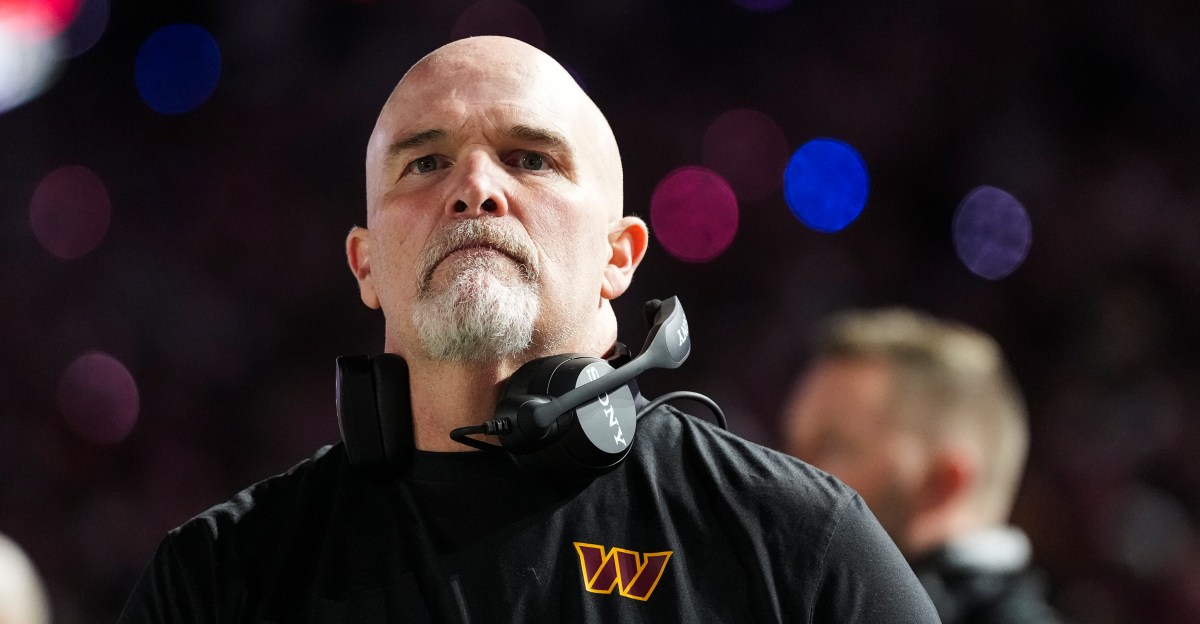
For Washington, the 2025 campaign has been precisely that: a year where the defense, a unit built with the intent to be rugged and adaptable, instead dissolved under the weight of injuries, failed experiments, and a talent base stretched far too thin for a system that demands cohesion. Yet in the closing weeks — after head coach Dan Quinn reclaimed defensive play-calling duties from Joe Whitt Jr. before the Miami game — something unexpected materialized. Order. Structure. And finally… a sense of direction.
What looked for months like a unit drifting without purpose now resembles something far more compelling: the fragile outline of what Quinn might forge in 2026 with the right personnel in place, and the philosophical recalibration he has begun applying across all three levels of the defense.
And as Washington enters Week 14 at 3–9, with the postseason all but mathematically extinguished and the evaluation period officially underway, this emerging blueprint provides the foundation for how Quinn may architect a full-scale defensive overhaul.
A Defense That Lost Its Contours
Context matters, particularly when diagnosing a season that spiraled early. Washington didn’t simply underperform defensively — they cratered.
The first half of the year was defined by coverage busts, blown assignments, edge defenders losing contain against even the most pedestrian run concepts, and a linebacker corps stretched to its breaking point in space. Injuries accelerated the decline: Will Harris early on, Deatrich Wise, Dorance Armstrong, second-round corner Trey Amos, the back end rotated through combinations no coordinator would willingly choose, and the pass rush rarely coalesced into the synchronized pressure packages Whitt’s system relies on.
The results were historically poor, both situationally and structurally. Opposing offenses pulsed with rhythm; Washington’s spacing often fractured under motion, misdirection, and layered route concepts. Whitt’s defense leaned too heavily into man-match principles without the horses at corner to withstand isolation. Too many plays felt like individual defenders trying to solve problems alone — an untenable dynamic in a system that thrives on disguised intention and synchronized movement.
It was not all effort; it was architecture.
Quinn’s Adjustments: Zone, Vision, and Intelligent Violence
When Quinn resumed play-calling, the shift was subtle, but profound. Washington has played more zone, but more importantly, more vision-driven zone — concepts that encourage corners and safeties to play downhill, triggering aggressively on in-breaking routes, and reducing the number of snap-to-snap one-on-one survival tests on the perimeter.
It also has masked Washington’s deficiencies.
With Bobby Wagner — still a cerebral, physical A- and B-gap defender, but no longer a functional coverage linebacker — Quinn has knitted together the middle of the field with layered zone drops, funneling crossers in to help rather than leaving Wagner exposed to space. Young players like Jordan Magee, a fast-flowing second-level defender who profiles as a hybrid weak-side/middle linebacker, has benefited from the simplified reads and has been allowed to attack, rather than process.
On the backend, Washington has finally seen some continuity from players who were never intended to handle such volume. Special-teams stalwart Jeremy Reaves became a chess piece out of necessity this fall —dropping into robber looks, buzzing under dig routes, walking down as a nickel insert, and showing enough mental quickness to survive. Then there’s Percy Butler, whose future remains up in the air in Washington, but is a young player who has the range and stride-length that showcase some of the traits of a natural single-high safety.
In the Miami and Denver games, the recalibration led to visible improvement: the defense played faster, more connected, and more confident. Structure often begets aggression. And aggression begets disruption.
This is the blueprint. But Washington cannot enter 2026 simply refining it — they need an injection of talent.
Daron Payne remains the anchor, a high-level interior disruptor who, despite an erratic season, remains one of the few pieces Washington can count on both schematically and culturally. Around him, however, the rest of the talent pool remains murky.
Who returns at edge rusher? The Commanders cycled through combinations due to injuries and inconsistency, and while they received flashes — spurts rather than stretches — the absence of a true alpha presence was glaring.
2026 free agency presents intriguing options:
Kwity Paye, a power-based rusher from Indianapolis entering his prime, fits Quinn’s preference for edges who can compress gaps and transition speed to power.Boye Mafe, an explosive arc-runner from Seattle, brings juice Washington sorely lacks. His ability to win high-side and threaten with speed creates spacing for interior twists and stunts — something Quinn’s fronts were built around in Dallas and Atlanta.
Either player would immediately elevate Washington’s pressure ceiling while restoring multiplicity to a front that has been forced to play too static.
Washington simply cannot enter 2026 with Bobby Wagner playing 90% or more of the defensive snaps. Great leader, yes, excellent early down run defender, sure, Hall of Famer? Absolutely. But his time in the nation’s capital has come to a close. The modern NFL is too space-driven, too RPO-centric, too horizontally stressed for a stationary MIKE to survive snap after snap.
This is where the NFL Draft becomes critical.
Ohio State’s Arvell Reese stands out as a prototype for Quinn’s second level: long, fluid, explosive, with the range and alignment versatility to erase perimeter runs and the instinct to sift through traffic. He is still a bit raw in some areas — he wins more at times with simply being the best athlete on the field than in pre-snap anticipatory feel — but he’s young, the game will only continue to slow down, and Quinn has historically thrived when he can mold young linebackers into system-specific weapons.
And the bottom line? Pairing Reese with Magee, or allowing the Ohio State product to play the ’spinner’ role and pin his ears back at edge, would give Washington a modern linebacker tandem for the first time in years: speed, length, adaptability — the ability to play in space without hemorrhaging yards after the catch.
The loss of Trey Amos was unfortunate to see — not only because of his talent, but because it forced Washington to abandon much of the structure they envisioned for 2025 with he and Marshon Lattimore on the perimeter.
Regardless, the corner room needs additions.
The real pivot point, however, is safety.
Washington has survived the season with a patchwork backend, but 2026 demands a centerpiece. Enter Caleb Downs, the do-everything savant also from Ohio State. Downs’ skillset is the exact archetype Quinn covets: anticipatory, decisive, with elite processing and the ability to toggle between deep-third responsibilities, robber roles, and pattern-match assignments without hesitation.
If Downs is available when Washington arrives on the clock (whether they trade back or not), he represents a potential transformative addition for Quinn’s group.
The Strategic Layer: Scheme Flexibility Through Talent Acquisition
Quinn’s defensive philosophy has always been miscast as static Cover-3 lineage. In reality, his core principle is adaptability both in it’s structure and from it’s personnel being asked to execute it: creating post-snap uncertainty and forcing quarterbacks into turnover opportunities. But that flexibility evaporates when personnel can’t handle the shifting burdens of disguise.
Washington’s improvements these last two weeks — more vision-driven coverage, more structured pressure looks — were made possible by simplifying, rather than expanding the scheme. It was triage. It was smart. But it can’t be permanent.
With reinforcements, Quinn can widen the defensive architecture again:
More simulated pressures, where edges drop into the hook while linebackers and safeties rotate into pressure lanes.More hybrid front alignments, allowing Payne or Johnny Newton (who needs to show up) to align as a shaded nose, 3-tech, or out to 4i based on matchup.More post-snap timing disguises, where safeties rotate late and corners play with top-down leverage to trap throws.
Washington has to build a defense that forces opponents to decode, not dictate.
A Glimpse of What Could Come in 2026
The irony of a lost season is that the final month may provide the clearest snapshot of the future. The Commanders won’t salvage their record, but they may salvage their defensive identity.
The last two weeks showed a group finally playing within its means — no longer overextending, no longer drowning in mismatches down after down, no longer miscast in one-on-one scenarios they couldn’t win. It’s been far from dominant, but it was competent. And competence can be the seed of transformation.
Injuries have decimated the group, and that’s understandable and absolutely a major factor, but Quinn now has the chance to reshape the defense with intentionality: acquiring players who fit his system, not just players talented enough to survive in it. With the right blend of emerging youth (Magee, Sainristil, Amos), foundational veterans (Payne/Armstrong), and potential additions (Downs or Reese, Paye, Mafe), Washington can build a defense with contour, identity, and modern viability.
A lost year can still be a turning point. The Commanders just have to treat the evidence on-field as a blueprint, not a postmortem.