
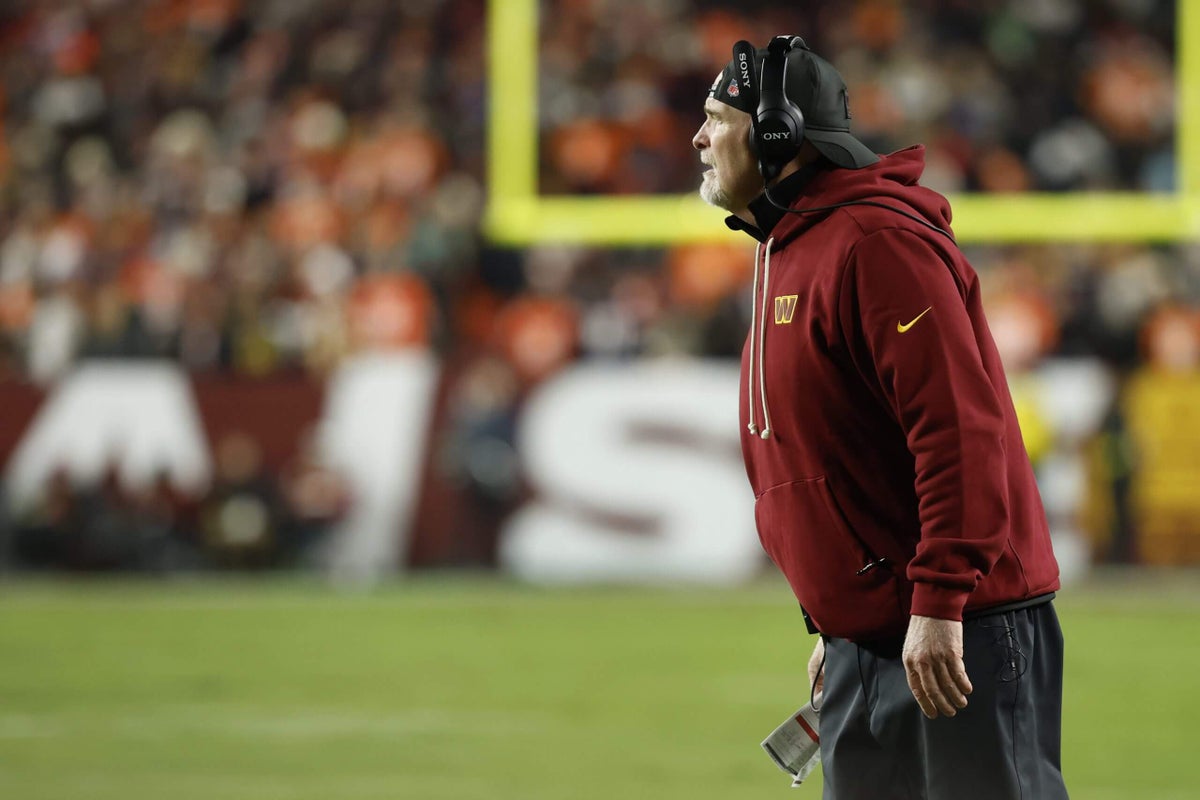
ASHBURN, Va. — When Dan Quinn was introduced as the Washington Commanders’ head coach in February 2024, he said he wanted his second go-round in that role to be different from the first. After his five-plus-season stint (2015-20) as the Atlanta Falcons’ head coach, he did an extensive self review to find his “blind spots” as a coach and rethink his approach for the next time — if he got a next time.
Among the lessons he took from his review was that he spread himself too thin in Atlanta. In two separate instances, in 2016 and again in 2019, he took over as defensive play caller in addition to his duties as head coach.
It’s why in Washington, he delegated play calling to defensive coordinator Joe Whitt Jr.
“As far as play calling, I’ll be involved with it, but those guys will call the game,” Quinn said at the time, speaking of Whitt and offensive coordinator Kliff Kingsbury. “The essence of this job as a head coach isn’t just to be on one side; it is to tie everything together. And that’s when I’m at my best.”
But after less than two full seasons in Washington, Quinn is back to pulling double duty. He took over play calling in Week 11, following four consecutive blowout losses, and has left open the possibility that he could remain both coach and coordinator in 2026.
“I’m finding a battle rhythm,” he said Monday. “… I haven’t discussed or gone down that road too far yet but yeah, I would say that’s a possibility.”
So what’s different this time around? He says his support group is bigger, and he’s relied on it more — both during the week and on game days.
Whitt remains on staff and has not officially relinquished his title. But his role has changed. He assists in developing the call sheets each week and has spent more time working with the secondary, his specialty before becoming Washington’s defensive coordinator. During games, he sits in the coaches booth at the stadium to give Quinn another set of eyes on the coverages.
Quinn also relies on assistant head coach/offensive passing game coordinator Brian Johnson throughout the week and during games, as well senior vice president of football initiatives David Gardi, who has regularly been in his ear for game management strategy.
So far, the returns have been promising. The Commanders’ defense hasn’t corrected all of its errors with Quinn pulling the strings, but the group has noticeably improved in consecutive overtime losses.
“I think it’s a combination of a little bit different calls, and then just us coming together,” cornerback Jonathan Jones said. “We established that we’re going to be a better team for the remainder of the season, and we all bought into that.”
Quinn and Whitt made a series of smaller changes to the team’s practices, call sheets and some of its personnel before altering coaching duties. Each time they hoped the tweaks would lead to better results. Instead, the Commanders missed more tackles, blew more coverages, gave up more explosive plays and fell into deficits too large to erase.
But in Week 11 vs. the Miami Dolphins in Madrid, the culmination of the changes seemed to take effect. The Commanders’ defense allowed only 16 points, and had two goal line stands and three sacks. Washington lost, 16-13, but not because of the defense.
In its next outing, against Denver, Washington again kept the game competitive until the end, taking the AFC West-leading Broncos to overtime before losing on a failed two-point attempt. The Commanders’ pass rush remained flat — losing three pass rushers to injury might have something to do with that — but the group as a whole produced a takeaway and forced three punts in the fourth quarter.
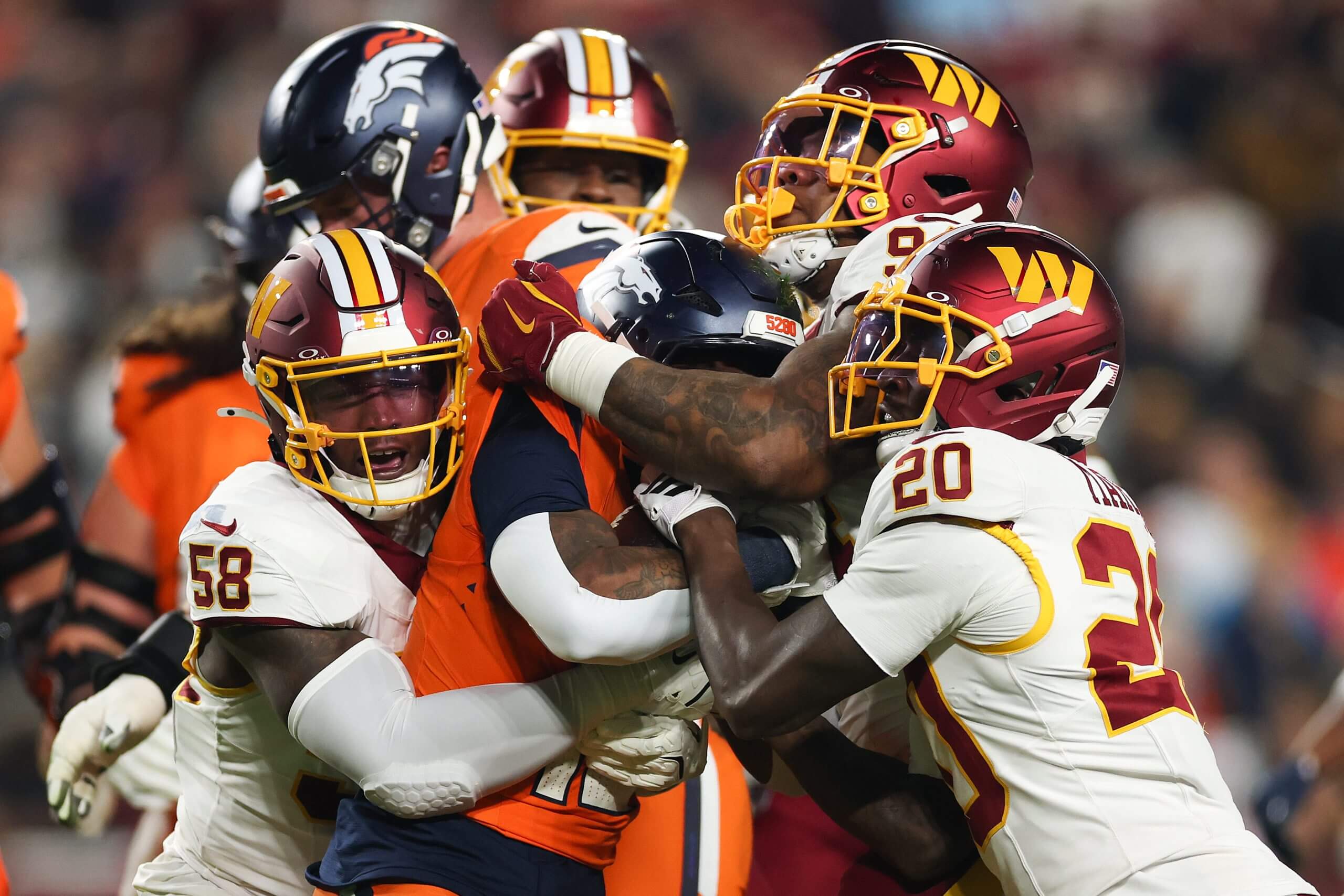
Washington’s defense made a gritty showing against RJ Harvey and the Broncos. (Patrick Smith / Getty Images)
The changes haven’t led to many drastic statistical shifts, but enough to make a difference. In the first 10 weeks of the season, the Commanders allowed 5.7 explosive pass plays (16 or more yards) per game, to rank 31st in the league. They also had a total defensive EPA per game of -8.16.
In Weeks 11-13, the Commanders allowed 4.5 explosive pass plays per game, moving up to 14th in the league, and had a total defensive EPA of -2.76.
“The calls are the same calls we’ve had,” safety Quan Martin said. “There are just less of them, so it allows us to play fast and not think too much when we’re out there.”
Quinn pushed back on the notion that his play calling led to the team’s defensive improvement in Madrid, crediting instead the “energy” of the players. Safety Jeremy Reaves seemed to agree, noting it came down to execution.
“I think guys are communicating at a high level,” he said. “We’re trusting what we’re seeing and taking shots. I think that’s the recipe of every good defense, is trusting the guys around you and knowing where to be and when to be there.
“As much as it is a confidence boost, and the games looked very different than they did before … we didn’t do enough to win. It doesn’t matter if you play well enough to lose.”