
On the field, the Big Ten has caught up to the SEC. In fact, it’s winning: The past two national champions, the top two teams in the current College Football Playoff rankings, three of the top five. The football people are smiling.
But the television partners are frowning. And the SEC and its one television partner are smiling.
The SEC is routing the Big Ten in college football ratings. That was the case last year, when at least one SEC team played in four of the top six-rated games of the regular season, and 18 of the top 25. And it’s grown this year: An SEC team has played in nine of the top 10, and 22 of the top 25 highest-rated games. The vast majority of those are SEC versus SEC games.
The Big Ten, meanwhile, has just three of its conference games on that list, and its only two appearances in the top 10 came in games against SEC teams.
Highest rated games of 2025 season
GameChannel Viewers (in millions)
Texas at Ohio State, Aug. 30
FOX
16.62
Georgia at Tennessee, Sept. 13
ABC
12.58
Notre Dame at Miami, Aug. 31
ABC
10.8
Alabama at Florida State, Aug. 30
ABC
10.66
Oklahoma at Alabama , Nov. 15
ABC
10.48
LSU at Clemson, Aug. 30
ABC
10.45
Texas at Georgia, Nov. 15
ABC
10.43
Alabama at Georgia, Sept.27
ABC
10.42
Ole Miss at Georgia, Oct. 18
ABC
9.79
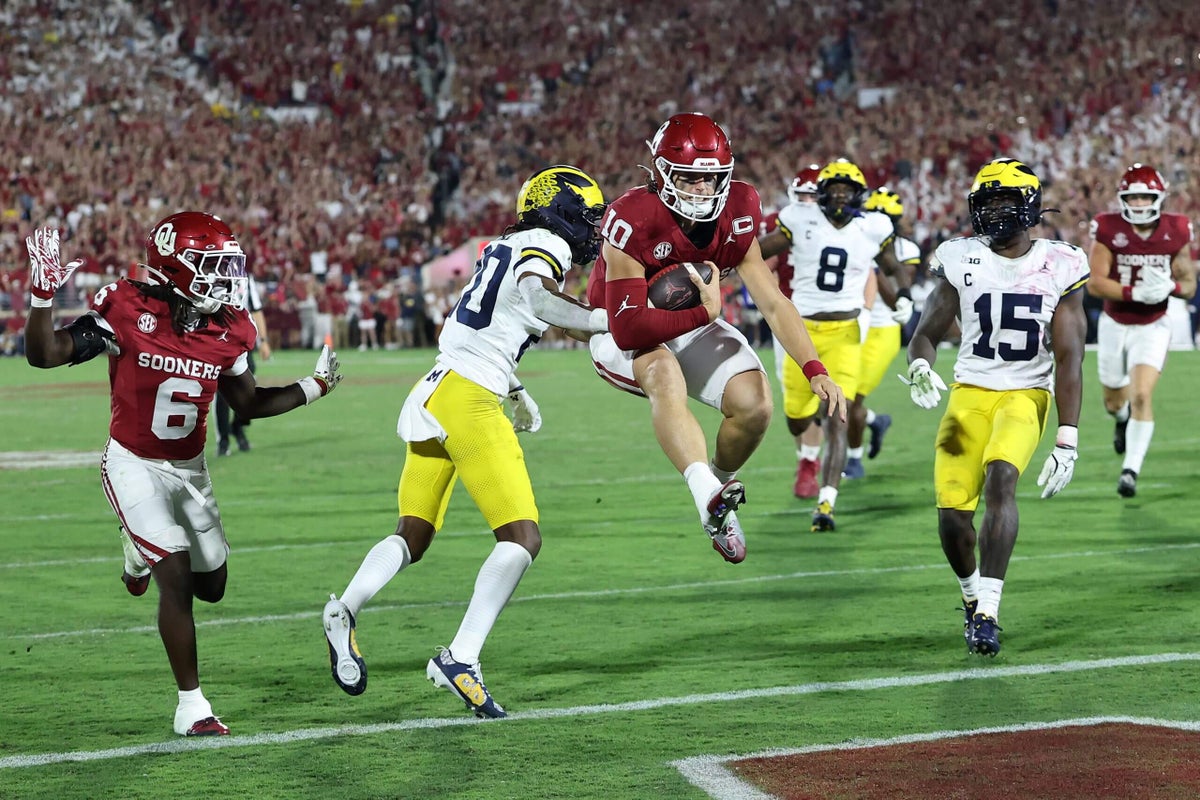
Michigan at Oklahoma, Sept. 6
ABC
9.67
Oklahoma vs. Texas, Oct. 11
ABC
8.73
Oregon at Penn State, Sept. 27
NBC
8.5
Tennessee at Alabama, Oct. 18
ABC
8.01
Alabama at South Carolina, Oct. 25
ABC
7.84
Georgia vs. Florida, Nov. 1
ABC
7.79
Florida at LSU, Sept. 13
ABC
7.64
LSU at Alabama, Nov. 8
ABC
7.54
Penn State at Ohio State, Nov. 1
FOX
7.19
Alabama at Missouri, Oct. 11
ABC
6.99
Texas A&M at LSU, Oct. 25
ABC
6.76
Georgia at Auburn, Oct. 11
ABC
6.69
LSU at Ole Miss, Sept. 27
ABC
6.69
Ole Miss at Oklahoma, Oct. 25
ABC
6.55
Florida at Miami, Sept. 20
ABC
6.46
Vanderbilt at Alabama, Oct. 4
ABC
6.41
Texas A&M at Notre Dame, Oct.13
NBC
6.2
Auburn at Oklahoma, Sept. 20
ABC
6.12
TCU at North Carolina, Sept. 1
ESPN
6.07
Indiana at Penn State, Nov. 8
FOX
6.03
Miami at Florida State, Oct. 4
ABC
6.03
LSU at Vanderbilt, Oct. 18
ABC
5.94
Arkansas at Texas, Nov. 22
ABC
5.6
Indiana at Oregon, Oct. 11
CBS
5.59
Oregon at Iowa, Nov. 8
CBS
5.47
Virginia Tech at South Carolina, Aug. 31
ESPN
5.43
USC at Oregon, Nov. 22
CBS
5.43
Missouri at Oklahoma, Nov. 22
ABC
5.37
This does not include this past weekend’s games, as those ratings aren’t expected until Thursday at the earliest. But while that will include the always highly rated Ohio State-Michigan game, it will also have the Iron Bowl, Texas at Texas A&M and Georgia-Georgia Tech, each of which was a top-25 game in the 2024 regular season.
There may be no better example of the SEC’s (television) superiority than what happened on Oct. 11: The Big Ten had a top-10 game, then-No. 7 Indiana going to then-No. 2 Oregon. It was on CBS at 3:30 p.m., and it was a close game until Indiana pulled away in the final minutes for a 30-20 win.
And yet the game still only drew 5.6 million viewers and was outdrawn by three SEC games that day: Texas-Oklahoma (8.7 million), Alabama-Missouri (7 million) and Georgia-Auburn (6.7 million).
And just two weeks ago, the top-15 matchup between 9-1 Oregon and 8-2 USC was beaten in the same time slot by 7-3 Texas against 2-8 Arkansas.
This is a more recent trend. From 2021 through 2023, ratings among the leagues were almost equal. In games with at least 3.5 million viewers, 128 involved at least one team from the currently constructed SEC, while 127 included at least one team from the current Big Ten. Highly rated games grew from 72 with at least 3.5 million viewers in 2021-22 season to 80 in 2023-24, according to SportsMediaWatch.com. This year, before the regular-season finale numbers have been announced, 70 regular-season games have hit that number, with 39 involving the SEC and 24 the Big Ten.
So what happened? Some of the reasons are competitive. Some are about their television deals. We dig into them, with our SEC writer (Seth Emerson) and Big Ten writer (Scott Dochterman) each providing perspective:
Conference depth
Emerson: Six different SEC schools have played in games that drew at least 10 million viewers. Ohio State was the only Big Ten team to do that, and it was against an SEC team (Texas).
The SEC has more good teams and brands. The Big Ten is top-heavy: It has won the last two national titles, and has three top-10 teams, but so does the SEC, which has eight ranked teams (as of this week) and unranked big brands like LSU, Auburn and Florida. Even the likes of South Carolina and Kentucky have managed to play competitive games against good teams.
More than half (57 percent) of SEC games this year have been decided by one possession, and the average margin of victory in SEC games this year is 11.4 points, about 3 points closer than last year.
“The conference is playing at a super high level with lots of teams that are competitive, lots of games that are going into the fourth quarter,” said Josh Kosner, a former executive with ESPN, CBS and the NBA who now runs a consulting firm.” You don’t have that on the bottom rung of the Big Ten. Now you have a lot of teams that just don’t generate a lot of national attention and don’t have a natural rivalry game either, that people really care about.”
Dochterman: Let’s rewind a bit to the 2023-24 season. Only eight games (in all conferences) exceeded 10 million viewers and just two in the regular season: Ohio State at Michigan and Colorado at Oregon. Three of those four teams compete in the Big Ten. One is an annual ratings staple, and the other captured a phenomenon.
The SEC has greater brand depth, which is a factor in how it markets matchups and generates ratings. Its marriage with ESPN has multiplied the number of great matchups and highly rated games. I think the number of quality teams is comparable, but preseason rankings have kept some SEC teams from tumbling out of the polls while it has prevented a few Big Ten teams from sticking around. Also, if the SEC had a ninth conference game, half the teams would accumulate one more loss, which would really even out the records between the leagues.
Several of the Big Ten’s best brands have struggled this year, which has crushed ratings. That starts with Penn State’s shocking collapse, but it also includes teams with ratings potential that flopped, like Wisconsin and Michigan State. In addition, UCLA and Nebraska failed to meet expectations.
As for close games, it wasn’t a competitive season among Big Ten teams. Only 28 of the league’s 81 games (36.4 percent) were decided by a touchdown or less and the average margin of defeat was 16.8 points per game. If the 10 combined one-score games involving Penn State and Iowa were off the table, that number would soar to an 18.7-point margin.
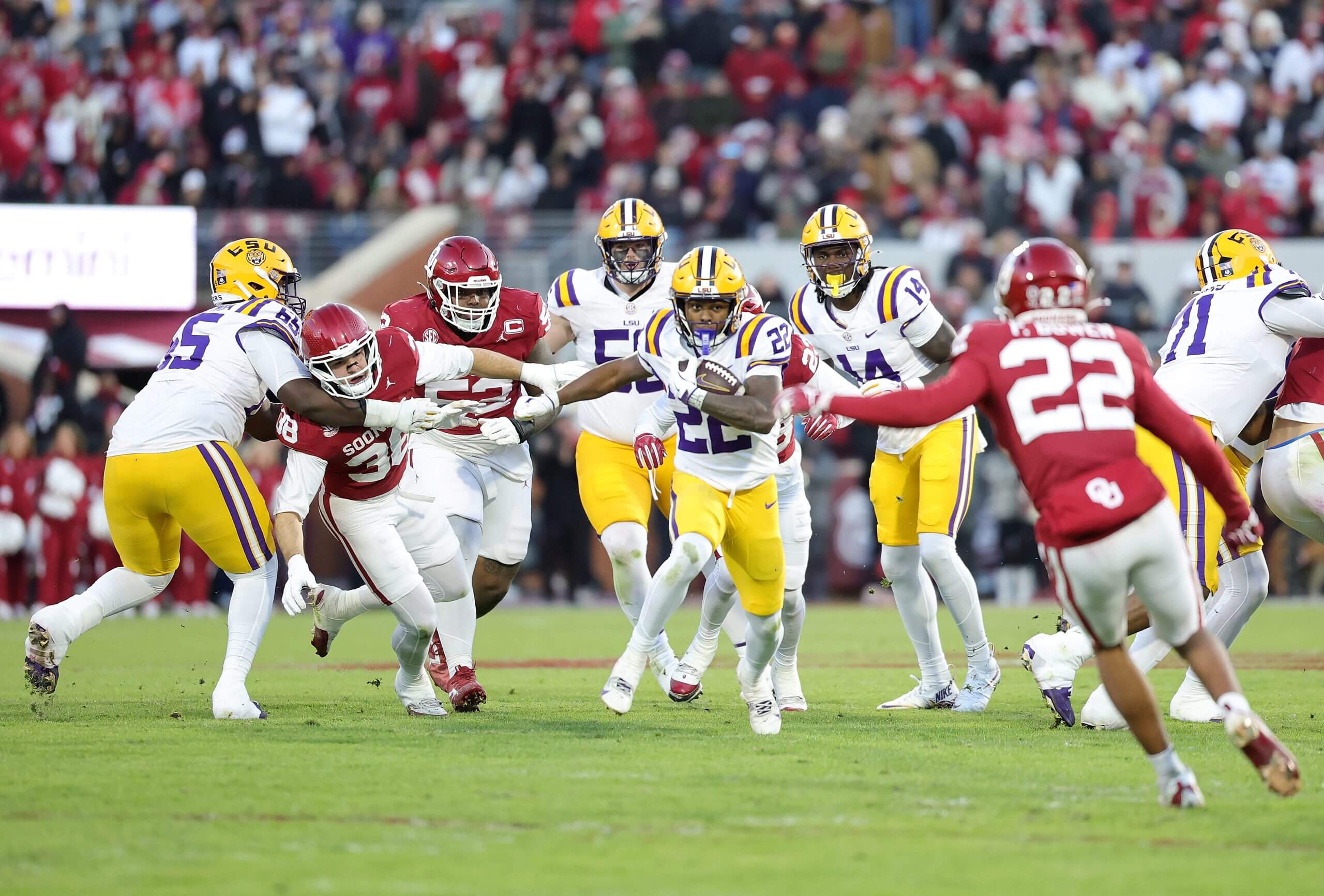
LSU, like many SEC teams, will draw a large audience off its brand even in a down season on the field. (Stacy Revere / Getty Images)
Geography and rivalries matter
Emerson: In the last rounds of expansion, the SEC added the Oklahoma-Texas game, brought back the Texas-Texas A&M rivalry, as well as geographic rivalries that Oklahoma and Texas had with other border-state programs: LSU, Missouri and Arkansas.
“Rivalry games are really good for TV,” Kosner said, pointing out that Georgia-Florida was still the highest-rated game that day (7.9 million), beating out Ohio State-Penn State (7.19 million), which was in the “Big Noon” slot.
The Big Ten expansion did import USC-UCLA and Oregon-Washington. But creating a coast-to-coast conference also set up some unfamiliar matchups, such as anytime the four West Coast schools played against any non-brand teams. Or even when they’re brand teams: Ohio State’s game at Washington — which was in the national championship two seasons ago — was the CBS 3:30 p.m. game on Sept. 27, drew 5.23 million viewers, and was outdrawn by two SEC games the same day.
Dochterman: The Big Ten’s football scheduling mirrors what commissioner Tony Petitti did as deputy commissioner with Major League Baseball when he chose to trim divisional rivalry games in favor of every team playing every other opponent. At the top, it’s great to see the Boston Red Sox play the Chicago Cubs and the New York Yankees face the Los Angeles Dodgers. But what about the Pittsburgh Pirates playing the A’s and the Tampa Bay Rays meeting the San Diego Padres? That’s kind of the case here.
There were plenty of comfortable, second-tier neighborly series that resonated with fans through divisional play that are no longer annual. Some were ratings winners like Michigan-Penn State and Michigan State-Ohio State and others were important regionally like Nebraska-Wisconsin or Illinois-Iowa. But there was a sizzle and rivalry factor. It helps to get Oregon-Penn State (8.5 million) and Ohio State-Washington (5.2 million), but in a coast-to-coast league, regionality no longer is a positive, which it still is for the SEC.
One network vs. many
Emerson: The SEC decided to go all-in with one place: Disney, meaning ABC, ESPN and the SEC Network, all are under the same umbrella. The Big Ten made deals with Fox, CBS and NBC, and made more money that way. But it may have handed the SEC and Disney a couple of big advantages.
Self-promotion is the obvious one: SEC games are promoted not only throughout the week and Saturday morning’s “College GameDay,” but on every SEC game broadcast, because they’re all under the same corporate umbrella. The Big Ten, meanwhile, has a situation where Fox, CBS and NBC are still competing with each other, so any promotion of games on other networks may come with less enthusiasm.
But the more important factor may be what TV executives call “audience flow.” By having one company make all decisions, SEC games have a general strategy: the noon game leads to the 3:30 p.m. game, which leads to the night game. And with a few other games parceled out to ESPN2 and the SEC Network.
The Big Ten has a more bifurcated approach, each of the three networks angling for the best games and not as much strategy.
There’s also a very human element: In the streaming world, it can be hard for viewers to switch between apps.
“You set a channel and forget it in the streaming environment,” Kosner said.
An example of this: On Saturday, Nov. 15, the highest-rated game was Oklahoma at Alabama on ABC. It went down to the wire. It had an average rating of 10.48, which doesn’t include the final quarter-hour that bled into the Texas at Georgia game, which ended up being a blowout but still drew an average rating of 10.43, the second-highest-rated game of the day.
The Big Ten’s highest-rated game that day was Michigan-Northwestern, at noon on Fox, drawing 3.76 million.
Dochterman: The multi-network approach hasn’t worked to perfection for anyone associated with the Big Ten. When you add the Peacock streaming-only option to BTN’s requirements of two games per team — including a conference game — it’s an unwieldy process that costs the league quality ratings.
Three games stand out this year that showed the Big Ten’s wide approach has flaws. On Sept. 27, Iowa hosted Indiana, a four-quarter battle in which the Hoosiers won on a last-minute touchdown pass. Peacock streamed that game in the late afternoon window.
On Oct. 18, Peacock streamed the Hawkeyes’ home contest with Penn State, which was the Nittany Lions’ first game after James Franklin’s firing. It kicked off at night but couldn’t air on NBC because it was showing USC at Notre Dame, and Iowa rallied for a 25-24 win. Neither of those Big Ten games earned countable Nielsen ratings for the league.
On Nov. 15, BTN carried Iowa at USC for its first ranked-versus-ranked matchup in November in 10 years. Neither Iowa nor USC had played a Big Ten contest on the league network, and the Trojans had only two games remaining (at Oregon and home against UCLA), both of which figured to rank among the linear networks’ top choices. The Trojans held on in the final minute for a win. CBS instead aired Penn State at Michigan State, and neither team had a conference win at that point.
For generations, Big Ten fans viewed the 3:30 p.m. ET window as the gold standard and noon ET was second tier. Fox, which has first-tier rights and owns 61 percent of BTN, has turned noon into its signature kickoff time. But it can’t air any West Coast games in that time slot. So it forfeited matchups like Michigan at USC or Indiana at Oregon. So Fox has leaned into flagship programs Ohio State and Michigan to carry that time slot, which irritates fans who prefer late afternoon or night kickoffs because those atmospheres are exciting.
Additionally, NBC shifting at least two Notre Dame home games into prime time forces some juggling. Sometimes it airs an early game, like in Week 4 with Maryland at Wisconsin. Or, NBC makes its Big Ten choice strictly for Peacock and there are no ratings attached. Along with this year’s Indiana-Iowa and Penn State-Iowa games, Peacock streamed Penn State’s White Out against Washington in 2024 at the same time Notre Dame played Florida State on NBC.
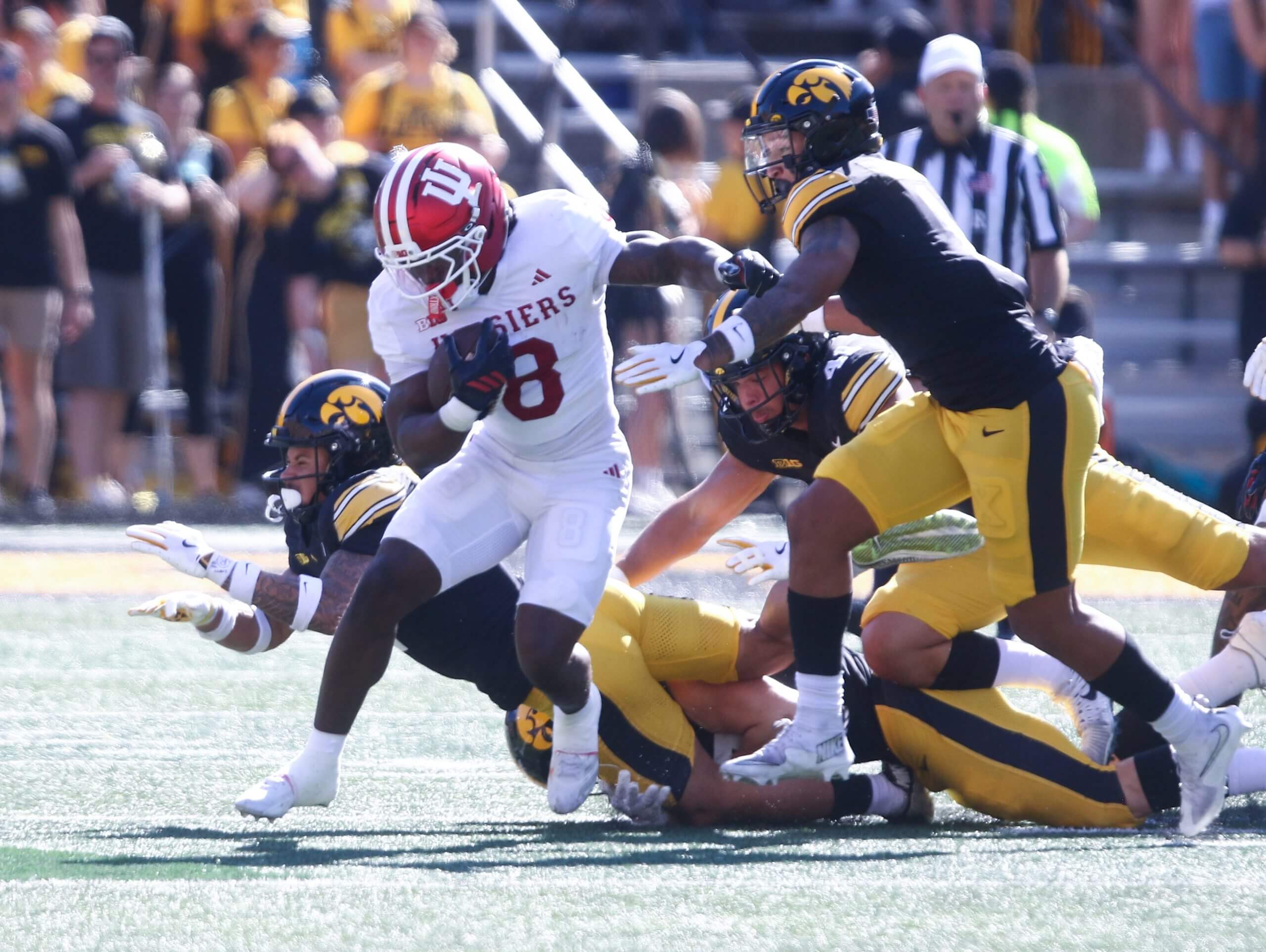
Indiana-Iowa was one of the Big Ten’s marquee games this season but was relegated to streaming on Peacock, which limited ratings. (Matthew Holst / Getty Images)
The ESPN factor
Emerson: This was touched on earlier, but bears repeating: ESPN, like it or not, is by far the most-viewed sports channel in the country. And not only is it the SEC’s exclusive home, but it carries no Big Ten games.
That doesn’t mean ESPN ignores the Big Ten. “College GameDay” has gone to Big Ten locales. But it’s not going to heavily promote games that are not on its channel.
Dochterman: The Big Ten choosing three linear networks has cost it the national narrative. No entity drives the sport’s conversation like ESPN, and the Big Ten suffers because of that. It impacted Indiana’s public perception last year, and also is part of the reason why the conversation has revolved around Lane Kiffin. I’m intrigued how ESPN handles this massive No. 1 versus No. 2 game for the Big Ten championship. If it was for the SEC title, it might squeeze a little more juice from the matchup.
Scheduling and sequence
Emerson: Expansion and the new TV contracts both took effect for the 2024 season. But something else happened that year: The end of divisions, in both conferences, but it seems to have had a more drastic — and better — impact in the SEC.
In the Big Ten, arguably the three biggest brands (Ohio State, Michigan, Penn State) had already been in the same division, playing each other every year.
In the SEC, however, separate divisions meant a bunch of big-brand games (Alabama-Georgia, Texas A&M-Florida, Auburn-Florida) only took place once every six years. The non-division format meant those happened the past couple years, along with the likes of Georgia-Ole Miss, Alabama-Vanderbilt, and others that replaced annual division games that had become stale, especially in the old SEC East (Georgia-Missouri, Florida-Vanderbilt, etc).
Dochterman: The leagues have chosen to sequence their scheduling very differently. The SEC often turns Labor Day weekend into a major splash with high-profile nonconference games that generate buzz all offseason. Remember how much we discussed LSU at Clemson in Week 1? It doesn’t matter that neither team approached their lofty projections. The game delivered 10.4 million viewers for ABC in prime time.
Most Big Ten schools play a Power 4 nonconference opponent, but neither the league nor the schools sync their nonconference schedules very well, which hurts their network partners. Take Week 2 as an example. The Big Ten played five Power 4 opponents but the top three games were on the road: Michigan at Oklahoma, Iowa at Iowa State and Illinois at Duke. The league’s partners had to pick between Oklahoma State at Oregon (again, not available for Fox) and Boston College at Michigan State. Fox’s agreement with the Big Ten calls for a league home game in that noon slot. It nearly had to air Florida International at Penn State but Fox persuaded the Big Ten to relax its contract so it could air Iowa at Iowa State at noon, which generated 4.3 million viewers.
But don’t expect the Big Ten to change and move league games into the first few weeks to balance the schedule. That’s something Petitti is wont to do.
“What I like about the way we do it,” Petitti said, “I think teams are on the same journey in November. They’re playing tough conference games all the way through and pretty much ending with their rival across the entire league. I like that part of the journey, because it’s consistent with what we’re saying, that we want these conference games to matter. So I wouldn’t necessarily support a system where you’re seeing those games, nonconference games, bleed into November for us.”
Conclusion
Emerson: SEC commissioner Greg Sankey has been criticized for not fetching as rich a deal as then-Big Ten commissioner Kevin Warren got. But whether or not this was part of Sankey’s calculation, it’s working out well.
Especially for Disney. Perhaps SEC presidents and athletic directors wish Sankey had waited a bit longer and wrangled a bit more out of that deal, but if things keep going this way, then the SEC’s next deal should be much better. Kosner, the media consultant, once worked with the late NBA commissioner David Stern, who told him: “When you make a deal, you always have to keep the next deal in mind.”
The SEC-Disney deal runs through 2033-34, which means negotiations don’t start until early next decade. The SEC probably wishes the negotiations were right now.
Dochterman: The SEC’s brand depth, especially with newcomers Oklahoma and Texas, will give it an edge over the Big Ten unless it ever adds Notre Dame. But the SEC’s decision to go all-in with ESPN vaulted the league’s profile, especially with the Big Ten vacating its relationship with ABC/ESPN in 2023. ESPN’s promotional edge is prolific, and it’s something the Big Ten will need to weigh when its current deal expires following the 2029-30 sports season.
The three-network strategy looked strong on paper and in revenue generation, but it hasn’t worked as anticipated. NBC reportedly is shopping the Big Ten’s 2026 championship game – the only one of which it has rights – to a streaming service, which could speak to some buyer’s remorse on its part. Perhaps in the next round, the Big Ten should consider cutting the linear networks by one and, say, incorporating a second window for Fox might help elevate ratings. Changing the BTN requirements or limiting the Peacock-only games might boost some ratings along with more strategic scheduling. The Big Ten needs some serious re-evaluation to cut into the SEC’s ratings gains, especially with the SEC adding a ninth league game next year.