
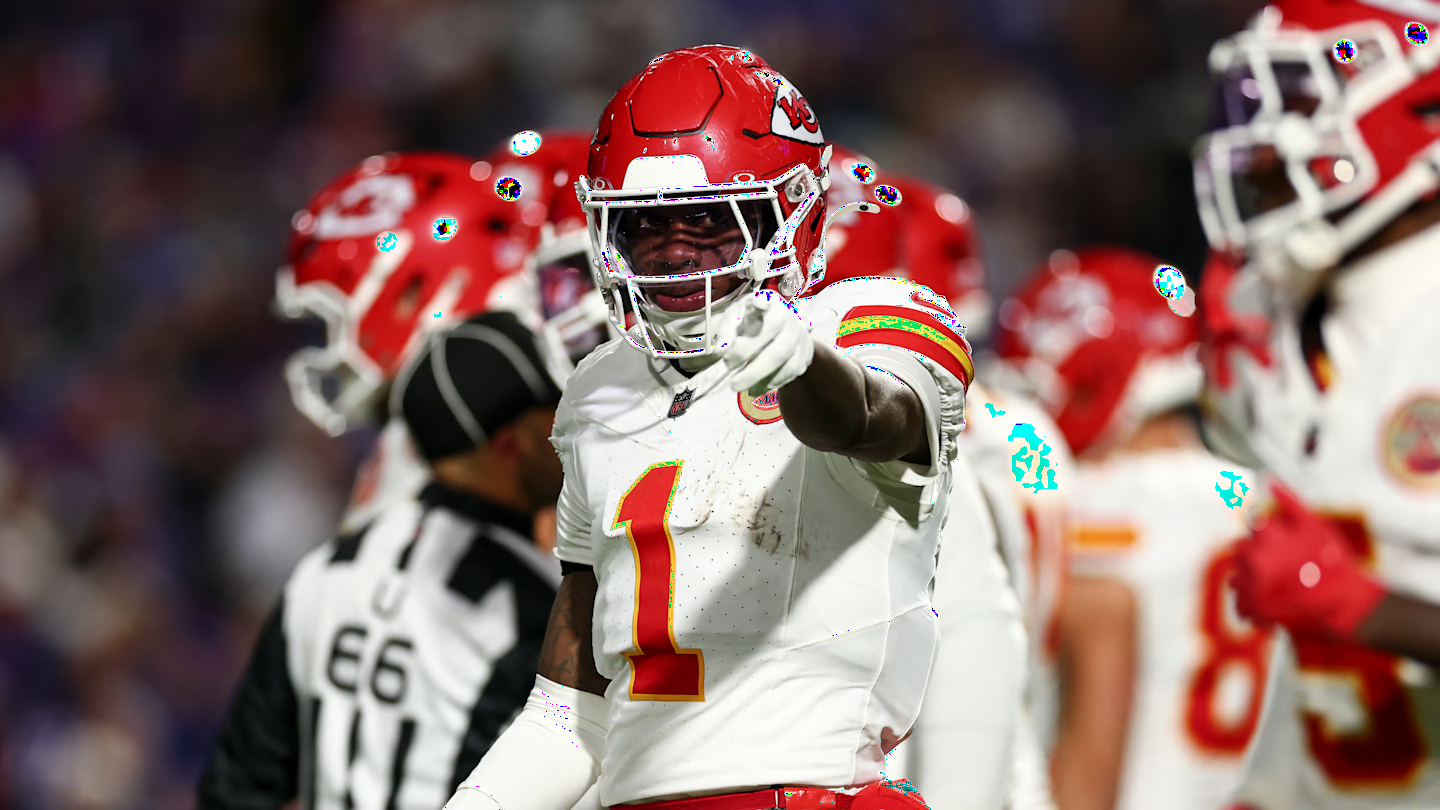
Xavier Worthy was never going to be a normal superstar wide receiver.
You don’t trade up in the first round for the fastest player ever recorded at the NFL Combine and then quietly fold him into the offense like he’s WR4. From the moment his 4.21-second time flashed on the bottom line, the expectation in Kansas City wasn’t just “this guy can help”; it was “this guy is the missing piece.”
Fast forward 10 games into his second season, and the discourse is all over the place. Worthy has 59 targets, 35 catches, 401 yards, and a single touchdown. That’s 6.8 yards per target, 11.5 yards per catch, and a fantasy line that screams “flex headache” more than “game-breaking weapon.”
Is he actually good?Is Andy Reid using him correctly?Is Mahomes part of the problem?Did the Chiefs draft the wrong receiver?
To get an honest answer, you can’t just stare at the box score or cherry-pick a couple of clips where he either burns somebody deep or mistimes a jump ball. You have to do what front offices do: zoom out, layer context, and drop him into a bigger ecosystem of players, second-year stars, and offensive environments.
What follows is a structured methodology built to evaluate Worthy through the same lens NFL teams use: advanced route data, alignment trends, air-yard profiles, and efficiency metrics. We’ll examine him in isolation, compare him to his draft class, and contextualize him against year-two breakouts, analyzing the quarterbacks and offenses that shape those outcomes.
And then we’ll answer the question that actually matters: What should Chiefs fans think of Xavier Worthy right now, and what should the team be doing with him next?
Methodology
Before we start firing takes, here’s what we’re really using to judge him (all analysis will be over his first 10 games of the 2025 NFL season):
Full-route and alignment data: Where he lines up (wide, slot, backfield, tight to the formation, off the line), how often he’s on the field, and how often he’s part of the concept.Air yards and opportunity share: For Worthy: 756 air yards on 59 targets, an average depth of target of 12.8 yards, and nearly 22% of Kansas City’s total air yards. That’s not a gadget profile, that’s a real vertical role.Catchable ball rate (CBL%): How many of his targets were actually catchable. For Worthy, 39 of his 59 targets have been charted as catchable after 10 weeks (a catchable ball rate of 66.1%). CBL% is a central pillar in this evaluation.Separation and coverage metrics: How often he’s open, how often defenses play zone vs man against him, how tight the coverage is at the catch point, and how frequently defenders close late.Deep efficiency: How many of his targets are 20+ air yards? How often are those completed? What kind of payoff are those shots actually producing?Comparative profiles: We’re not just looking at Worthy in a vacuum. We’re putting his profile next to fellow 2024 draftees (Ladd McConkey, Brian Thomas Jr., Malik Nabers, Troy Franklin, Xavier Legette) as well as second-year players (DeVonta Smith, Jaylen Waddle, Amon-Ra St. Brown, DK Metcalf, George Pickens, Chris Olave, Marquise “Hollywood” Brown, Jaxon Smith-Njigba, and Tank Dell).Offensive and QB context: Team-level offensive DVOA and quarterback accuracy/efficiency for Patrick Mahomes, Justin Herbert, Trevor Lawrence, Bryce Young, Bo Nix, and Russell Wilson in 2025; because receiver stats don’t happen in a vacuum.The point isn’t to drown the conversation in numbers. The point is to answer a simple question: How much of Worthy’s current production is him, how much is the offense, and how much is just the normal growing pains of an explosive young receiver?
Again, we’re on the verge of overthinking this… but the data makes one thing really obvious:
If Xavier Worthy got even league-average catchable balls, his YPRR profile would look a LOT different.
Most WRs with their catchable ball % (CBL) sit well above him on the efficiency… pic.twitter.com/ralBebTV2Y
— Christian Ainsworth (@Chris_Ains32) November 21, 2025The most important statistic: Catchable Ball Rate (CBL)
You can’t fairly judge a receiver without knowing how many real chances he’s getting. If a receiver is constantly targeted on uncatchable go balls into double coverage, his raw yards and catch rate are going to look ugly, no matter how good he is. That’s where catchable ball rate (CBL%) comes in (the percentage of a receiver’s targets that are actually catchable).
For Worthy, the number is 66.1% (39 of his 59 targets have been charted as catchable, and he’s hauled in 35 of those). That’s a 89.7% catch rate when the ball is actually catchable, which tracks with the film: he doesn’t have perfect hands, but the “he drops everything” narrative doesn’t hold up.
Now, that 66.1% becomes more meaningful when you drop it into a larger group:
Amon-Ra St. Brown (Year 2): 84.2%DeVonta Smith (Year 2): 82.4%Jaylen Waddle (Year 2): 81.9%Jaxon Smith-Njigba (Year 2): 78.8%Brian Thomas Jr.: 74.6%DK Metcalf (Year 2): 73.6%Chris Olave (Year 2): 71.0%Ladd McConkey: 69.2%Tank Dell (Year 2): 69.1%George Pickens (Year 2): 68.9%Xavier Worthy: 66.1%Marquise Brown (Year 2): 66.7%Xavier Legette: 62.3%Troy Franklin: 61.9%Malik Nabers: 54.3%
The group average is exactly 71%. Worthy is a hair below that, but he’s not living in the basement. The true outlier on the low end is Malik Nabers at 54.3%, which is what happens when your quarterback is Russell Wilson in the late stage of his career and the offense is constantly off-schedule.
So what does a 66.1% CBL really tell us about Xavier Worthy? He’s not being destroyed by an unreasonably low catchable rate. Mahomes is not throwing him Nabers/Russell-level garbage. He’s also not enjoying the super-clean environments that guys like St. Brown, Smith, and Waddle got in year two. He’s firmly in the middle: getting enough chances that we can actually evaluate him, but not in some pristine “perfect ball every time” world either.
To sum it up: Worthy’s catchable ball rate says this isn’t a “QB ruined him” situation. Mahomes has not been perfect, but Worthy is getting a real, evaluable slice of the offense.
What the Chiefs are actually asking Worthy to do
Let’s talk role, because this is where the frustration really starts to crystallize around Worthy. Through 10 games, Worthy has:
456 offensive snaps, which is 54.7% of Kansas City’s snaps (per FTN)282 routes, a 60.3% route participation rate.59 targets, good for a 12.6% target share.68 total opportunities (targets + carries, etc.), or 8.6% of the team’s offensive opportunities.
For a young, first-round receiver, those are “used but not featured” numbers. He’s clearly part of the plan, but he isn’t anywhere close to a primary option. It gets more interesting when you dig into how he’s used.
Alignment: Treated Like a Veteran X, Not a Protected Young Receiver
Worthy’s route distribution:
Wide: 191 routes (67.7%)Slot: 87 routes (30.9%)Backfield: 4 routes (1.4%)Tight to the formation (LINE): 0 routesOff the line in stacks/bunches (OFF): 0 routes
That’s a massive red flag for how the Chiefs are deploying him. For a 165-pound receiver whose greatest strength is vertical speed and space-driven separation, the usual developmental path looks like:
A lot of slot repsPlenty of reduced splits and tight alignmentsOff-line looks in stacks and bunches to protect against press coverageMotion to free him from jams and force favorable leverage
Instead, the Chiefs have lined him up like he’s a seasoned X or Y (on the ball, wide, in space where corners can get hands on him and disrupt routes). He has zero routes from tight splits and zero from off-line stacked alignments. That’s almost malpractice for his archetype.
The slot usage isn’t nonexistent (a third of his routes come from the slot), but between the lack of tight or off-line alignments and the heavy wide usage, he’s being asked to live in some of the toughest real estate on the field for a smaller receiver.
First-Read Usage: When They Go to Him, It’s Intentional
Despite the modest target share, the Chiefs clearly do call plays specifically for Worthy.
40 of his 59 targets have been first-read throws.That’s a first-read rate of 67.8% on his targets.But those 40 “first reads” make up only 7.8% of the team’s total first-read plays.
In other words, when they throw to Worthy, it’s almost always by design. He is the intended target of the concept, but the offense doesn’t draw from that well very often. This means Worthy lives in this weird space
Routes that are hard for his body type (wide, on the ball, vertical).Targeted on concepts that are clearly built for him.But without offense-level commitment to making him a consistent focal point.
To sum it up: The Chiefs are giving Worthy a veteran’s assignment without a star’s workload. He’s being used like a clear-out X/Y who occasionally gets his number called, not like an undersized accelerator you build easy buttons around.
Separation, coverages, and how defenses treat Worthy
One of the easiest lazy takes is “Worthy doesn’t separate.” The data says otherwise. Here is his coverage profile through ten games:
Routes vs man coverage: 32.3%Routes vs zone coverage: 67.7%Yards per route vs man (MYPR): 1.8Yards per route vs zone (ZYPR): 1.2
Those numbers being nearly identical is a good thing. It means he isn’t a one-trick pony who only works vs one coverage shell. He’s been reasonably efficient per route regardless of whether defenses are in man or zone.
The more telling signals are in the separation metrics:
Open on target (OPEN%): 28.8%Wide-open (WIDE%): 6.8%Strict coverage (SC% — defender within a step): 35.6%Tight-window targets (TGH% — within a yard): 25.4%Late close (CLOS% — open at throw, defender closes late): 1.7%
A few things jump out:
Worthy is open on almost 30% of his targets. For a vertical-usage, wide-aligned receiver, that’s pretty solid. This isn’t a guy who never shakes free.He’s dealing with tight coverage a lot. A combined ~36% strict coverage and ~25% tight-window targets is a heavy workload of “gotta win at the catch point” situations for someone his size.Defenses are playing him with fear. With just under 70% of his targets coming vs zone, teams are clearly worried about his ability to blow the top off and are playing with a safety-first approach.
If you’re a Chiefs fan wondering, “do defenses actually respect Worthy?” the answer is yes. That 67.7% zone rate and his 12.8-yard ADOT say defenses treat him like a real vertical threat, even if the raw numbers haven’t exploded yet.
To sum it up: Worthy does separate, but he’s being asked to separate in the hardest possible situations: wide, vertical, into tight coverage, with defenses playing zone shells designed to keep him capped.
What happens when Worthy actually has the ball?
Now we’re into the heart of the “is Worthy good or not?” discussion. Here are his stats through 10 games:
Targets: 59Receptions: 35Yards: 401Touchdowns: 1Yards per target: 6.8Yards per catch: 11.5YAC: 143 total, 4.1 yards after catch per receptionExplosive receptions (big gains): 5, for 165 yardsMissed tackles forced: 5Routes run: 282Yards per route run (YPRR): 1.4
That YPRR number doesn’t scream “instant superstar,” but it’s completely in line with what you’d expect from a vertical, second-year complementary piece in a cluttered offense.
The more encouraging note is the missed tackles forced and YAC. For a 165-pound receiver to force 5 missed tackles on 35 catches is quietly impressive. You can see it when he gets a screen or a slant in stride. He isn’t just track-fast, he’s got that glide-through-traffic agility once he gets north-south.
Drops? The narrative doesn’t match the reality:
Total drops: 1Drop rate: 2.6%
By any reasonable standard, that’s fine. Especially once you add in:
Success rate (SUC%): 45.8% of his targets counted as successful playsEPA per target: +0.197
He’s not lighting up efficiency charts, but he’s not a drag either. You’re looking at a mildly positive playmaker being used in a very specific, high-difficulty role.
To sum it up: When Worthy actually gets a catchable ball, he catches it 97% of the time, generates solid YAC, forces missed tackles at an encouraging rate, and delivers slightly positive EPA. That’s not a finished product, but it’s a useful one.
The deep ball problem: High usage, low reward
This is the piece that every fan feels in their bones. Worthy’s deep ball profile includes:
Deep targets (20+ air yards): 14Deep receptions: 4Deep catch rate: 28.6%Deep yards: 137Percentage of his total targets that are deep: 23.7%Deep touchdowns: 0
Almost one in every four of his targets is a deep shot. That’s a huge vertical load for a second-year player, and so far, it hasn’t produced efficient returns. Meanwhile, Patrick Mahomes in 2025:
Deep attempts (20+ air yards): 60Deep completions: 19Deep completion rate: 31.7%Deep yards: 682Deep touchdowns: 1Deep attempt rate: 13.6% of his passes
Mahomes is still hitting deep balls at a slightly above-league-average rate overall, but the payoff has been unusually low (only one deep touchdown on 60 shots). That’s as much about route spacing and play design as it is about arm talent.
When you marry those two profiles, you get the current Worthy deep experience: A high volume of deep targets in an offense where the deep passing game as a whole is underperforming on touchdowns and consistency with a receiver who is seldom protected with tight or off-line alignments to create free vertical access
If you told me in a vacuum that a second-year WR with a 12.8 ADOT, a 23.7% deep target rate, and almost no stacked/tight looks was sitting at 28.6% deep catch rate and 0 deep touchdowns through ten games, I’d say: that’s a coaching and structure issue as much as a player issue.
To sum it up: The deep ball isn’t working right now for Worthy or the Chiefs. He’s being asked to live on a diet of low-percentage vertical shots in an offense whose deep touchdown rate has completely dried up.
How Xavier Worthy stacks up against his draft class
It’s impossible to talk about Worthy without bringing up the receivers taken around him. Here are some quick lines for the 2024 receiver group:
Name
Targets
Catches
Yards
TD
YPRR
ADOT
CBL
Brian Thomas Jr.
63
32
448
1
1.5
13
74.6%
Ladd McConkey
91
58
683
5
1.7
8.9
69.2%
Xavier Leggette
53
28
287
3
1
9.8
62.3%
Troy Franklin
84
48
530
5
1.5
13.8
61.9%
Malik Nabers
35
18
271
2
2.19
15.9
54.3%
Xavier Worthy
59
35
401
1
1.4
12.8
66.1
The first takeaway: this is not some embarrassing outlier profile. He’s roughly in line with the other big vertical receivers (Franklin and Nabers by role, BTJ by deployment) in both YPRR and environment difficulty.
McConkey is the clear early winner in “plug-and-play target magnet” terms: shorter ADOT, higher volume, more efficient usage. That’s exactly how he was supposed to look in the league: a professional separator built to work with an accurate quarterback in a timing offense. If you’re asking if the Chiefs drafted the wrong guy, the honest answer is:
If you wanted the guy who would be most productive in year one, McConkey was probably the safer pick.If you’re still aiming for a Tyreek-type offensive ceiling (a player who can tilt the field in a way defenses can’t solve with normal answers), Worthy’s profile still fits that ambition.
What this comparison really shows is not that Worthy is broken, but that his usage looks like a high-difficulty version of what Franklin and Nabers are living in, without the corresponding “just throw it up” catch radius or contested-catch profile.
To sum it up: Relative to his draft class, Worthy is not underperforming to some catastrophic degree. He looks like what he is: a vertical receiver in a high-leverage role, used more as a stressor than a featured engine, in an offense that hasn’t fully figured out how to cash in his gravity.
What elite receivers looked like in year two
A lot of Chiefs fans are basically asking: “Is this the beginning of an Amon-Ra St. Brown or Jaylen Waddle arc, or is this going to be a Mecole Hardman or Skyy Moore-type of story?” Looking at year-two profiles for some of the league’s best:
Name
Targets
Catches
Yards
TD
YPRR
ADOT
CBL
Amon-Ra St. Brown
146
106
1,175
6
2,46
6.5
84.2%
DeVonta Smith
136
95
1,196
7
2.11
11.0
82.4%
Jaylen Waddle
117
75
1,356
8
2.68
12.2
81.9
DK Metcalf
129
83
1,303
10
2.0
13.4
73.6%
Chris Olave
138
87
1,123
5
2.1
13.3
71%
George Pickens
106
63
1,147
5
2.24
13.5
68.9%
Tank Dell
90
56
827
7
2.05
11
69.1%
George Pickens (Year 2): 106 targets, 63 catches, 1,147 yards, 5 TDs, 2.24 YPRR, 13.5 ADOT, 68.9% catchable ball rate.Tank Dell (Year 2): 90 targets, 56 catches, 827 yards, 7 TDs, 2.05 YPRR, around 11 ADOT, 69.1% catchable ball rate.
When you look at those guys, you see three key trends:
Volume is king: Every one of these players cleared 100 targets in year two, many of them in the 130–140+ range.They were placed in roles that actually matched their skills: St. Brown: lower ADOT, slot/glance merchant, insane volume; Smith: intermediate assassin in a high-efficiency offense; Waddle: a vertical threat and horizontal stressor in a motion-heavy, spacing-max offense; and Metcalf/Pickens/Olave: true outside alphas with quarterbacks willing to give them chances.Catchable ball rates generally sat in the low-70s or higher: Their teams made sure that being “the guy” didn’t just mean “go run deep into bad looks all day.”
Worthy right now is nowhere near that kind of volume, nor is he in a role as structurally friendly as what those guys had by year two. But what you do see in his data (the air yard share, the deep target rate, the YAC per catch, the missed tackles) is that he has the skeleton of a player who can be a major offensive engine once his environment and usage catch up.
If you want comps, his current usage and efficiency sit somewhere between:
Tank Dell’s style of deployment (small, explosive, real WR not a gadget)George Pickens’ deep, contested-heavy life (high ADOT, tight coverage)
It’s a strange hybrid, and that’s less about what Worthy is and more about what the Chiefs are asking him to be.
To sum it up: Worthy doesn’t yet look like those year-two stars because he isn’t in that kind of role. But his traits and current underlying numbers don’t disqualify him from getting there once volume, usage, and structure align.
The offense and the quarterback: Context matters
Now we have to talk about Mahomes and the offense as a whole. In 2025, Kansas City’s offense is still grading out extremely well in advanced metrics:
Total offensive DVOA: 19.4%Weighted offensive DVOA: -3.8%Passing DVOA: 36.2%
Those are elite numbers. Whatever our eyes feel about the product (the disjointed drives, the stalled red-zone trips, the ugly turnovers), the overall down-to-down efficiency is still upper-tier. But within that big-picture efficiency, there are cracks:
Mahomes is at 64.6% completion on 441 attempts, with 7.3 yards per attempt and 22 touchdowns.He’s thrown deep 60 times and completed only 19 of those passes (31.7%) — with just one deep touchdown to show for it.He’s had 14 passes charted as dropped (around a 3.2% drop rate), 42 passes broken up, and 10 batted at the line.
What that means for Xavier Worthy is simple:
This is still a high-functioning offense in aggregate.But the specific part of the field where Worthy lives (deep, wide, vertical routes) has been the least efficient part of Mahomes’ 2025 profile.
Compare that to what other second-year receivers are getting:
Ladd McConkey benefits from Justin Herbert’s accuracy in the intermediate and short areas, with a lower ADOT and a catchable ball rate near 70%.Brian Thomas Jr. gets a more traditional X role with Trevor Lawrence, with a solid 75% catchable ball rate and a pretty consistent linear usage.Malik Nabers is living in chaos with Russell Wilson, and his 54.3% catchable ball rate shows how brutal that environment is.Troy Franklin is being used like a classic vertical Z in Denver, with a high ADOT and a catchable rate in the low 60s.
Worthy sits right in the middle. He’s not being destroyed by QB play, but he’s also not being maximized by it. The offense is good, but the intersection of “what he’s best at” and “what this version of Mahomes + this version of the structure are doing well” is very small at the moment.
To sum it up: The Chiefs’ offense is still strong overall, but the specific zones where Worthy lives (deep sidelines and vertical routes from wide alignments) are not where Mahomes and this scheme are at their best right now.
So… what should the Chiefs do with Xavier Worthy?
If you take all of this together (the catchable ball rate, the alignment, the deep usage, the comparisons), it stops sounding like a “bust” conversation and starts sounding like a “usage and development” conversation. Here’s what should change.
1. Make Worthy’s Life Easier with Formation and Alignment
Right now, Worthy has:
0 routes from tight splits0 routes from off-line outside stacks67.7% of his routes from wide alignment
That’s backwards for his body type and skill set. The Chiefs should:
Increase his slot share and especially his slot usage on early downs.Start giving him condensed splits by aligning him tight to the formation to force off coverage and create free access for crossers, posts, and deep overs.Use stack and bunch formations to get him off the line and prevent corners from landing clean jams.Pair him more frequently with motion to stress leverage before the snap.2. Rebalance His Route Tree
A quarter of Worthy’s targets being deep shots is too high, given the inefficiency of the deep passing game. KC doesn’t need to eliminate those (that speed is too valuable), but they should:
Shift some of his vertical workload into intermediate crossers, digs, and over routes where his speed can stress zones horizontally and vertically.Build in more quick-hitting touches where his 4.1 YAC per catch and 5 missed tackles can pay off.Use him as a primary on RPO-adjacent concepts, not just a clear-out on the back side.3. Treat Him Like a Real Weapon, Not a Specialty Piece
A 12.6% target share and 8.6% opportunity share for someone with almost 22% of the team’s air yards is a sign of a player the offense respects but refuses to commit to fully. Worthy doesn’t need 140 targets tomorrow. But nudging his usage up into the 20–22% target share range with a more varied alignment profile and a slightly lower deep attempt rate would give you a much clearer answer on what he really is.
To sum it up: The Chiefs don’t need to change who Xavier Worthy is, they need to change how and where they deploy him. Less “track star X receiver,” more “space and leverage merchant who happens to run 4.21.”
What should Chiefs fans think of Xavier Worthy right now?
If you’ve stuck with all the numbers, here’s the honest, balanced answer. Through ten games:
He has 401 yards and 1 TD — not the breakout people wanted.He’s earning 59 targets, a 12+ yard ADOT, and nearly 22% of KC’s air yards in a strong offense.His catchable ball rate is 66.1%, just below the larger group average and in line with plenty of productive receivers.When the ball is catchable, he catches it 90% of the time.He’s forcing 5 missed tackles, generating solid YAC, and providing structural gravity even when the box score doesn’t pop.He’s being asked to win like a veteran outside receiver (wide, on the ball, down the field) without the schematic help that most small receivers get.
Worthy is not:
A bust.A chronic drop problem.A player the league “figured out” already.
Worthy is:
A talented, explosive second-year receiver being deployed in a role that amplifies his weaknesses and fails to fully weaponize his strengths.A player whose current production is as much a reflection of offensive structure and usage as it is his individual play.A legitimate long-term weapon whose underlying profile still lines up with the kind of players who become stars in year two and three (once their teams commit to building around them).If you want the simplest possible takeaway as a Chiefs fan:Xavier Worthy is not the problem.The way the Chiefs are currently asking him to play football (wide, vertical, unprotected, and selectively involved) is the problem.The numbers back that up just as clearly as the film does.
I know we’re dangerously close to crossing the line between analytics and straight-up nerd shit… but while digging into the Xavier Worthy data for my article, I found something pretty wild:
Worthy’s ADOT & deep-rate are basically the same number (r = .93)… but his catchable… pic.twitter.com/N03emz2kiN
— Christian Ainsworth (@Chris_Ains32) November 21, 2025
And the optimistic part? All of that is fixable.
Xavier Worthy doesn’t need lessons on how to use his speed. The Chiefs need to learn how to make that speed the backbone of their offensive identity instead of an occasional novelty.