
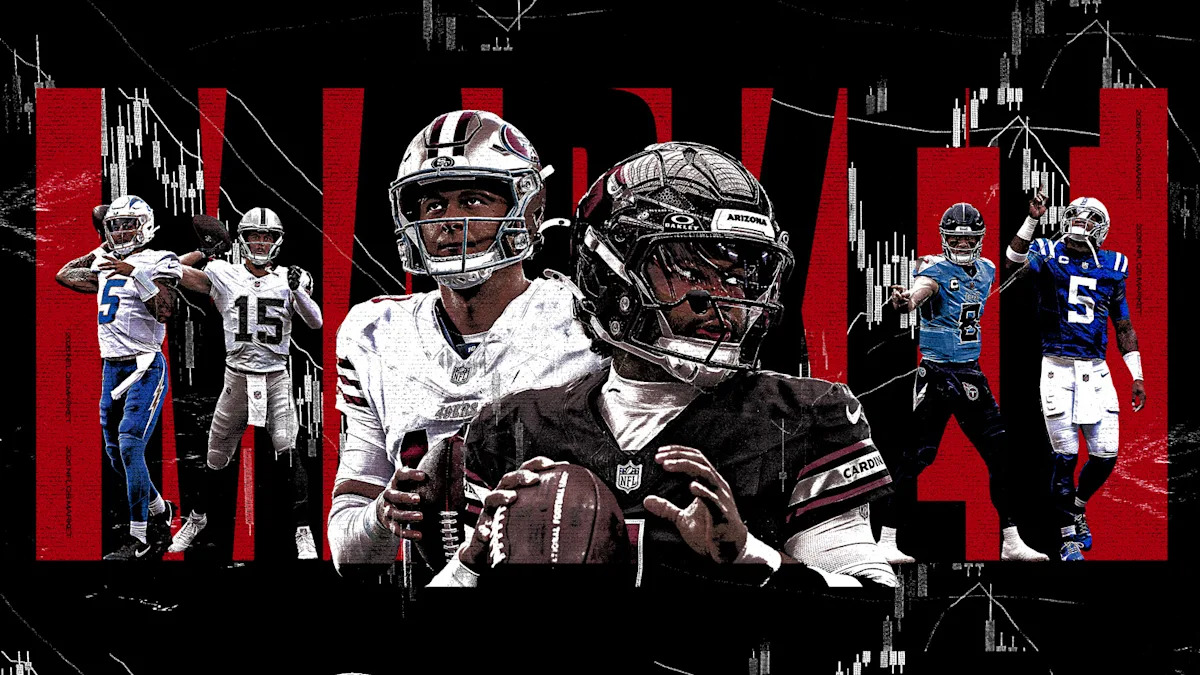
“There’s always going to be those highs. What we’ve got to do is hopefully eliminate those lows.”
That was the response in late July, when I asked Arizona Cardinals general manager Monti Ossenfort for his assessment of Kyler Murray and the step that needed to be taken by the quarterback in 2025. As expectations went, it was a short and succinct checklist: Keep Murray healthy and available; remove the lowest of lows in his performance cycles.
Advertisement
Just over five weeks into the season? Murray was coming off three consecutive losses that showcased some of the frustrating portions of his career, and he was suddenly headed to injured reserve with a foot injury. What we didn’t know then is what we found out on Friday: Murray’s season was over — and likely with it, his stint as a Cardinals quarterback.
That’s how Friday’s news should be absorbed, with Cardinals head coach Jonathan Gannon announcing that further evaluation of Murray’s foot injury isn’t showing the advancement that would get him back onto the football field. In light of that information, he’s being shut down.
“It’s not progressing where it’s gonna make sense that he can go [play],” Gannon said Friday, ahead of his team’s home game against the Los Angeles Rams. “So he’s gonna be done for the year.”
Advertisement
Asked if Murray was going to be a Cardinals quarterback in 2026, Gannon declined to answer, stating “I’m worried about the Rams right now.”
And just like that, Murray became arguably the No. 1 “reboot” quarterback target of the coming offseason — with any career turnaround now focusing on a new franchise.
Murray hasn’t spoken to reporters since after Arizona’s Week 5 loss to the Tennessee Titans, when he sustained the foot injury that landed him on injured reserve. However, he may have alluded to the his end of his time with the Cardinals Thursday night on his TikTok account, when he posted a short video of himself walking with teammates Marvin Harrison Jr., Michael Wilson and James Conner. The video was overlaid with the text “weird year” and posted with a caption reading “Never again”. The caption portion was later deleted.
Advertisement
Friday’s announcement only fuels divorce speculation that has swirled around Murray and the Cardinals since he was placed on injured reserve. Given that 2025 was seen as yet another year where Arizona was looking for Murray to turn a corner, it’s a failure that weighs heavily on both Gannon and Ossenfort as the tandem complete their third season trying to turn the franchise around.
When I visited with the Cardinals in training camp, both head coach and general manager expressed optimism, along with offensive coordinator Drew Petzing, that Murray was going to make the advancement Arizona needed to fuel an offensive roster that featured little change from 2024 to 2025. With that hope failing to materialize, and with Harrison Jr. seeming stuck in a middle gear with the current offense, it’s suggestive that there will be some inspired change from both the coaching staff and front office. However, that change would come at a steep cost, with Murray’s contract a burdensome issue moving forward.
Due to the structure of Murray’s deal, the Cardinals would take on a $57.75 million dead cap charge if they were to release him prior to June 1. If they designate him as a post June 1 release, that can be split into a $50.5 million charge in 2026 and a $7.2 million charge in 2027. The ideal move would be for the Cardinals to find a team to trade for Murray, which would yield a much more comfortable dead cap charge of $17.9 million, but also an overall cap savings of $35.3 million. For the latter to happen, the Cardinals would likely have to trade Murray away for very little in return and hope that an acquiring team would be willing to commit to the $36.8 million that’s already fully guaranteed on his 2026 salary.
Advertisement
It’s unlikely, given Murray’s struggles and injuries, that a team would be willing to give up anything of substance in trade while also eating Murray’s guaranteed money in 2026. However, if the Cardinals were willing to eat some of that guaranteed money in 2026, they could find a limited market for him before a mid-March deadline when his $19.5 million base salary in 2027 becomes fully guaranteed (if he’s still on the Cardinals roster after the fifth day of the new league year in March).
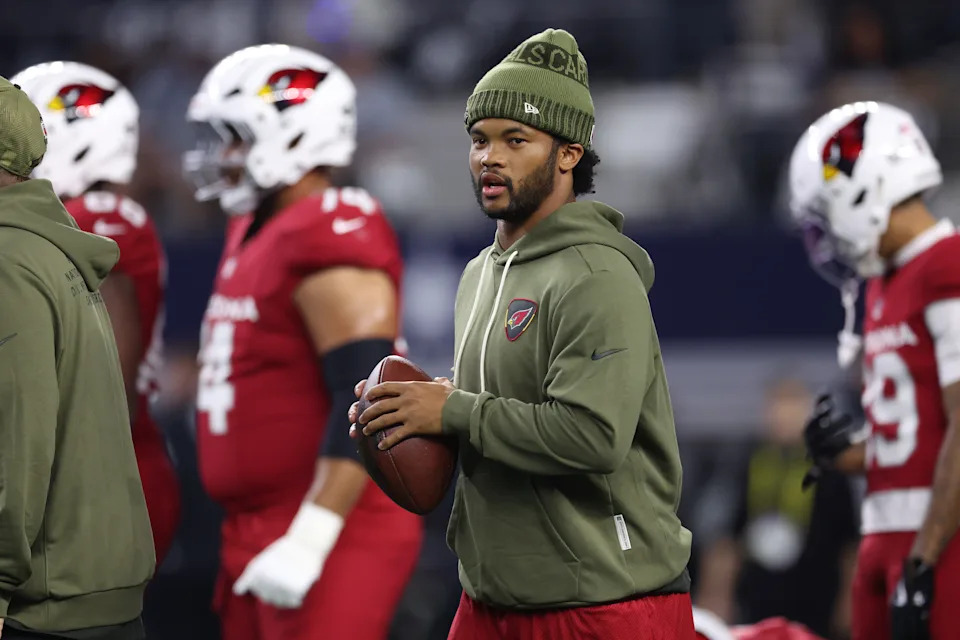
Kyler Murray might have played his last snap for the Arizona Cardinals. (Photo by Sam Hodde/Getty Images)
(Sam Hodde via Getty Images)
In simplistic terms? If the Cardinals are moving on from Murray, they will need to be very motivated sellers and find a trade partner in place prior to March 15. That also means team owner Michael Bidwill needs to have all of his business with the current staff finalized as quickly as possible following the end of the season. Will Gannon and Ossenfort be afforded another season to get the franchise onto a playoff track? Given the competitive nature of the Cardinals despite a massive spate of injuries , there is merit to the tandem returning. If Bidwill feels otherwise, he’ll need to have an either a new head coach or GM — or both — in place quickly to make a move with Murray.
Advertisement
For now, the appetite for Murray appears to be mixed. Multiple personnel executives placed a low value on Murray as a trade asset, but their overall assessment was dependent on the amount of money the Cardinals would be willing to eat on his contract and what his health status is come January. Murray doesn’t turn 29 until August, but the perceived red flags about his work ethic, leadership and consistency are very real. That said, several executives noted that Murray’s athletic profile and overall experience as a starter is still far superior to any other veteran options that are expected to be on the trade market or free agency this offseason.
“He still has the elite athletic profile,” an AFC general manager told Yahoo Sports this week. “When you start comparing him to some of the other guys that might be available, [Murray’s] good is still on a totally different level.”
For that reason, the ballpark on Murray value is hard to pin down. The aforementioned AFC general manager suggested that Murray could still draw a third-round pick, similar to the price the Las Vegas Raiders paid to acquire Geno Smith last offseason. Other executives were less flattering, putting Murray’s value at fourth-round pick or less, depending on what the Cardinals were willing to eat from his current contract.
Advertisement
Here are five more quarterback reboot targets to keep an eye on …
Jones has been a hot name as a quarterback reboot for the balance of the season, taking over for an injured Brock Purdy and putting together a 5-3 record in eight starts, while completing 69.6 percent of his passes for 2,151 passing yards and 13 touchdowns against six interceptions over that expanse. His two games against the Los Angeles Rams stood out in particular, including a 26-23 Week 5 overtime win and a Week 10 loss that saw Jones keep the 49ers competitive into the fourth quarter before the game unraveled into a 42-26 loss.
Advertisement
Along the way, Jones showcased efficient starting-level play that was reminiscent to his best year in the NFL — the 2021 rookie campaign that saw him help lead the New England Patriots to a 10-7 record and tease a future life after Tom Brady. Of course, the Patriots entire organization collapsed onto itself after that season, ultimately leading to Jones’ play deteriorating behind a poor offensive line and average-to-below-average skill position players. His part in the wheezing end of the Bill Belichick era looked like it would stamp the end of Jones’ career, delivering him to the Jacksonville Jaguars in 2024, where he went 2-5 in relief of an injured Trevor Lawrence before departing last offseason to sign with the 49ers.
His rebirth under Kyle Shanahan this season teased thoughts that Jones could be the next quarterback after Sam Darnold to rekindle a starting shot — despite Darnold and Jones having very different athletic profiles and skill sets. Some of the Jones hype has settled a bit with the return of Brock Purdy to the starting lineup, with the offense looking more vertical and explosive despite continued injury issues and Purdy having a three-interception game in a sloppy 20-9 win over the Carolina Panthers in late November.
The reality for Jones is that his best fit and the other options available will drive interest in him this offseason. While framed by some in the potential reboot tier of a Darnold, Daniel Jones or Baker Mayfield, neither his arm or overall athleticism compares well to that group. He also fits best in a Shanahan or Sean Payton specific type of scheme that is a West Coast timing offense or similar hybrid. The teams that readily come to mind with both need and system fits are the Minnesota Vikings (if J.J. McCarthy can’t find traction by the end of the season), Pittsburgh Steelers (if Aaron Rodgers retires) and Miami Dolphins (if Tua Tagovailoa falls out of favor and Miami wants to bring in someone to compete for the starting job). The Las Vegas Raiders and Cleveland Browns could also be fits. But almost all of these options for a Jones trade will be predicated on what happens with existing starters and in some respects, potential coaching changes. Jones is simply not a one-QB-fits-all player, and the slots out there for a team to chase him are more challenging that most want to admit.
Advertisement
And as one NFC West executive pointed out about Jones earlier this week, his best fit may already have been realized as a backup to the oft-banged up Purdy. Jones has already excelled in limited time with Shanahan and if Jones were to get another spate of snaps between now and the end of his deal in 2026 — and if he once again performed well with those opportunities — he could potentially be a coveted 28-year old free agent in March of 2027. With the 49ers likely inclined to hold onto him as an insurance policy next season, the hype about a Mac Jones reboot might be just one season earlier than when it’s at a peak.
Alongside Kyler Murray and Mac Jones, Richardson’s future should be one of the most interesting storylines of the offseason when it comes to the reboots. There is clearly still interest in his immense set of physical tools in spite of injuries, poor performance and what some evaluators believe is just an overall lack of maturity for the 23-year old quarterback. Beaten out for the starting job in the preseason by Daniel Jones, Richardson is currently on injured reserve after a freak accident in pregame warmups resulted in an orbital fracture in October. He’s still expected to return this season and resume his backup duties behind Jones, who is currently dealing with his own fibula injury.
Advertisement
Like Murray and Jones, Richardson is under contract and would have to be acquired via trade. His rookie first-round contract gives the Colts or any potential acquiring team the opportunity to trigger a fifth-year option on his current deal, which would take Richardson through the 2027 season. The question is whether the Colts have any inclination to continue developing Richardson if Jones is ultimately deemed to be their long-term starter. And all of this is coming to a head quickly, with the 28-year old Jones set to be a free agent in March. One way or another, the Colts either have to make some kind of commitment to either Jones or Richardson moving forward. As it stands, Jones has appeared to have played himself into a long-term extension offer. That could change the approach of general manager Chris Ballard, who said in late August of Richardson: “We’re not trading him.”
It’s a stance that will make little sense if Jones is awarded a long-term extension — even if it’s a deal similar to those signed by Sam Darnold with the Seattle Seahawks and Geno Smith with the Las Vegas Raiders. Both of those deals are essentially two-year contracts with the ability to keep each on the fold for a third. Even if that’s the kind of limited commitment deal signed by Jones, it would likely be too cost prohibitive in 2027, when Richardson’s current fifth-year rookie option projection is salted to be $22.9 million. Of course, the Colts could fiddle with the payout to Jones and the structure of his contract to make it work, but it would also be wildly awkward for both Jones and Richardson to have the franchise basically betting on both to be the starter in 2027 and beyond.
All this sets up the expectation of Richardson being made available for trade as soon as Jones is under a long-term extension. The question is what the Colts could net in return. Three front office executives pegged Richardson’s value at a fourth-round pick, which would put it in line with what the Dallas Cowboys surrendered for Trey Lance in 2023. However, two other executives Richardson’s trade value at nothing more than a 5th rounder due to an acquiring team having to make a decision in May regarding Richardson’s costly 5th year option for the 2027 season.
Advertisement
“He’s a developmental player and you’re trading for one year of development,” said an executive who pegged Richardson’s value at a fifth-round pick. “The Raiders traded a fifth for one year of Kenny Pickett.”
Levis will be an interesting gamble if some team is drawn to his very big tool set. When you talk to people around the league who have a track record with first-year Titans GM Mike Borgonzi, there is a pretty solid expectation that the Titans will work to trade Levis with one year left on his deal — although it should be noted that the next coaching staff has yet to chime in with its own assessment. But with Cam Ward making strides in the starting job, the time-tested and logical playbook for 2026 is for Tennessee to seek out a trusted veteran backup whose skill set and experience will mesh with preparing and developing Ward to the fullest extent. With Levis having lost his job to Ward and having only 21 games of experience as a starter, he’s not a natural fit in that role. He’s also a roster relic of a previous head coach and general manager.
Advertisement
But even with that inclination to trade him, the reality is that Levis’ trade value is about as low as it can get. He had surgery to repair a significant AC joint tear in his throwing shoulder last July, knocking him completely out of the 2025 season. Not only will he have not practiced or thrown in months, there also will be little — if any — proof of how healthy his throwing shoulder is or will be once he returns to the field. That’s not going to get you much on the trade market. Maybe a seventh-round pick at this point. But for those who might roll the dice on that, there is some merit to taking a very low risk on a player who has had a few flashes of brilliance. And Tennessee’s struggles regardless of whether or not Levis was on the field may actually help him.
One AFC evaluator drew culture comparisons between what Levis experienced with the Titans and the poor surrounding environments that Sam Darnold and Baker Mayfield experienced with the New York Jets and Cleveland Browns, respectively — and then the Carolina Panthers jointly — as having merit for a deeper look. The Titans’ offensive line was a mess, the running game was largely nonexistent and he ultimately ended up playing for two different coaching staffs in his first two seasons. In short, not the kind of environment that fosters seamless development.
“When a guy is coming out of a mess, sometimes that’s good and sometimes that’s bad,” the AFC evaluator said. “It depends on how that affects a player and what they learn.”
Advertisement
The evaluator also qualified that the overall skill sets between Levis, Darnold and Mayfield were not apples-to-apples comparisons.
“Levis came in with a whip [for an arm]. Darnold and Baker were superior athletes overall,” he said. “Darnold and Mayfield came [into the league] having shown a lot of leadership qualities,” he said. “Levis was a big arm and some toughness. Now there’s the injuries on top.”
While Levis’ shoulder will be difficult to set aside, it worth remembering that he had some very respectable games as a rookie under head coach Mike Vrabel before his second season under now-ousted head coach Brian Callahan went sideways in 2024. Levis also had some very competitive games with Callahan at the helm, but any positives were almost entirely overshadowed by terrible decisions, benchworthy interceptions and injuries. Not to mention the clear well of frustration that Callahan developed over the course of the 2024 season, which was often aired during games or in Callahan’s meetings with the media.
Advertisement
Taken as a total package, it’s a lot to sort through. But it can’t be ignored that some of the scrap heap quarterbacks that have revived their careers and thrived this season also went through some staggering low points, too.
The ship has not sailed on Lance getting one more starting shot just yet — but he also needs to step out from behind proven veteran quarterbacks and get meaningful snaps in 2026. He’s 25 (turns 26 in May) and has now been in the league five years without finding a team willing to give him a sustained test run since the San Francisco 49ers traded him to the Dallas Cowboys in August of 2023. One longtime AFC evaluator who was high on Lance heading into the 2021 draft made a compelling point for Lance still potentially having some ceiling.
Advertisement
“He’s never really gotten his shot — and you can also say he’s never really forced it — but it’s not like he’s gotten beaten out by bad quarterbacks,” the evaluator said. “There’s some circumstances. Injuries when he needed a lot of development [in San Francisco] and then look at the guys he’s been behind.”
The argument in a nutshell: Lance essentially played one season of quarterback in high school and one season of starting quarterback in college. He needed significant patience and development, but spent his rookie season filling in behind veteran Jimmy Garoppolo and had issues with injuries (and eventually) confidence. By the end of his second season, he’d lost any shot at starting to rookie Brock Purdy, who has turned out to be a good starting quarterback. Eventually, he lost his backup job in San Francisco to Sam Darnold …who has also turned out to be a good starting quarterback. Since then, he has spent time with the Dallas Cowboys behind Dak Prescott and Cooper Rush (who proved to be a quality backup) and now has been the backup to Justin Herbert with the Chargers.
Aside from failing to supplant Rush as Prescott’s backup in Dallas, Lance’s history has been littered with other good quarterbacks in the room, and severely limited chances to take strides forward on the field. What hasn’t changed is that he’s still a young, 6-foot-4, 225-pound quarterback with a strong arm and the ability to impact games with his legs, too. In some respects, his tool set is a similar to that of Levis, but with much less on-field tape to actually showcase it. If you’re a believer in Lance, you’re a believer in late-bloomers who just needed a sustained opportunity to get their game up and running. Jordan Love, for example, did virtually nothing his first three seasons in the league and often looked extremely poor in Packers practices. You’re also a believer that Lance can fit multiple schemes, whether it’s RPO heavy, play action heavy, etc.
Advertisement
It’s worth noting that Lance had some very impressive flashes in his preseason games. And that Chargers head coach Jim Harbaugh praised him this week as “cool, calm collected” after Lance took some first-team and goal-line reps following the non-throwing hand injury to Herbert. It’s very possible Lance will get some snaps Monday night against the Philadelphia Eagles. With Lance once again becoming a free agent in March, whatever he does between now and then will determine if another NFL team is willing to bring him in as something more than just a reliable backup.
It says something that Geno Smith has had such a rough season with the Raiders — some of it certainly induced by the league’s worst offensive line — and Pickett still hasn’t gotten a shot at a start. Head coach Pete Carroll continues to lean into veterans over young players and there’s been little doubt that he views Smith as the quarterback who gives the Raiders the best shot to win games. At this point, if Pickett ends up with a start, it will either be due to an injury to Smith or someone above Carroll forcing the change to see if Pickett has anything to offer. But with his rookie deal expiring after the season, there’s little motivation for the Raiders to give him a test drive now, only to see him find some traction and lose him in free agency.
Advertisement
Unlike Trey Lance, there’s a strong sense that Pickett has already shown his ceiling. His limitations are well known, from his lacking arm strength. But when you talk to evaluators in his last two spots before Las Vegas, with the Philadelphia Eagles and then briefly with the Cleveland Browns, there is some insistence that Pickett’s early development was almost completely submarined in with the Pittsburgh Steelers by a mismatched offensive coordinator in Matt Canada and an offensive line that was a revolving door of problems. It became a rhythmless system with a rhythm quarterback plugged inside it.
“We know the top end with Kenny is limited,” said an evaluator from one of Pickett’s previous stops. “But his floor is probably higher than people think. He has to be in the right scheme and have positive alignment with an offensive coordinator. He didn’t have that [in Pittsburgh].
While I think Pickett was slated to compete for (and maybe even favored to win) the Cleveland Browns starting job before preseason injuries derailed him, it remains to be seen if any other team is willing to take a look at Pickett as anything more than a backup. All of that said, Pickett does have 25 games of starting experience under his belt and still could be seen as a possible spot starter with journeyman bridge potential. He turns 28 this offseason. Think along the lines of Jacoby Brissett, who has shifted back and forth between backup, spot starter and bridge starter roles for the last 10 years.