
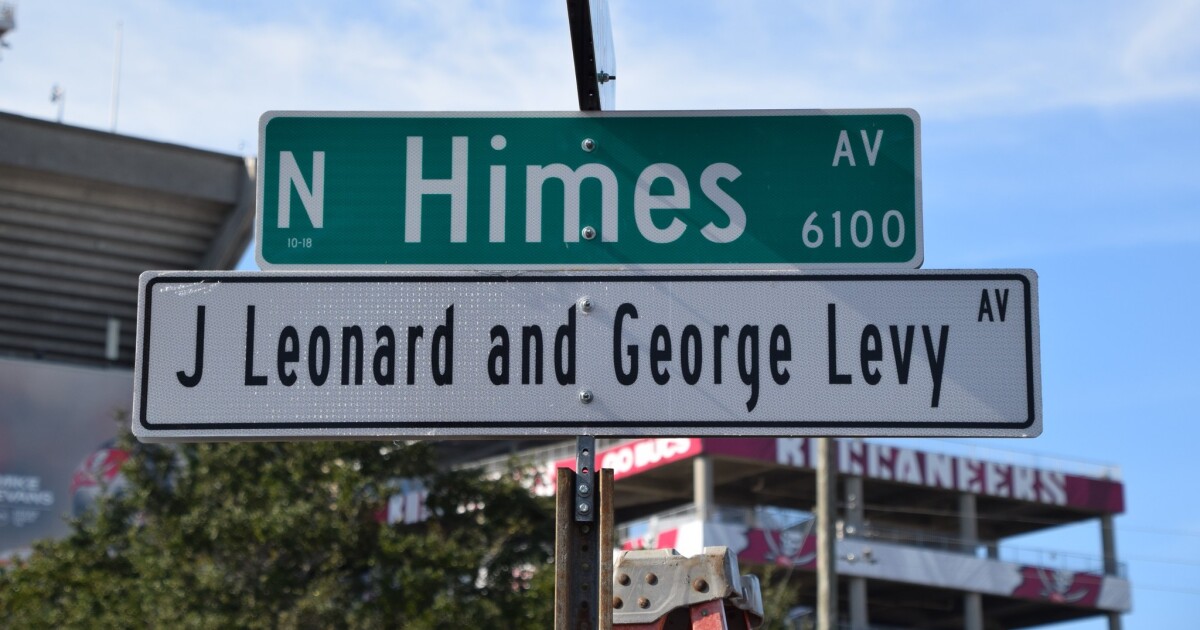
Without the grindstone civic work of the Levy twins, Tampa might not be a Super Bowl town. Imagine: no Buccaneers, no “Big Sombrero” stadium.
Dare we say, no “Tampa Bay area”?
Hence, J. Leonard and George were recognized by the city Friday for their role in bringing professional sports to the area and other endeavors to better their hometown.
The corner of Himes and Ohio avenues, adjacent to Raymond James Stadium, was named “J. Leonard and George Levy Avenue” at a ceremony.
The Tampa natives dedicated their lives to community engagement and development. Their efforts brought the NFL to the area and laid the groundwork for multiple Super Bowls and the construction of stadiums that continue to anchor the region’s big-league sports identity.
Attendees included Levy family members and friends, city chair Alan Clendenin and council members Charlie Miranda, Bill Carlson and Guido Maniscalco, D.C. Goutoufas, who initiated the street-naming for the family, and Bucs owner/co-chairman Bryan Glazer and chief operating officer Brian Ford.
“Leonard and George had a deep and abiding love for Tampa,” said Richard Barrett, Leonard’s son-in-law. “They gladly gave their time, talent, energy and wisdom to make this community a better place for all of us.”
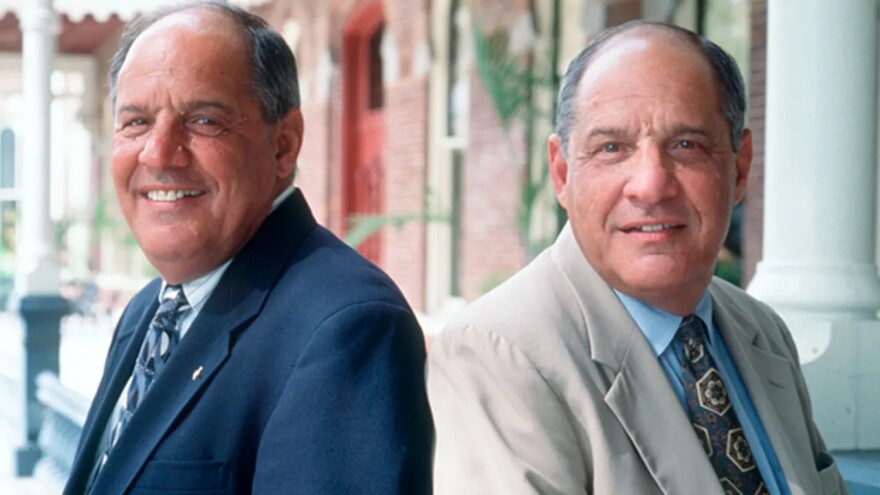
The late George, left, and J. Leonard Levy, were Tampa boosters and business leaders who helped make the region a major-league sports destination. The city honored the twins by putting their name on an intersection adjacent to Raymond James Stadium on Himes Avenue.
The brothers’ most significant achievement came in 1974 when, as part of a small task force that began meeting with then-NFL Commissioner Pete Rozelle in 1970, the group successfully secured an NFL franchise for Tampa.
That day, Leonard asked the commissioner, “Now, how do we get a Super Bowl?”
A key part of getting the team was Leonard’s branding of “Tampa Bay.” By uniting multiple communities, he convinced the league the region could support a team. Meantime, George helped build the infrastructure, serving on civic and sports boards, backing public financing, and promoting youth and regional athletics.
Leonard chaired local Super Bowl task forces from 1984 to 2021. He also played key roles in establishing the Lightning, Rays and original Rowdies, as well as attracting the NCAA Men’s Final Four to St. Petersburg in 1999 and College Football Playoff championship game to Tampa in 2017.
Both were instrumental in the building and expanding of Tampa Stadium, known as the “Big Sombrero,” and Raymond James Stadium, its 1998 replacement.
George, who owned a successful trophy and awards business, died in 2016 at age 83. Leonard, who worked his way up to president of a Tampa printing company, died in 2022 at age 89.