
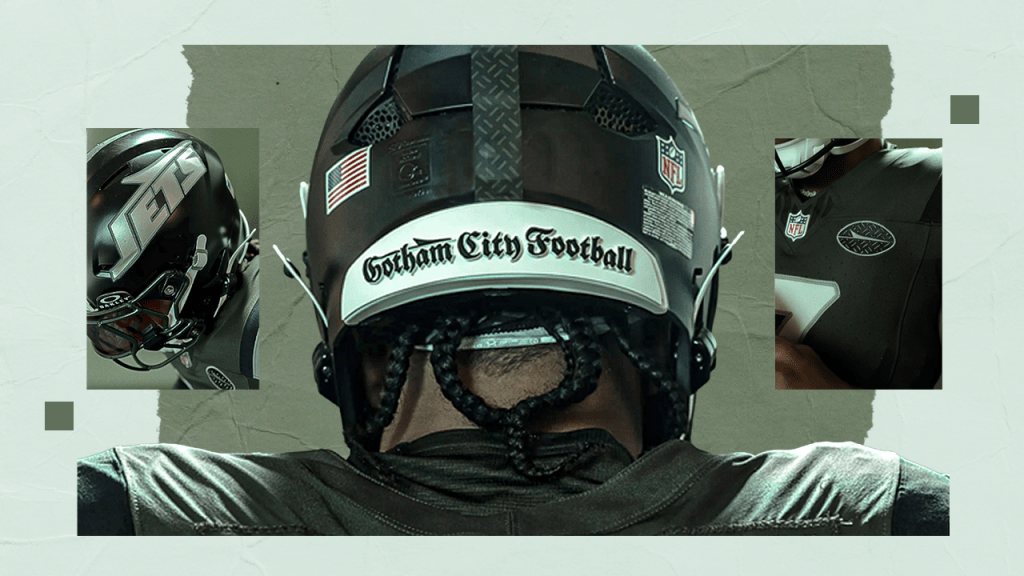
It’s Gotham week for the New York Jets.
On Sunday, the NFL team will wear its Gotham City Football uniforms for the first time, donning a new jersey that features a “Gotham Green” colorway and the phrase stamped on the back of each helmet. Five days later, perhaps by coincidence, the team faces a deadline in its ongoing quest to trademark the nickname.
Like the 2025 season, that process has so far provided few victories for the team. As Sportico detailed in July, the USPTO denied the team’s application, made through the NFL, which seeks trademark protection for T-shirts, hoodies, caps and other apparel. That followed months of back-and-forth between lawyers and the U.S. government. In late August, the team was granted a three-month extension to appeal that denial. The new deadline is Dec. 12.
Representatives for the NFL and the Jets didn’t respond to questions about whether they intend to file an appeal by the deadline.
The Jets don’t appear deterred by the lack of trademark registration. For years, they’ve used Gotham City Football on sideline apparel and other merchandise, some of which is available for purchase by fans. Sunday’s jerseys are their version of the league’s Rivalries uniform program, which allows teams to design an alternative look to wear against one divisional opponent.
“It quickly became evident that Gotham City Football was an obvious direction for us to take with the Rivalry uniform,” Chris Pierce, the team’s vice president of fan commerce, said when the plan was unveiled this summer. That announcement came on Aug. 28; the three-month extension was signed by the NFL’s lawyer on Aug. 29.

The USPTO’s rejection, categorized as a “final action,” was primarily based on Gotham City being understood as a physical location—New York City. Generally, physical locations can’t be trademarked. The USPTO’s denial cited additional reasons, including that consumers might be confused by Gotham City Football given the presence of the trademarked Gotham City Crew, a popular Jets fan club. There was no mention of Gotham Football Club, the NWSL team owned by the family that also owns the New York Giants.
The Jets have argued that “Gotham City” shouldn’t be understood as a physical location since it is not a real place. Gotham City has been popularized by Batman, the superhero comic book launched in 1939 that spawned an IP empire of TV, cinematic and video-game properties. To that point, federal judges have referenced Gotham City as the home to Batman, not an actual place.
But the USPTO disagrees, reasoning that Gotham City was invented not by Bob Kane, Bill Finger and others who gave life to Batman but instead by writer Washington Irving, who authored The Legend of Sleepy Hollow and Rip Van Winkle. As the New York Public Library details, Irving described New York City as Gotham City in a literary magazine published in 1807—more than a century before Finger “was inspired by an entry in a telephone book for Gotham Jewelers.”
Beyond the appeal due next week, the Jets could also appeal to the Trademark Trial and Appeals Board. Four years ago, the TTAB greenlighted the registration of the “Republic of London,” which like Gotham City—at least in the Batman context—is a fictional location. The goods sold under the Republic of London brand didn’t originate from the English capital and weren’t made there.
The TTAB noted that “Paris Beach Club” was permitted, partly because there is no such place. “Paris is not located on an ocean or lake, and does not have a beach,” the TTAB noted, adding “purchasers would not necessarily expect T-shirts and sweatshirts so marked to originate in the city of Paris.”
Even if the Jets ultimately lose their bid to register Gotham City Football, the team could obtain other types of trademark protection. Trademark registration is valuable for a number of reasons, including a presumption of ownership and exclusive right to use a mark.
But states’ laws, common law (meaning case precedent) and licensing contracts between the Jets and businesses for use of Gotham City Football on merchandise and apparel can all supply varying levels of legal protections. When the USPTO moved to cancel the Washington Redskins (Commanders) trademark on grounds it disparaged Native Americans, Washington could still rely on other sources of law to protect its brand.
The Jets, however, do have historical claim to the semi-fictitious turf. Back in 1963, the then-New York Titans were acquired for $1 million by Gotham Football Club Inc. and its five shareholders, who renamed the team in honor of their field being near LaGuardia Airport.