
Join the huddle. Sign up here for Ravens updates in your inbox.
In real time, it looked as if Isaiah Likely did everything right.
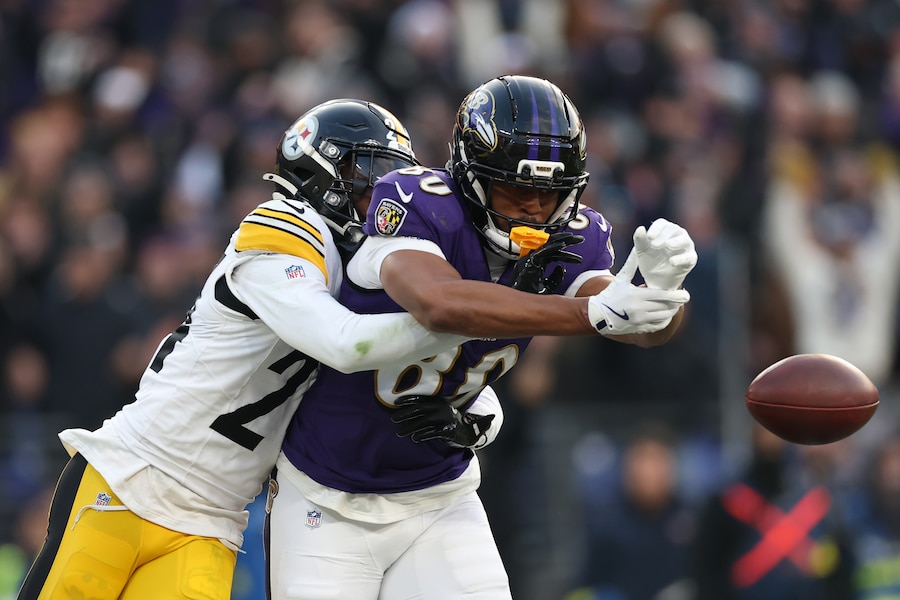
The Ravens tight end got open in the end zone, extended his arms for a catch and took two steps before Pittsburgh Steelers cornerback Joey Porter Jr. caught up and punched the ball loose.
Likely left the ball in the end zone to go celebrate with his teammates because, as quarterback Lamar Jackson said, “If you were on the field with us, I believe you would’ve thought it was a touchdown, too.”
But someone didn’t agree: an official.
Shortly after a review, the replay official reversed the call and ruled the pass — what would’ve been the go-ahead score in the fourth quarter — incomplete. It was a pivotal moment in the Ravens’ 27-22 loss to the Steelers that cost them the top spot in the AFC North.
Ravens players and coaches threw their arms up in disbelief rather than celebration when the official announced the call. There was nothing they could do, because teams can’t challenge an official review.
Instead of getting off the field, the offense had to gear up to try to get in the end zone again, so Jackson said he didn’t ask for an explanation.
“I thought it was a touchdown, but the referees made the call that they wanted; they believed that was right, so you have to go with it and you have to stay locked in,” Jackson said.
Coach John Harbaugh got one, though.
“The explanation was that a third foot didn’t get down before the ball came out,” Harbaugh said after the game.
Every player who faced a question about the play in the locker room said he thought Likely scored but that it’s not his job to make the calls.
The officials stood by their decision.
“The receiver controlled the ball in the air, had his right foot down, then his left foot down,” NFL Vice President of Instant Replay Mark Butterworth said. “The control is the first aspect of the catch. The second aspect is two feet or a body part in bounds, which he did have. Then the third step is an act common to the game and before he could get the third foot down, the ball was ripped out. Therefore, it was an incomplete pass.”
The reversal was the difference between a win and a gutting loss for the Ravens (6-7). With a touchdown, they would have gone ahead by one point with a chance to make it two or three, depending if they had gone for a 2-point conversion. Instead, the Ravens turned it over on downs shortly after Likely’s disallowed catch and did not score again.
The play was one of several controversial calls that factored into the result of the game.
On the previous drive by the Steelers (7-6), the Ravens had a chance to get the ball back in Pittsburgh territory when linebacker Teddye Buchanan appeared to intercept a batted pass.
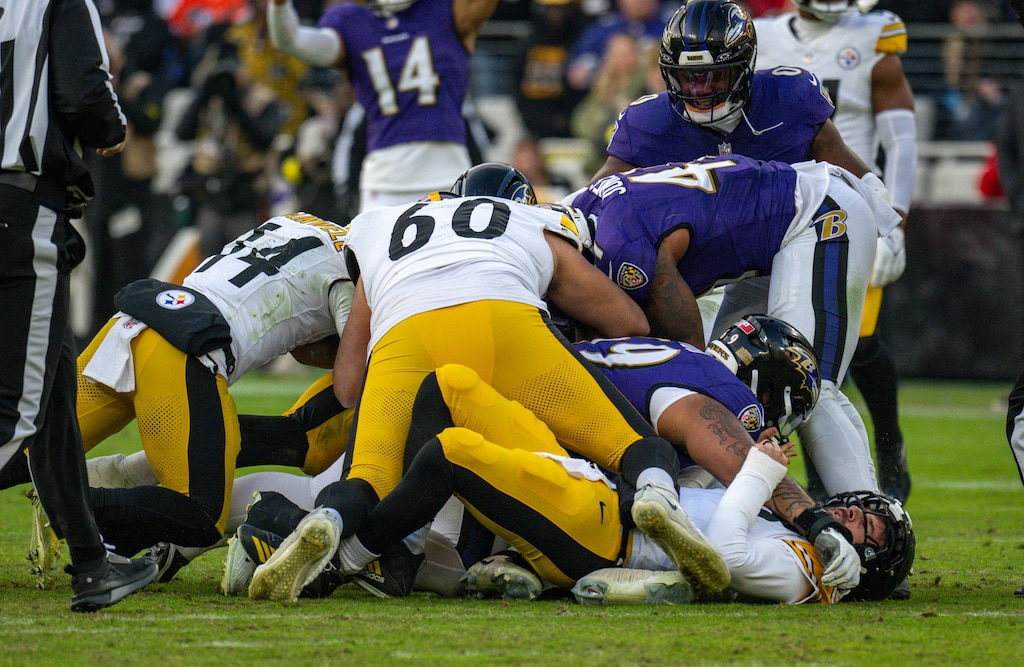
Steelers quarterback Aaron Rodgers lies at the bottom of a pile of players vying for a deflected ball late in the fourth quarter. The ruling was that Rodgers recovered his deflection and was down by contact. (Jerry Jackson/The Banner)
The officials overturned the initial call of an interception, saying Steelers quarterback Aaron Rodgers had possession of the tipped ball and was down by contact before Buchanan ripped it away.
“I think the Aaron Rodgers play — just talking about rules here — it’s not an officiating issue; it comes from New York, but when you’re making a catch, you have to survive the ground,“ Harbaugh said. ”He didn’t survive the ground. He’s not down by contact, he was catching the ball on the way down with another person, so you have to make a catch there and survive the ground. I don’t know why it was ruled the way it was on that one.”
Buchanan said, after he saw the replay, the call made sense. He was still awarded a tackle for loss and the Ravens forced a punt, but the offense did not benefit from the starting field position the interception would have provided.
Harbaugh had questions about another call that made a difference in the score. The Steelers kicked a field goal in the second quarter, but the officials called defensive lineman Travis Jones for unnecessary roughness against the long snapper.
When asked what he thought happened on the play, Jones said he didn’t think he hit the long snapper in the head or neck. His coach didn’t think so, either.
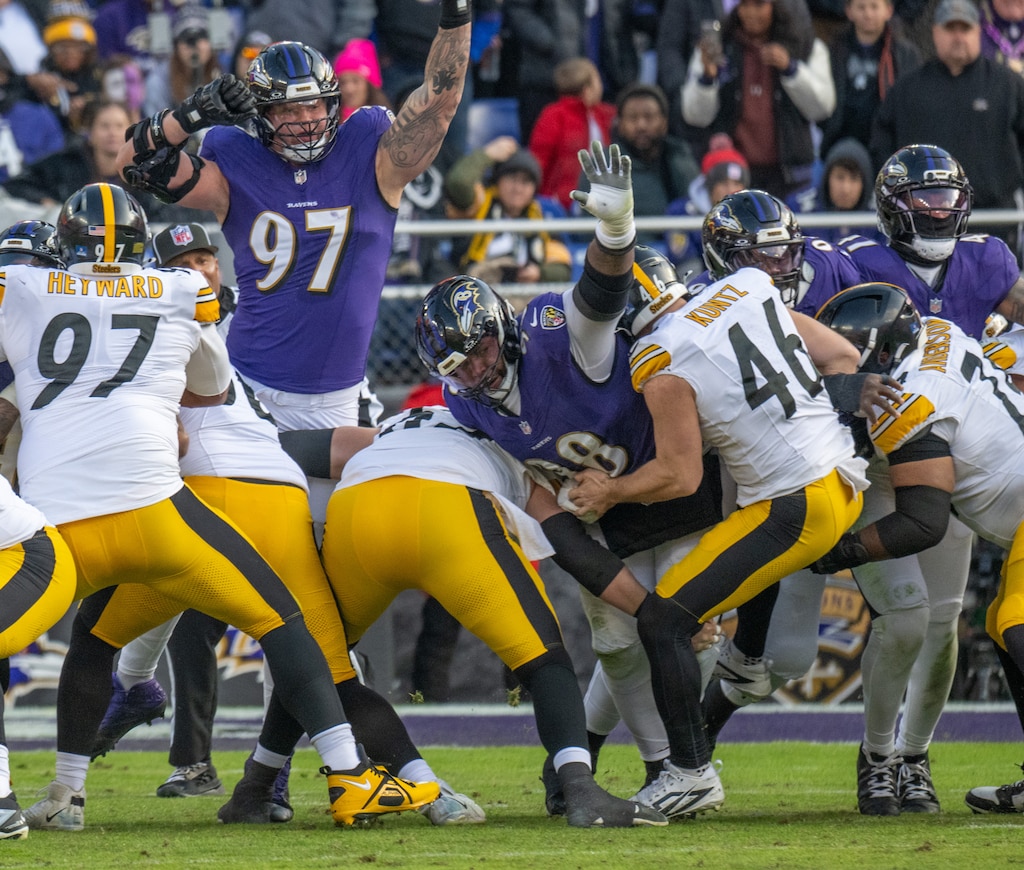
Ravens defensive tackle Travis Jones was called for unnecessary roughness for hitting Steelers long snapper Christian Kuntz during a field goal attempt in the second quarter. (Jerry Jackson/The Banner)
“I didn’t see the head and neck contact,” Harbaugh said. “That’s what I did not see, which you need to have head- and neck-area contact there, and it has to be forceful contact, not incidental contact. But I didn’t see any contact myself.”
Referee Alex Moore said it was illegal contact because the long snapper is considered a defenseless player and Jones basically “ran him over.” Jones was headed for the guard but made contact with the snapper. The officials deemed it unnecessary roughness despite his intended target.
“It does not necessarily matter who is contacted first,” Moore said. “The snapper is still by rule a defenseless player. … You cannot make any forcible contact to that player.”
However, the NFL rule book does not say that defenders cannot make contact with a defenseless player. It says they can’t make contact with the head or neck. They cannot lower their head and make contact with their helmet, and they can’t launch at the defenseless player.
It also adds that “these provisions do not prohibit incidental contact by the mask or helmet in the course of a conventional tackle or block on an opponent.”
The call turned the Steelers’ field goal into four more attempts at the red zone. It took them one try to score a touchdown.
Despite all the officiating calls that drew attention, Ravens players also took responsibility for decisions and actions that led to the loss.
“It’s just tough,” running back Derrick Henry said. “The game is in the refs’ hands, but we just have to be better. I’m focused on me being better. I feel like I needed to be better today to give us a better chance to win in the run game and do my job, but we just didn’t make the plays when it was needed.”
Despite clearly working through his own frustrations with the officiating, Harbaugh said that’s how he expects it to be.
“I tell them, basically, that we don’t make any excuses,” Harbaugh said. “We don’t point any fingers. That’s not what we do here. We never have. We walk out of here with our chest out and our chin up, and we look to the next game. We are fighting, still, for everything that we want to accomplish. So it’s tough. It’s been a tough, challenging road, for sure, but that’s where we’re at, and we will keep fighting. We believe we can get it done.”