
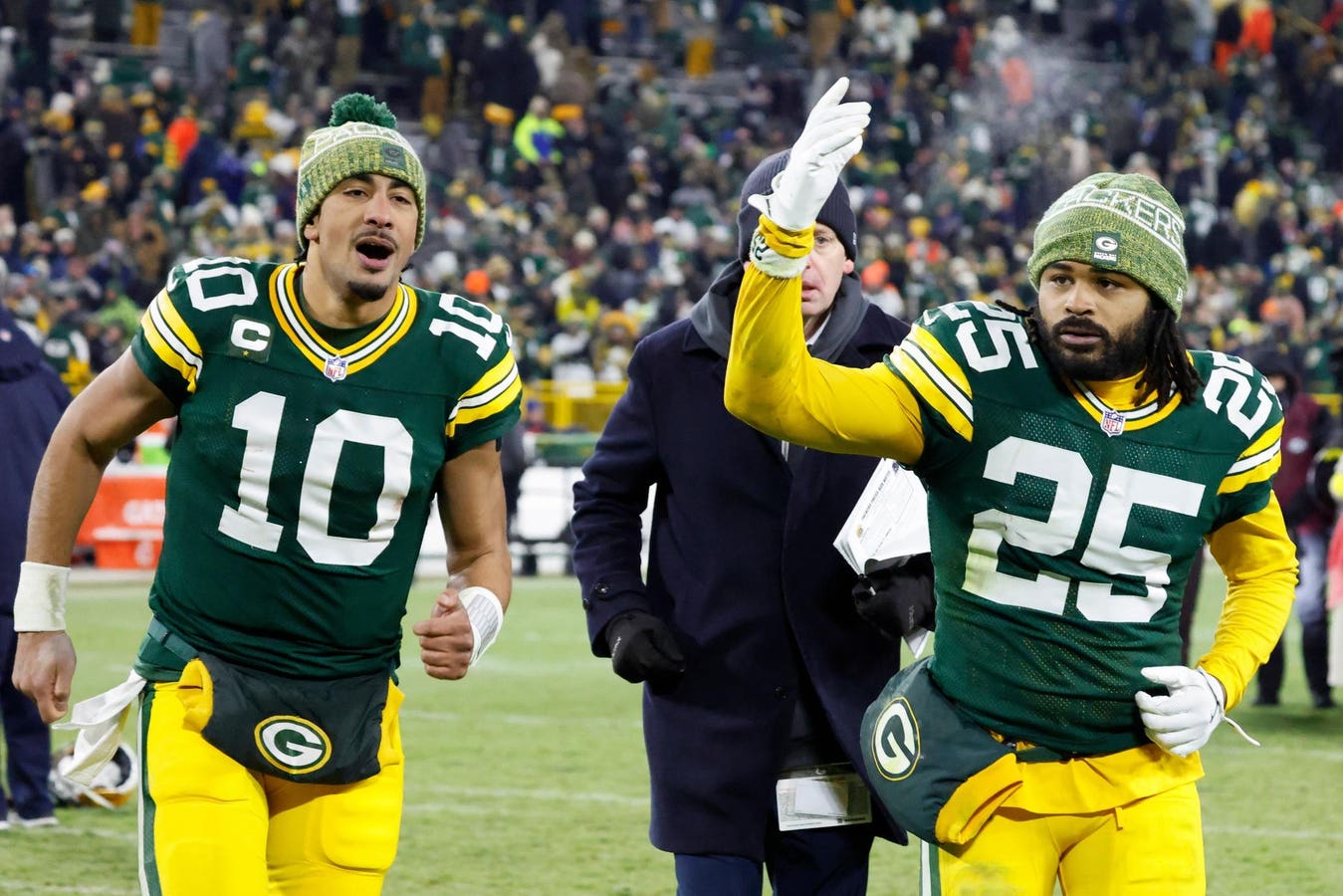
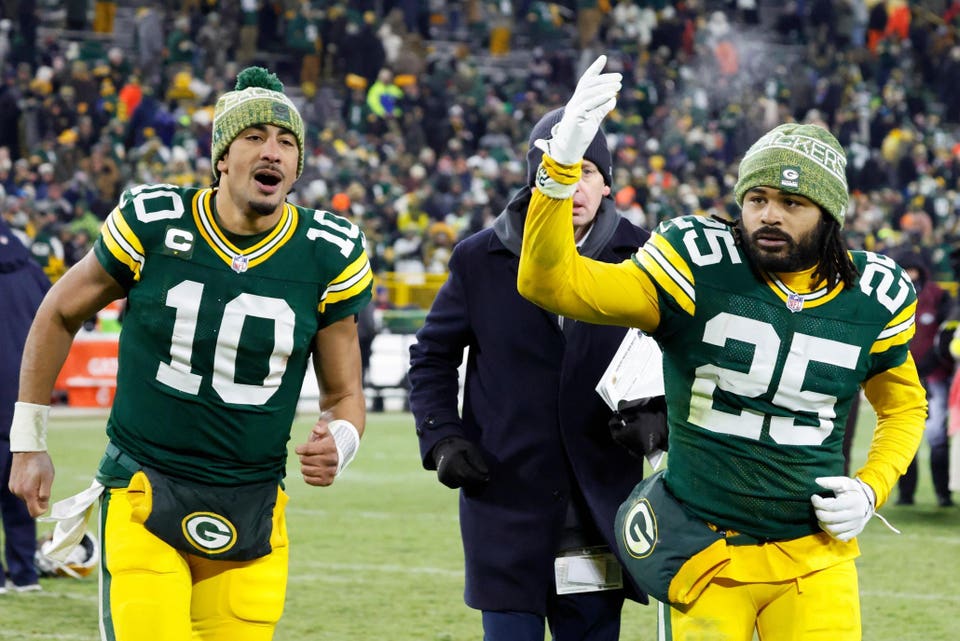
Green Bay Packers quarterback Jordan Love (10) and cornerback Keisean Nixon (25) run off the field after beating the Chicago, 28-21, Sunday.
Copyright 2025 The Associated Press. All rights reserved.
The 78,000 fans that packed Lambeau Field on a frigid Sunday evening left the historic stadium chanting, “The Bears Still Suck. The Bears Still Suck.”
That’s certainly not the case, as Chicago is arguably the most improved team in football this season.
But when it comes to playing the Green Bay Packers, one fact still holds true.
“Like everyone has said for a long time now … the Bears are our younger brother,” Green Bay defensive tackle Colby Wooden said. “Hey, that’s what the facts say.”
They sure do.
Green Bay defeated Chicago, 28-21, to take over first place in the NFC North. The Packers improved to 9-3-1, took over the division lead and are suddenly the No. 2 seed in the conference, while the Bears fell to 9-4.
In the process, Green Bay’s dominance over its bitter rival to the south continued.
Packers coach Matt LaFleur improved to 12-1 in his nearly seven years in Green Bay. The Packers are now 52-16 against the Bears since the start of the 1992 season and hold a 109-96-6 lead in the all-time series.
“It’s old fashioned hate,” Green Bay safety Javon Bullard said of facing the Bears. “I love it. I love it. And these are the type of games that nobody’s got to get you up for.
“Like, if you ain’t ready to play this game, you might as well sit your (tail) out. These are the type of games that really get you going, and credit to Chicago, they’re a hell of a team. But we’re big brother and we know that.”
That’s certainly been the case since 1992.
Chicago held an 80-57-6 lead in this magnificent rivalry that began back in 1921 when the Packers traded for Hall of Fame quarterback Brett Favre on Feb. 11, 1992. Since then, everything has gone Green Bay’s way.
Favre went 2-2 his first four games against Chicago, then led the Packers to a remarkable 10-game winning streak from 1994-’98.
Favre’s record against Chicago jumped to 20-4 by the end of the 2003 season, before the Bears went 6-2 against Green Bay in Favre’s final four seasons as a Packer. Still, Favre went 22-10 against the Bears and pulled the Packers within 90-79-6 in the overall series.
Amazingly, Aaron Rodgers took it up a notch during his 15 seasons as Green Bay’s starting quarterback.
Rodgers went a remarkable 25-5 against Chicago — including a 12-1 mark in his last 13 games against the Bears. Rodgers and the Packers knocked off Chicago in the 2010 NFC Championship Game, beat them with the division on the line in the 2013 regular season finale, and got the better of them in every situation imaginable.
“Little Green Bay was getting beat up for a long time by our foes to the South,” Rodgers said. “And then Favrey showed up and we closed the gap and then we’ve overtaken them. It’s nice.”
When the Packers won in Chicago, 24-14, in 2021, Rodgers ran towards the corner of an endzone and told Bears’ fans: “All my f—ing life, I own you. I still own you. I still own you.”
He was right.
Only two quarterbacks in NFL history have at least 25 wins against a single franchise with a better winning percentage than Rodgers did against Chicago.
• Tom Brady went 36-3 against Buffalo (.923).
• Pittsburgh’s Ben Roethlisberger was 26-3 against Cleveland (.897).
LaFleur has also been a huge player in the Packers’ dominance.
LaFleur won his first 11 games against Chicago before the Packers dropped a 24-22 home game to the Bears in the 2024 season finale.
The Packers got back on track Sunday, as current Green Bay quarterback Jordan Love improved to 4-1 against the Bears.
“The stadium was rocking,” Green Bay defensive end Micah Parsons said. “I though the atmosphere was really great. I saw a lot of Bears (fans) in there, which I’m upset about the Packers for that because that means they’re selling tickets because it’s hard to get tickets around here.
“I am upset about that, but it was a great atmosphere. I think it was pretty dope, but to me it’s just about ball and we got the win.”
Which means for now, at least, Chicago remains the little brother in this storied rivalry.