
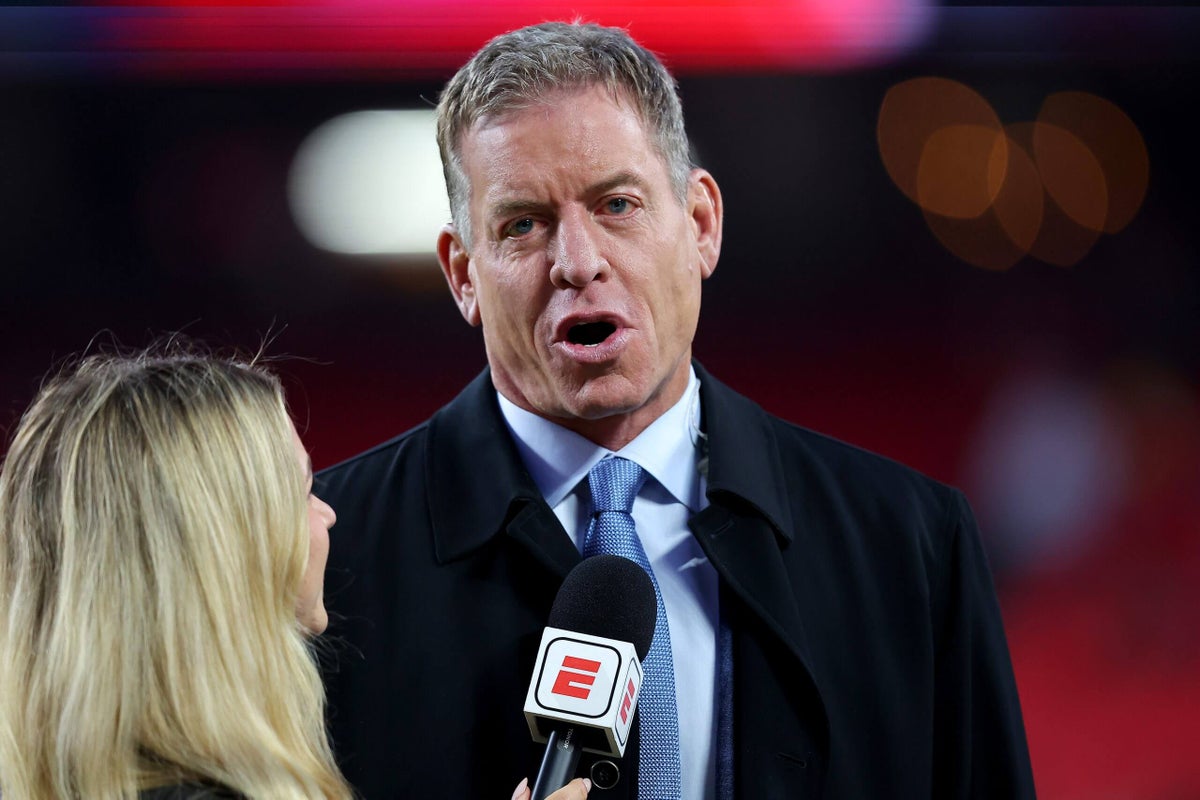
Troy Aikman has rightfully earned his reputation as someone who brings honesty to a broadcast, particularly when it comes to NFL officiating. You hear it each week when Aikman and Joe Buck call games for ESPN/ABC’s “Monday Night Football.”
“I never try to make anything personal,” Aikman said. “I do try to be honest ,and I don’t think I’m the Lone Ranger in that regard. I think everybody tries to be honest. But there are a lot of times where that’s difficult. The biggest thing that I try to do is I try to be fair. There’s that fan who’s sitting at home that has a real vested interest in their team and wants to see them win.
“With the emphasis or the popularity currently going on with sports betting, not only do they want to see their team win, but there’s money that’s exchanging hands. I keep that in mind as well because some of these calls certainly impact that. So I try to draw attention to it when I can, but not in a way that I hope is is attacking officials. It’s more about the call or what my opinion of it might be.”
Coming off of one of Aikman’s biggest games this season — the defending Super Bowl champion Eagles losing to the Chargers in L.A. in the Week 14 edition of ESPN’s “Monday Night Football — Aikman spoke to the Sports Media Podcast, where he hit on a broad number of topics including his not wanting to call games into his 70s. (He’s 59.) Below, an edited version of that conversation.
You once told me you were very close to walking away from broadcasting. In the years since, it seems like you are enjoying this more than ever. What changed?
It was the Super Bowl was in Arizona [February 3, 2008], Eli Manning hitting Plaxico Burriss for the touchdown against the Patriots. I was at the hotel after the game having dinner with my then-wife, and I just remember thinking that could be the greatest game that I will ever call. It was a tremendous Super Bowl, a great finish, a historical game. Yet after the game I felt more empty than I did at any moment in my life. I just thought, ‘Wow, if this is how I feel, maybe I’m in the wrong profession?’ I didn’t do anything to address that. I didn’t go into the offseason thinking anything differently, But I did think at that moment, maybe I should be doing something else.
With that said, it was the last time that I felt that. I don’t know why it turned, quite honestly. I went back the next year, I broadcasted, had a great time. Then every year I’ve enjoyed it more and more. At some point I’ll walk away. Hopefully, it’s my decision whenever that time comes. But for right now, I’m really enjoying my time at ESPN. I love working with Joe [Buck]. I love the people I work with. It’s been a lot of fun. I don’t see the end coming anytime soon. But obviously at my age and as long as I’ve been doing it, there will be an end at some point.
Could you see yourself doing this in your 70s, health permitting?
No. I’m a little careful about saying that because I know there are executives that listen to your podcast, and I’d hate for them to think that okay, well, he’s here for X number of years. But as I kind of map out my life and what I have left of it, I do not see myself doing this at 70 years old. Not because I couldn’t do it, not because I wouldn’t still be enjoying it. But I have not had falls off since I was a kid. There’s just things that I want to be able to go do and things I want to see before my time on earth is done. And I want to be able to do it in the fall (laughs).
Why do you think you and Joe have seen a more positive response to your work in recent years, which clearly seems to the be the case?
Really since going to ESPN, I feel like maybe we’ve been recognized more than we had been prior to that. I think that’s a fair evaluation. But I was proud of the work we did in the years prior to that. The interesting thing from my perspective about broadcasting is it is all about opinion. Whatever one person likes is their opinion. If they like this broadcast team, that’s great. If someone else likes this other broadcast team, that’s great too. Nobody’s right, nobody’s wrong. Because of that, there probably is some frustration on everyone’s part that’s in this profession.
So you just keep your head down and keep doing your job as best you can. You don’t pay a whole lot of attention to it. Whereas in sports, there’s a scoreboard. You have an idea as to who’s doing what and who’s doing it well and who’s doing it the way it needs to be done.
I’m thankful for whatever accolades or whatever positivity people have about our team, but it’s kind where it ends. I know when I feel like I’ve been good or when I feel like man, that wasn’t to the level that I expect. It’s more of a personal scoreboard for me than what somebody might say.
How would you define culture at ESPN versus Fox Sports’ culture?
Fox was really more of a mom-and-pop operation. [Former Fox Sports Media Group Chairman & CEO] David Hill and [former vice chairman of Fox Sports Media Group] Ed Goren, they were boots on the ground from Day One. They were the decision-makers. Whenever talent or anyone had an issue or a question or a suggestion, you went directly to David Hill or Ed Goren. Then after they stepped down, you had [CEO of Fox Sports] Eric Shanks and [President of Production and Operations and Executive Producer of Fox Sports] Brad Zager, and they became those people.
So the culture at Fox remained consistent because Shanks had been there with David Hill and Ed Goren and so had Brad Zager. They understood how it had been done, and they continued with that. Even though they’ve added more properties since then, it still has remained this mom-and-pop type operation. ESPN is a conglomerate, as you know. It’s like the U.S. government (laughs). There are people on top of people. There’s so much content, and everything that goes into that here. ESPN is far more corporate than what I experienced at Fox Sports.
How does someone who has been broadcasting as many years as you have get better at the job?
Well, the game’s always changing. It’s a far different game today than the one I played and far different today than the one that was played 10 years ago. So it’s keeping up with the trends. Analytics has become a huge part of our game.
I remember the first time we called a game years ago, there was a team down 14-0. They scored a touchdown, and they were going for two. I remember on the air saying, “This makes no sense to me.” I have no idea what this team is doing right now. That was my first introduction into analytics. All of a sudden everybody’s saying here’s why they are doing that. I realized right then that if I’m the voice for the fan at home that’s watching the game, I can’t simply say this makes no sense. I may not agree with it, but I’ve at least got to be able to explain why the coach is doing what he’s doing. Then I can go into, yeah, this is why I don’t agree with it.
In off-seasons past, I’d reach out to [former NFL head coach] Ron Rivera. I’d say, ‘Hey Ron, I said, I’ve been away from the game for a while, even though I’m still calling the game. I’d love to come to your OTAs for three days, sit in on the meetings. I won’t use anything publicly. It’ll just be for my own consumption, but it’ll give me a chance to kind of sit in the meetings, hear what’s being coached, what’s being taught to the players. It will help me as a broadcaster. He said, Great, come on down. The following year I spent some time with Sean McVay and the Rams. I call coaches in the offseason and say, hey, explain this to me or what are you guys doing?
ESPN’s first-ever Super Bowl is coming in February 2027. How much are the on-air people such as yourself thinking about it at this time or is this more of a production-focused thing right now?
This is only on the production side right now. Our producer and director were at the Super Bowl a year ago and they’ll be at the Super Bowl this year during the week leading up to it. Joe and I obviously were a part of the rotation every three years. It’s something we grew accustomed to. Now when we call next year’s Super Bowl, it will have been eight years or so. It’ll be much different.
But I think one of the great things about the way we approached the Super Bowl at Fox, at least from within our game crew, was we treated it just like any other game. It’s easy to say to that because you know that it’s not. The broadcast is totally different. The buildup to the Super Bowl for those two weeks is huge. Obviously, you want it to be your best broadcast.
With all that said, we really did approach it that way. Our meeting the night before the game was just like it was in Week 3 of the regular season. That really has been kind of my message to our crew even though we are still a full year away. Whatever is happening beyond our game crew, great. Let ESPN, let Disney, let ABC, all the people involved, let them build it up as big as they want it to be. But for us, we gotta have trust and confidence in what we do as a crew to prepare as we have each and every week.
The trick is is not getting psyched out and and believing it to be something bigger than what it is, because then you just paralyze yourself.
On a totally different topic: How do you view Lane Kiffin moving from Ole Miss to LSU?
College football has become the Wild West, as everybody knows. Forget about Lane Kiffin for a minute, but starting with NIL, there just has been no guardrails. I’m on the National Football Foundation Board, so I hear firsthand from a lot of the commissioners and athletic directors and the people involved in all of that. It’s gotta get cleaned up, first and foremost.
I was a transfer. I went from Oklahoma to UCLA, and I’ve always felt that if a coach is able to pick up and leave, that a player should have the same opportunity if a coach leaves. What’s happened obviously over the years since I got out of college football is that in recent years with NIL, there’s been no accountability on the players. So the players pick up and now they’re leaving all the time whereas before it was typically the coach. The player used to have to sit out a year. Now, the players can up and go regardless of whether or not they’ve been paid. It’s every man for himself.
I think it has created somewhat of a culture with that mentality to where the idea of team, whether it’s from the staff or from the players, it just seems like it’s a harder thing to put together.
Lane Kiffin’s motivation? Is it his thoughts that it’s a better opportunity for him at LSU? Possibly. Is it money? Possibly. Is it lifestyle? Possibly. I can’t answer any of those questions. But whatever his motivation is, he feels like LSU is the right place for him. So I don’t fault him for that at all. I know there’s always hard feelings. Ole Miss did not want to lose Lane Kiffin. Once he made the decision to leave, now he’s a pariah. Let’s get this guy just as far away from us as we can. I understand that as well. Everybody gets a little bit jaded.
Where I’m at is I think there’s gotta be some leadership at the very top that kind of cleans all of this up. Starting with players that accept money, there’s gotta be some accountability and responsibility on their behalf to have to stick with a program. I gave money to a kid. I won’t mention who. I’ve done it one time at UCLA. Never met the young man. He was there a year, he left after the year. I wrote a sizable check, and he went to another school. I didn’t even get so much as a thank you note. It’s one of those deals to where I’m done with NIL. I mean, I wanna see UCLA be successful, but I’m done with it.
A couple of months ago Michael Jordan mentioned on NBC he had not picked up a ball in many years and felt pressure on making a free throw in front of a big group of people. I want to ask a similar question to you. If you went out on a field today, realistically, how accurate could you throw the football?
Right now I’ve got something going on with my shoulder. But I’ll say this: I’ve got a place in Santa Barbara. I go to the beach in the summertime, and there’s always some seven- or eight-year-old kids on the beach. Their parents will tell them, hey that guy over there used to play in the NFL for the Dallas Cowboys. So the kids want me to throw the ball to them and of course I will.
But kids also want to run 60 yards down the beach and they want me to hit ’em in stride. I gotta wave ’em back in (laughs). I can’t throw it that far.
But I’ve always had the ability to to throw a ball, whether it’s a baseball or football, or shooting a basketball. I’ve always had an ability to put it where I wanted to put it. That hasn’t changed. I think my accuracy would still be on target. It wouldn’t get there as fast and I wouldn’t be able to be be as accurate as far down the field. But otherwise, I think I could pretty much do it.