
I was lucky enough to be in attendance for the Green Bay Packers’ tremendous win over the Chicago Bears on Sunday (my annual trip up with a few of my brothers), which means two things:
I’m still very much riding a high on this incredible win.Needing to travel back to Central Kentucky afterwards means I’m shorter on time for writing than I am in a typical week.
With point #2 in mind, let’s get to it. In this space, we take a look at the Packers passing game from the previous week.

The Packers have not been a team that has run a ton of plays on offense this season. They’ve been a good offense, and have been scoring at a solid clip on a per-drive basis: per FTN, the Packers score 2.68 points per drive, the 5th-best mark in the league. The problem is that they don’t get many drives. Their 120 drives is tied for the fewest drives in the league this season. Part of that is their average time per drive (6th longest average time of offensive drive), but the other part of it is their defense. The Packers have a good defense, but it’s also very much a bend-but-don’t-break defense. As a result, they are allowing the longest average drives on defense.
Combine those two factors — 6th longest average drive on offense and longest average drive on defense — and you have a compressed kind of game. The offense needs to be efficient and explosive, because they don’t get many chances.
That was fully on display here. The Packers only ran 51 plays, tied for their second fewest number of plays all season. They also turned in their 3rd-lowest pass rate of the season (51%). That’s a long way of saying that Jordan Love may not have had a ton of opportunities to impact this game, but he made the most of those opportunities. He accessed all areas of the field and was efficient in doing it. Love generated 6 explosive plays on his 26 dropbacks, good for an explosive play rate of 23.1%, his second highest rate of the year (just behind the 23.5% mark against the Commanders).
Once again, Love absolutely shredded the Bears defense when they blitzed him. Per NFL Pro, the Bears blitzed Love on 11 of his 26 dropbacks (42.3%). On those dropbacks, Love was 8/11 (72.7%) for 126 yards (11.5 YPA) and 2 TDs. That was good for a QB Rating of 150.0 and an EPA Per Play of +1.01. Just to hammer that point home, every time the Bears blitzed the Packers when passing, Love generated 1.01 points on that play.
Love has been good against the blitz all season, which we talked about in the game preview. That held true here. When blitzing, the Bears only generated pressure on 18.2% of the dropbacks, despite the fact that Love’s average time to throw was 2.75 seconds. They were blitzing, but the offensive line did a good job of picking up the blitzes and giving Love time to find the best option. And, with an ADOT (Average Depth of Target) of 14.6 yards, he was absolutely looking to push the ball downfield when blitzed.
We looked at a couple of those big plays the other day – which took the form of touchdown passes to Christian Watson – but we’ll look at another explosive play against the blitz in this space before we get out of here.
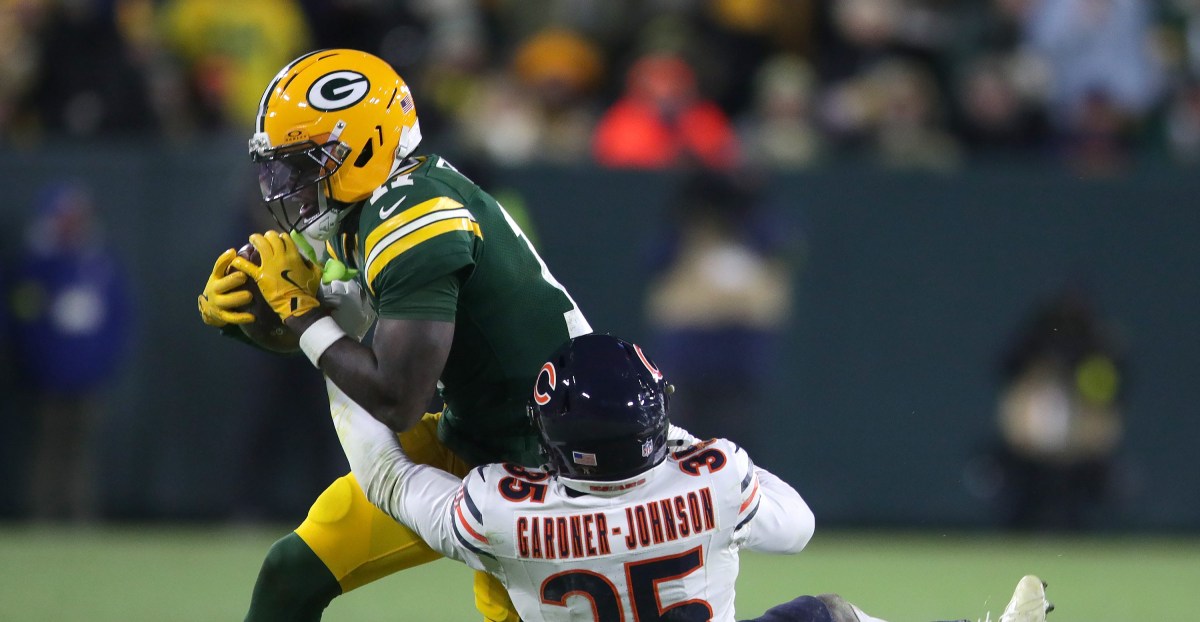
Jayden Reed made his return in this game and his impact was huge. He didn’t put put a gaudy stat line, with 4 catches for 31 yards, along with 2 carries for 22 yards on 25 snaps, but he helped open things up all over the field. Today, we’re taking a look at Reed’s longest reception, which came during a huge drive.
After being down by 10 in the 3rd quarter, the Bears had just scored a touchdown to tie the game with 8:00 remaining in the game. The Packers kicked off their next drive with an 11 yard run by Josh Jacobs. That found them facing 1st & 10 with 7:18 left in the game, on their own 46 yard line. They went with an old staple, and something that Reed has had a ton of success with over the years: Cross-Country Dagger.
The Packers roll with a personnel grouping of 610, and it’s the first time they’ve shown this all season. Typically, personnel grouping is noted with two digits: the first number would indicate the number of RBs on the field while the second number would indicate the number of TEs. Since there are 5 possible skill position players on the field, you can figure out the number of WRs based on that. So, 11 personnel would be 1 RB, 1 TE, 3 WR. The “6” in front indicates an additional offensive lineman. So 610 would be a 6th offensive lineman (Darian Kinnard, in this case), 1 RB, 0 TE and 3 WRs. The Packers have been leaning more into 6 OL packages over the last few weeks, but this is the first time we’ve seen 610. It’s a very exciting time for me and, hopefully, you.
Cross-Country Dagger is a concept designed to attack the middle of the field. They ran some version of this concept 4 times against the Bears (their most-used passing concept of the day) for an average gain of 15.8 yards and a 50% success rate. Given the weaknesses for the Bears at the second level, this was a concept I thought the Packers could have success with this week, and they did exactly that.
The Packers motion Christian Watson [9] under the formation as an insert blocker before the snap, aligning under Kinnard (the 6th OL) and the right tackle. That gives the Packers a heavy run look on the right and a stack of Jayden Reed [11] and Romeo Doubs [87] on the left. Reed is running a crossing route from the point while Doubs is running an in-cutting route behind him. The read is Reed-to-Doubs. The idea is that, if Reed isn’t open, his route will open room in the middle for Doubs.
The Bears are showing a lot of bodies at the line. When Watson goes in motion, he is followed by a defender, signaling that this is likely man coverage. This is an under center, play action concept, so you’re wanting to draw the linebackers up to the line to help clear the middle.
The Bears send 6 men on the rush, giving them man-to-man on the back end with a single-high safety. Reed has inside leverage on CJ Gardner-Johnson [35] before the snap, and a little jab-step release ensures that he keeps that post-snap. Reed is able to gain immediate inside leverage on the release, and the break at the top of the route gives him a little extra separation.
Love checks the line to make sure no one is dropping underneath, then layers a beautiful pass to Reed, away from Gardner-Johnson.
Reed hauls in the catch for an 18 yard gain.
The Packers would score a touchdown 6 plays later to take a 28-21 lead with 3:32 remaining, and Keisean Nixon would seal the game a few minutes later with a heady play.
Albums listened to: Hum – Inlet; Beach Bunny – Tunnel Vision; Veruca Salt – American Thighs; Richard Edwards – The Soft Ache and the Moon