
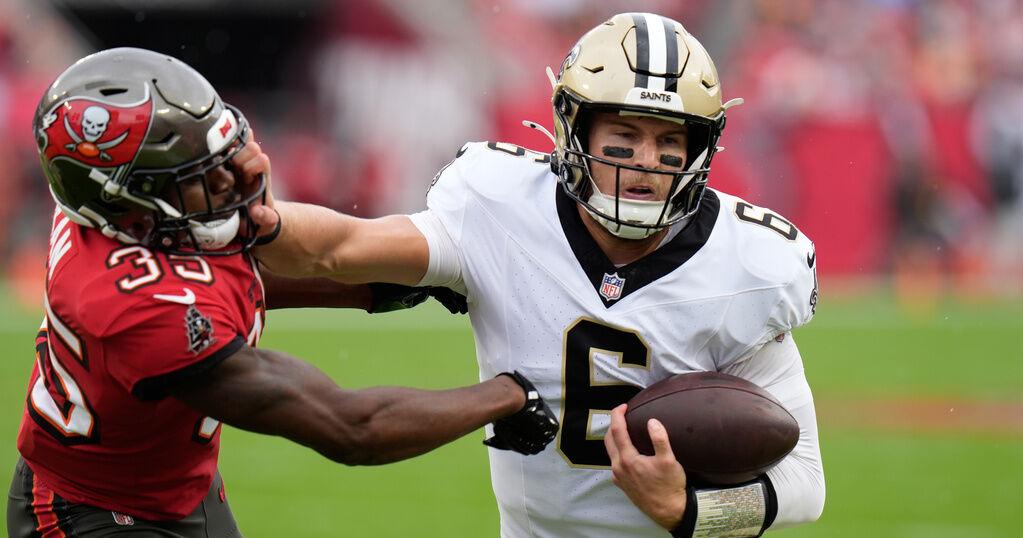
Nearly every time Tyler Shough went to hand off the ball in Sunday’s win over the Tampa Bay Buccaneers, the defense in front of him would pause for a split second to see what the New Orleans Saints quarterback was going to do.
Was it truly a simple handoff? Would the rookie take it on his own?
The Saints used the hesitation to their advantage.
“I thought Tyler having that ability to run the football obviously played a factor into it,” coach Kellen Moore said.
“It,” in this case, was a Saints run game that had one of its better outings of the season, a much-needed performance for a group that was held to under 90 yards in seven of its previous eight games before beating its NFC South rival.
Shough was a “big part” of why the Saints finished with 139 yards rushing on 32 attempts, Moore said. Against Tampa Bay, the 26-year-old rookie racked up 58 yards on five attempts before his two kneel downs. He also ran for two touchdowns. Beyond the numbers, the mere threat of Shough helped unlock the team’s rushing attack.
The Saints, for instance, used an 11-yard gain from Shough on their first drive to set up their first touchdown of the afternoon. Just one play after the rookie quarterback’s keeper on a run-pass option, New Orleans ran the same concept again — but handed it off to rookie running back Devin Neal instead for the touchdown.
Then in the third quarter, Shough took off for a 34-yard touchdown — again on an RPO where he ran to his left.
Keeping Shough involved may be a way to spark a run game that hasn’t had a ton of success this season.
“(There’s an) element of keeping them honest,” Shough said. “Being able to have the defense on their toes, not knowing who has the ball, and I’ve got to continue to do my job of that on certain plays. That’s an element I feel like I can continue to grow at and be good at.”
Running the football always has been something that Shough insisted he could do. It was an element of his game at Oregon and Texas Tech, two colleges that relied on designed quarterback runs. In 2020 for Oregon and then in 2022 for Texas Tech, Shough had more than 200 yards rushing in each season on more than 65 attempts.
But then Shough’s injury history — two broken collarbones and a fractured leg — caused a shift. When Shough transferred to Louisville in 2024 for his final collegiate season, the Cardinals placed less of an emphasis on his legs. This was done partly to keep him healthy, but Louisville also ran a pro-style offense that asked Shough to stay in the pocket.
The Saints aren’t asking Shough to run at the same rate he did at his first two stops in college, but they aren’t afraid to use him, either.
The New Orleans coaching staff, like Shough, believes his injuries were more of a byproduct of unfortunate circumstances than a player prone to getting hurt. The quarterback’s broken collarbone in 2021, for instance, came when Shough landed awkwardly on a dive to the end zone rather than a defender crushing him on the run. His 2023 season-ending leg injury occurred on a hip-drop tackle in the pocket.
“There’s still times when it’s advantageous,” Moore said earlier this season. “Part of the component is (you’ve got to) pick and choose your opportunities.”
That decision extends to quarterbacks. The coach said signal-callers have to be smart about when to fight for extra yards and when to get out of bounds.
Not counting kneel downs, the rookie has 23 rushing attempts in seven games. Nearly half — 13 — have come on either RPOs or designed runs. The other 10 have come on Shough scrambling, which has been an effective weapon (including his 18-yard, go-ahead score against Tampa Bay).
Shough doesn’t seem to be putting himself in any extra danger when he runs. He slides, gets out of bounds and gives himself up when appropriate.
On Wednesday, Shough recalled an instance when he opted to avoid Bucs safety Antoine Winfield rather than try to “truck him” for an additional few yards.
“I think four years ago, I probably would’ve tried something stupid and tried to hurdle or truck him or whatever, and I’ve gotten hurt,” Shough said. “But you’re going to try and get the first down, and I feel like I’ve had the opportunity to learn from that where … you’re not playing scared, but you’re not playing dumb, either.”
A quarterback’s mobility always has been an important part of Moore’s offense.
As an offensive coordinator, Moore called plays for Dak Prescott, Justin Herbert and Jalen Hurts — all threats to take off and extend plays. Before Shough took over for the Saints this season, Spencer Rattler also used his legs a fair amount. Moore liked to say that the second-year quarterback ran the “fakest 4.9 ever.”
But Shough’s speed has been forcing defenses to account for him. According to Next Gen Stats, the second-round pick has the second-most carries (20) and third-most rushing yards (95) for his position over the last three games.
Shough, who ran a 4.63 40-yard dash at the combine, clocked 19.43 mph on his 34-yard touchdown run.
“Everyone kind of counts out his wheels, but … that’s another part of his game that’s very underrated,” Neal said of Shough. “People are, hopefully, starting to notice.”