
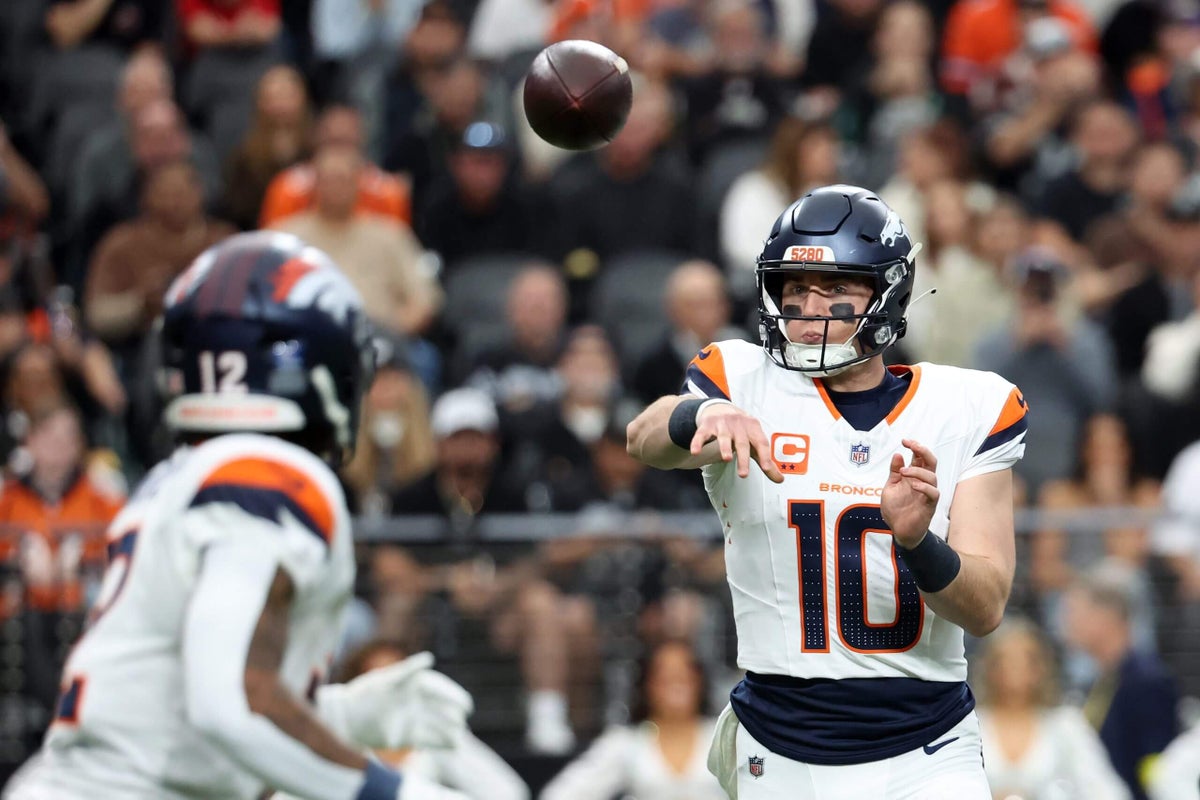
ENGLEWOOD, Colo. — Denver Broncos quarterback Bo Nix completed 31 throws in last week’s 24-17 victory against the Las Vegas Raiders without registering a single explosive pass play. His longest pass, a 15-yard strike to wide receiver Courtland Sutton on Denver’s opening drive, fell short of the explosive category by 1 yard, and Nix just kept investing in small profits from there as Denver coasted to its 10th straight win of the season.
He didn’t throw a touchdown pass. He didn’t blaze through the Las Vegas defense with a field-flipping scramble. He just made the right play, over and over. So when he was asked afterward about having “managed” the Broncos’ offense on a day when it produced three drives of at least 10 plays and 8 minutes, 54 seconds of possession time, Nix didn’t exactly view it as a backhanded compliment.
“It’s become a negative thing and I don’t know why,” the second-year quarterback said of the “game manager” label. “The best quarterbacks of all time manage the game at a high level. I think the biggest difference is, when the time comes down to it, they just find ways to make either an explosive or make another play. So, all the good ones, all the great ones that win, they manage the game at a high level. Some are just more flashy, and I think they don’t have that context or that tag. But it really doesn’t matter because your job as a quarterback: execute the play that’s called, get your team in the end zone and, at the end of the day, have more points than the other team and find a way to win. That’s what we’re managing to do. Ten (consecutive) wins is a long time (to win).”
Nix has completed 70 percent of his passes in his past three games. He has just one interception in that span. He has exhibited a level of patience that has helped the Broncos rank third in EPA (expected points added) per offensive snap since Week 11.
“I feel like I’ve seen the field very well the last three games,” Nix said. “Just understood where the outlets are, understood where the ball needs to go.”
It all represents a blueprint for how Nix must guide Denver’s offense Sunday against a Green Bay Packers defense that guards against explosive plays nearly as well as the Broncos do. Denver ranks first in opponent explosive play percentage (7.1) and Green Bay ranks third (8.5 percent), according to TruMedia. It’s one of the biggest reasons both teams enter this massive matchup at Empower Field at Mile High firmly in the hunt to earn the No. 1 seed in their respective conferences.
Nix said after Sunday’s game that the Broncos still have to find a way to create more explosive plays in the pass game, calling it a “balance” the unit is still trying to strike. But Denver’s offense just produced its most efficient three-game stretch, in part, because it isn’t depending on shot plays to rescue the unit from the long stretches of three-and-outs that popped up at times earlier this season.
Nix, across his last three games, has attempted only 10 passes of 20 or more air yards, according to TruMedia. It’s a noticeable drop from his first 10 games, when his 48 deep-ball attempts trailed only Rams quarterback Matthew Stafford (49). The inefficiency in the deep passing game contributed to Denver’s clunky rhythm at times. Nix completed just 29.2 percent of those during the first 10 games, which ranked 27th out of 33 qualified quarterbacks. He’s connected on 5-of-10 deep chances in the smaller sample size of the past three weeks, but he’s also moved Denver frequently into different plays when the offense doesn’t get the “money look,” as Sutton calls it, from the defense against the original call.
“The understanding of what to expect each week has been something that has allowed us to be able to catch a rhythm,” Sutton said. “It takes time. We get asked from training camp to now, ‘Where do you guys feel like we are?’ For myself, I can say there is always room for improvement and I still believe that, but the more reps you get with your personnel and the more understanding you get with the offense and what you have, it helps you to be able to play with a sense of confidence that you know what you want to get to. You know what plays work best with what works on the field.”
Improved efficiency for Denver’s offense has gone beyond Nix’s accuracy in the past three weeks. The Broncos have only been called for six accepted penalties on offense since their Week 11 win against the Kansas City Chiefs. The unit has been flagged only three times in the last two games combined. It is a marked difference from the first 10 weeks of the season, when the Broncos were 8-2 despite committing 40 penalties for 314 yards offensively, the latter mark being the second-highest total in the NFL during that span.
“It helps when it comes to third down,” Broncos coach Sean Payton said. “You’re in a much more manageable position. The minute you get a holding call, if you look at the statistics of converting on that drive, you really paint yourself in a bit of a corner. That’s the No. 1 thing that comes to mind.”
A cleaner operation has indeed led to more tenable third-down opportunities for Denver of late. The Broncos had an average distance to gain on third down of 7.5 yards, which ranked 25th in the NFL. That has ticked down to 6.4 yards needed per third-down attempt since Week 11, which ranks 16th. It’s part of why the Broncos have been able to grind out longer drives in recent weeks.
But perhaps the most noticeable difference has been Nix’s ability to get the Broncos into the right play and then sticking with the small profits. It will be pivotal against a Green Bay defense that isn’t giving up many big gains this season. The Packers have given up the second-fewest explosive pass plays in the NFL this season (48), but Nix has shown the past three weeks he’s comfortable taking a different path to victory.
“Honestly, you go into a game and you hope all of (the play calls) can be explosives,” Nix said. “Sometimes you don’t get the look and you have to minimize the damage. Sometimes you ride it out, hit the check down, run, scramble, find a way out of it. If they cover it up, don’t make it worse.”