
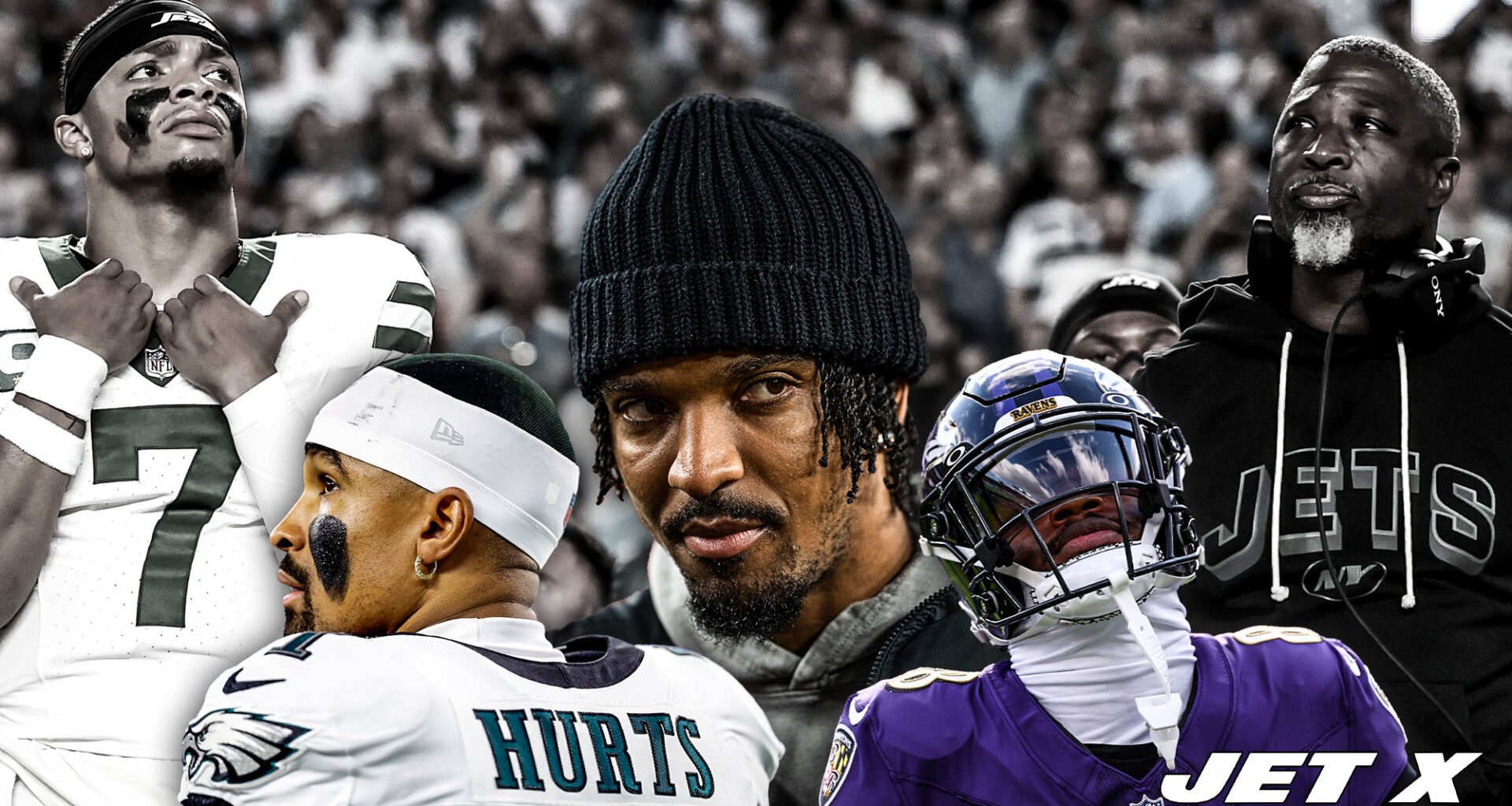
When Aaron Glenn made Justin Fields the New York Jets’ starting quarterback last spring, everybody understood the deal. Regardless of one’s particular view of Fields as a quarterback, in a vacuum, at the very least, Glenn’s vision was widely recognized.
The newly minted defensive-minded head coach of the Jets sought to ride the NFL’s quarterback-rushing evolution.
With Week 15 on the horizon, it’s more than safe to say things haven’t exactly worked according to plan. Fields is still sidelined via injury, as is veteran backup quarterback Tyrod Taylor, which leaves undrafted free agent Brady Cook as the QB1 with the Jacksonville Jaguars on the mind.
Analyzing how and why it didn’t work out is undoubtedly a worthwhile discussion. To delve into the topic appropriately, we must first recognize what’s happening beyond the small world fans label as 1 Jets Drive.
First and foremost, we must realize that Aaron Glenn chose a particularly unique offense in the very season this type experienced its most backbreaking decline.
“Only the Jets,” a sizeable part of the fanbase just silently uttered.
Either way, the decision looks terrible
Think about it …
On the heels of the Aaron Rodgers experience—which undoubtedly featured an immobile quarterback whose pocket needs are more fragile than the average modern player—the Jets pivoted in an 180-degree direction. Justin Fields isn’t and has never been simply a dual-threat quarterback who uses his legs as one of many ingredients; he’s a player who wholly relies on his legs for production.
If his legs aren’t driving the offensive bus, life becomes extremely difficult for everybody, including the quarterback himself.
Although Glenn’s prior comments about not wanting to risk Fields by running too much are troubling, it’s indeed irrelevant how far they pushed the quarterback-rushing idea this season.
If they intentionally let up with zone reads and RPOs with an eye on the quarterback’s health, well … that’s a brutally unaware strategy (when understanding who Fields is as a quarterback). If they pushed the envelope as far as it could possibly go, well, that purely means they chose this unique offense in the very same season it all fell apart.
The QB-rushing evolution crumbled
Whether it’s the guy leading the Baltimore Ravens, Washington Commanders, or defending champion Philadelphia Eagles, things haven’t exactly lined up with previous seasons.
After 14 weeks of action, Buffalo Bills’ Josh Allen currently leads all quarterbacks in rushing with 487 yards. Los Angeles Chargers quarterback Justin Herbert is in the two-hole with 419 yards, while Kansas City Chiefs legend Patrick Mahomes is third (407).
The man of the hour, Justin Fields, is still fourth, with 383 rushing yards—despite having played just nine games (not all of which were start-to-finish jobs).
Remarkably, all of this information contrasts with the seasons of recent history.
Lamar Jackson, the perennial leader in this category, has been a shell of his former self this season. The man who led this category with 915 yards in 2024 has rushed for only 307 yards in 2025.
Sure, injury limited him to just 10 games played, but his 30.7 rush yards per game is a far cry from his career 57.3 per-game average.
A similar story plagues sophomore Jayden Daniels, whose injury devastation this season currently puts his stat line at 278 rushing yards in 7 games. Daniels’s average-per-game mark of 39.7 falls well short of his 52.4 average in his league-storming rookie campaign.
Then there’s the defending champs. In 13 games, Jalen Hurts has compiled 337 ground yards on 88 attempts. His 3.8 yards-per-carry falls well short of his career 4.6 mark, and his 25.9 rushing yards per game is laughable compared to his 42.0 mark from last year’s championship season.
Jackson, Daniels, and Hurts finished one, two, and three in quarterback rushing last year. Baltimore, Philadelphia, and Washington—three of the NFL’s final eight tournament teams as well—finished one, two, and three in team rushing last year.
To say that trend didn’t hold in 2025 would be the understatement of the century.
QB rushing is only complementary
The first essential note is as follows: Quarterback rushing production was never the critical item when evaluating the modern NFL. It’s only complementary in nature.
Driving the sport’s genuine change is the increase in passing efficiency, thanks to the rule changes (encouraging offense and eliminating head injuries), which is reflected in completion percentage and yards per completion.
For the fourth-straight season (at least through the first 14 weeks), the league average for yards per completion ties the record low:
2025: 10.9 yards per completion
2024: 10.9 yards per completion
2023: 10.9 yards per completion
2022: 10.9 yards per completion
2021: 11.0 yards per completion
The highest average came all the way back in 1947, when 16.7 yards per completion was the mark, whereas the early 1970s hovered around 13.2. For further context, the number was 11.5 in 2010 when Rex Ryan was roaming the Jets’ sideline—and make no mistake about the fact that 11.5 is incredibly different than 10.9.
In fact, the dataset suggests that Bill Walsh’s West Coast offense was the first significant change to the way the game is played. The league’s policing of defensive holding and illegal contact, coupled with the rule changes aimed at player safety, has put us in this spot.
So far this season, quarterbacks have rushed for approximately 7,441 yards, which is on pace for 9,731 yards over the course of the entire regular season. That pales in comparison to the monstrous 11,015 number from 2024, or even 10,231 from 2022.
It does, however, align with the 9,840 quarterback rushing yards in 2023, which is interesting. Plus, the percentage of rushing yards accounted for by the quarterback position has remained pretty consistent throughout the years (at least once this evolution showed face):
SeasonQB YdsTotal Rush Yds% of Rushing by QBs
20188,08658,593~13.8%
20196,62157,803~11.5%
20209,43560,868~15.5%
20219,43162,683~15.0%
202210,23165,892~15.5%
20239,84061,287~16.1%
202411,03565,174~16.9%
The trend holds pretty consistently. That is until … this season.
Considering the league’s rushing total stands at 48,328, the quarterback-rushing share is a paltry 15.4%, a steep decline from the 2024 high-water mark of 16.9%.
Granted, 15.4% is still in the neighborhood of the last half-decade, but could it be the first sign of many to come? Could this playstyle, which Lamar Jackson began under John Harbaugh’s vision pre-2020, have already seen its apex?
Is it only now commencing its subtle decline?
So, what happened?
Perhaps, perhaps not. Maybe the quarterback-rushing evolution is now on the way down. Maybe not.
At the very least, the familiar names that have littered the leaderboard disappeared this season. Then again, it is just one season, so perhaps it’s just an injury-induced outlier.
Either way, the Jets chose a unique offense that takes considerable time to implement and run effectively, at precisely the wrong time. The only thing left is to assess those mistakes and move forward correctly.
And the correct path ahead possesses the acute awareness that quarterback rushing is complementary. No matter where the quarterback-rushing numbers are, the fact that this league’s bread and butter lies in the efficiency of its passing game is what rules the roost.
No matter the quarterback’s share of rushing yards as a whole, the NFL’s pass-per-completion numbers remain frighteningly similar.
Why?
Well, due to the aforementioned rule changes, playing defense became impossible. And although it took some time to realize this, defensive coaches made the proper adjustments. Instead of game-planning with a “give-no-inch” attitude, strategies instead focus on what’s best to “give up” to the opponent.
It’s why one of the popular coaching assignments in the modern era is the “defensive pass-game coordinator.” Zone match techniques, responsible rush lanes, and holding on for dear life aren’t just a defensive identity in today’s league; it’s the actual necessity for every unit.
Not even the 1985 Chicago Bears could dominate in 2025. They, too, would be placed in the same discriminatory boat.
Offensive coaches know this. And although offensive production fluctuates yearly, it has little to do with efficiency and everything to do with special teams rule changes and/or other miscellaneous items.
In short, the NFL is a time-of-possession game led by passing efficiency. With each passing year, defenses adjust to confront that reality.
Whether or not the quarterback-rushing evolution is starting its decline or not, the fundamental aspect of what drives success most has not changed (short-passing efficiency). The read-option and RPO game (QB rushing) is just one of many ways to capture passing efficiency.
Unfortunately, the New York Jets took a chance on a highly inefficient passing quarterback who can absolutely run with the best of them, at precisely the worst time.
If Justin Fields’s legs couldn’t get it done, there was no chance that his befuddling (and painstakingly long) release and accuracy would be enough in the short-passing game—the bread and butter of the modern National Football League.