
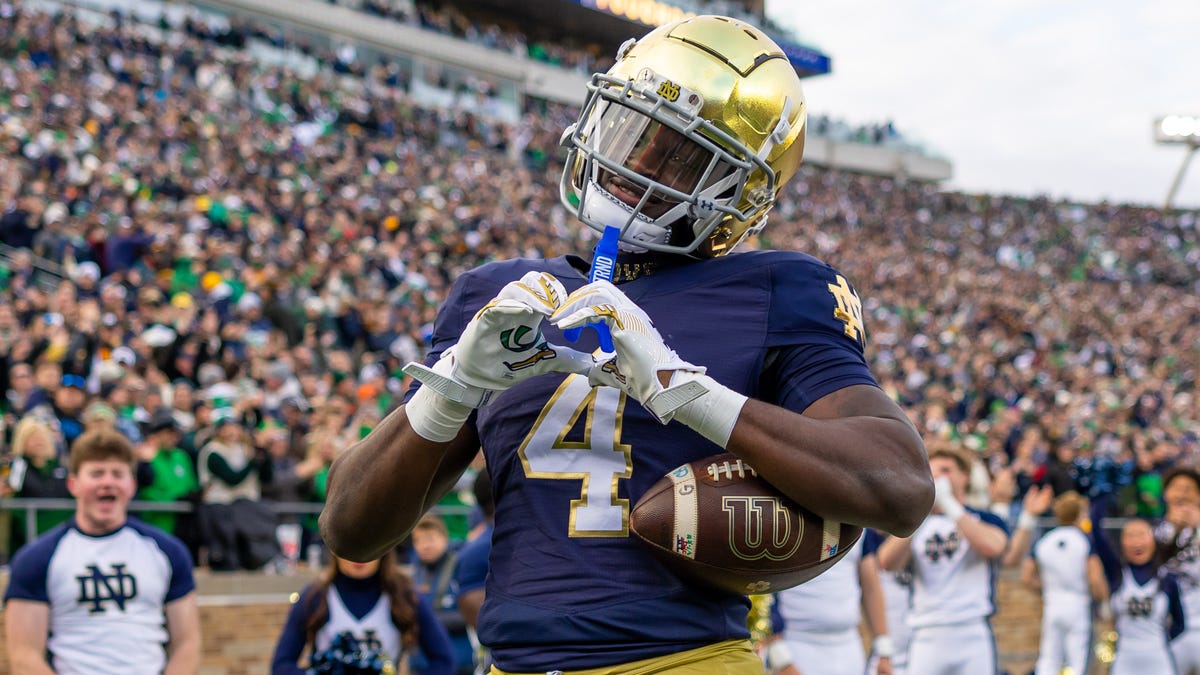
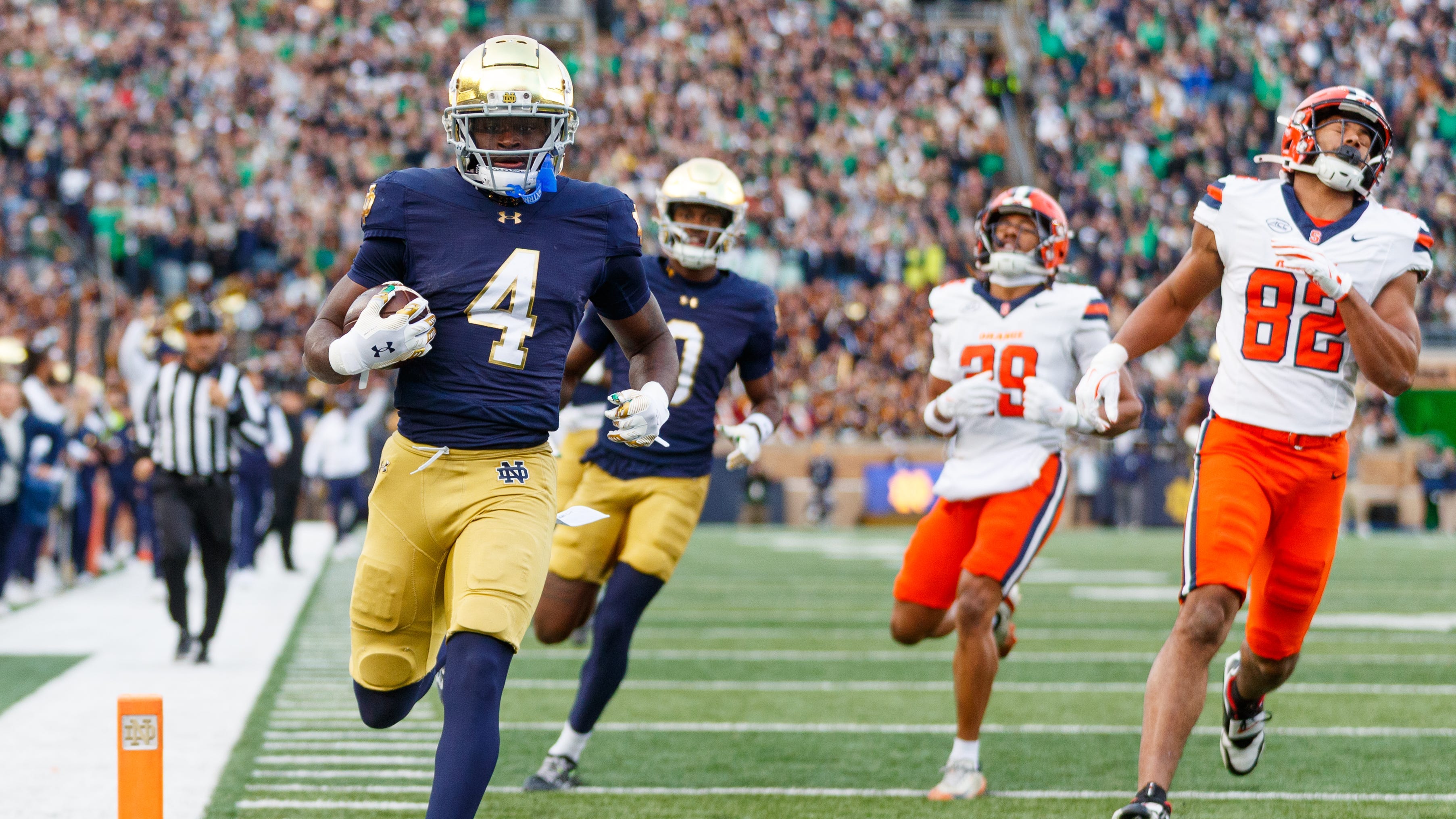

Jeremiyah Love’s teammate on why he deserves Heisman consideration
Fellow Notre Dame player Jadarian Price explains why Jeremiyah Love should be a top choice for winning the Heisman Trophy.
Sports Seriously
After a class dominated by offense, things got more back to normal with the 2025 NFL Draft. A quarterback went No. 1 overall but the first defensive player went much earlier than a year ago with wide receiver/cornerback Travis Hunter off the board at No. 2.
From there, it was a relatively even split between the two sides of the ball, with offense leading early on. Quarterback, wide receiver, offensive line, running back and tight end all saw prospects taken in the top 10 picks.
The 2026 NFL Draft could see a similar spread.
Quarterback and offensive line were arguably the top positions in the draft on offense. That didn’t pan out as expected in the 2025 college football season.
While those two positions underperformed, the interior offensive line and wide receiver groups have taken off. There could be multiple wide receivers in the top 10 selections again and even more as the first round wears on.
This class could see some significant changes depending on which prospects return to school, especially at quarterback. Oregon’s Dante Moore could be in contention for a top-three selection or end up back in Eugene for another campaign with the Ducks.
It’s an intriguing class at every position, offense included. Here are our top 10 prospects at every position on offense for the 2026 NFL Draft:
2026 NFL Draft top 10 by position: OffenseQuarterback1. Fernando Mendoza, Indiana2. Ty Simpson, Alabama3. Dante Moore, Oregon
These three are the top of the class and all likely first-round picks, should Simpson and Moore declare.
Mendoza is the most polished of the three; evaluators know what he is thanks to his standout season with the Hoosiers, which showcased his football IQ, decision-making, quick release, and accuracy. His high floor will make him a starter in the NFL.
Simpson has shown a lot of good in his lone season as the starter for the Crimson Tide, but his lack of experience will be a major knock, as will his performances against Georgia and Oklahoma. The son of a FCS football coach, Simpson could grow into the best of the group with all of the traits evaluators liked out of Mac Jones but with more mobility.
Moore has a tough decision ahead of him. If he declares, he’s a lock for the first round, likely the top 10. The flashes he’s shown at Oregon are impressive, but he’s also shown some inexperience against defenses that change the picture after the snap. His mobility, arm talent, quick release, and poise show shades of C.J. Stroud.
4. LaNorris Sellers, South Carolina5. John Mateer, Oklahoma6. Garrett Nussmeier, LSU7. Jayden Maiava, USC
This next group includes some incredible talents but few finished products. Sellers is in a rare class among other prospects thanks to his ridiculous athleticism in a 6-foot-3, 240-pound frame. He has a ways to go as a passer to reach his incredibly high ceiling and may ultimately return to school.
Mateer showed flashes that put him in first-round consideration early in 2025 before a hand injury stymied his progress. Nussmeier’s nagging core injury and poor decision-making dropped him from top-three status through the year. Maiava’s a late riser who’s impressed in a bigger role for USC and boasts ideal NFL size and arm talent.
8. Sam Leavitt, Arizona State9. Brendan Soresby, Cincinnati10. Drew Allar, Penn State
The bottom three all raise more questions. Leavitt’s a dual-threat quarterback at the college level but that may not stick against NFL competition. Soresby may go back to school for another year; if not, he has the upside to develop well in time. Allar was considered a first-round lock entering the season before an injury ended his lackluster season.
Running back1. Jeremiyah Love, Notre Dame
All respect to the other running backs in this class but Love stands a tier above them all. He’s a Heisman candidate for good reason as a dynamic threat in the open field with receiving skills as well.
2. Justice Haynes, Michigan3. Jonah Coleman, Washington
Haynes and Coleman have solidified themselves behind Love as the next-best options at the position. Both are compact, physical runners who have the speed to score from a distance. Haynes is out with a foot injury which will likely hurt his draft stock slightly. Coleman offers more as a receiver out of the backfield with impressive contact balance in a 5-foot-9, 225-pound frame.
4. Kaytron Allen, Penn State5. Jadarian Price, Notre Dame6. Nicholas Singleton, Penn State7. Demond Claiborne, Wake Forest
Of the Penn State duo, Singleton is the more impressive athlete, but Allen has had the better campaign in 2025. Allen is more of a power runner with less speed compared to Singleton, who is more of a home-run hitter.
Price is an archetype that offers value to teams later in the draft: a true three-down back who played a smaller role in college behind a top-tier prospect. Claiborne is a creative, dynamic open-field threat but his leaner frame may limit him to a change-of-pace back role.
8. Le’Veon Moss, Texas A&M9. C.J. Baxter, Texas10. Darius Taylor, Minnesota
Moss is an ideal gap scheme runner who works exceptionally well downhill and between the tackles. An injury late in the season against Florida may affect his draft stock. Baxter has good burst and an impressive 6-foot-1, 227-pound frame that should handle short-yardage situations and running between the tackles well. He lacks home run speed, though. Taylor’s a versatile runner who should be a three-down back at the NFL level.
Wide receiver1. Jordyn Tyson, Arizona State2. Carnell Tate, Ohio State3. Makai Lemon, USC4. Denzel Boston, Washington
What was initially seen as an underwhelming wide receiver class has turned things around over the 2025 college football season. Tyson’s metronomic production is powered by his impressive separation abilities and catch-point acumen. Tate took on a bigger role in Columbus in 2025 and rose to the occasion. He’s dominant at the catch point with an impressive yards per reception despite his lack of elite speed.
Lemon is this year’s Emeka Egbuka: a reliable slot receiver who will likely have an immediate positive impact on whichever offense he ends up in. Boston is a prototypical outside receiver, comparable in size to Tee Higgins or Keon Coleman (6-foot-4, 210 pounds) and with strong catch strength.
5. Chris Brazzell II, Tennessee6. Chris Bell, Louisville
Brazzell and Bell are both fringe first-rounders. Brazzell offers a good mix of burst off the line with his long frame (6-foot-5, 200 pounds), but also brings a good skillset to work in the intermediate areas. Bell is an eye-of-the-beholder prospect; he could be a Deebo Samuel type with his linebacker size and dynamic speed or he could end up like Treylon Burks.
7. Germie Bernard, Alabama8. KC Concepcion, Texas A&M
Bernard is a savvy wide receiver who knows how to attack both inside or outside. He’s not elite at anything but very good at pretty much everything. Concepcion is a dynamic intermediate threat who should have immediate upside as a returner but will likely need to bulk up his smaller frame (5-foot-11, 187 pounds).
9. Elijah Sarratt, Indiana10. Ja’Kobi Lane, USC
Sarratt has benefited from strong chemistry with quarterback Fernando Mendoza, allowing him to showcase his impressive intermediate skills. He’s an impressive route-runner who racks up first downs at ease despite his lack of long speed. Lane is an ideal red zone threat with the frame (6-foot-4, 200 pounds) to maximize soft spots in zone. Like much of this top 10, he lacks breakaway speed that may show up more in the NFL.
Tight end1. Kenyon Sadiq, Oregon
Sadiq is the brightest spot in a down year for the tight end position. He’s a dynamic vertical threat and willing blocker at 6-foot-3 and 245 pounds. He’s also one of the youngest players in the draft with plenty of runway to develop.
2. Max Klare, Ohio State3. Joe Royer, Cincinnati4. Eli Stowers, Vanderbilt
All three of these next batch of tight ends offer receiving threats but will need to improve as blockers at the next level. Klare’s route-running is very good and he thrives down the seam; his best may be ahead of him due to a limited role in a talented Ohio State offense. Royer’s football IQ shows up against zone and he plays vertically very well despite his lack of elite athleticism. Stowers is an elite athlete at 6-foot-4 with natural hands but his lean frame at 235 pounds raises some questions about his blocking ability at the NFL level.
5. Jack Endries, Texas6. Michael Trigg, Baylor7. Eli Raridon, Notre Dame
Endries put together a strong 2025 campaign thanks to his verticality, alignment versatility and blocking efforts, especially as a puller or in motion. Trigg is a dynamic threat that a creative offensive coordinator will love but there are question marks over drops and his blocking technique. Raridon offers impressive speed with his outlier size (6-foot-7, 251 pounds) but that height can work against him as a blocker and an after-catch threat.
8. Tanner Koziol, Houston9. Justin Joly, N.C. State10. Oscar Delp, Georgia
Koziol’s 6-foot-7 frame makes him an ideal red-zone threat, with impressive college production and toughness. Joly’s put up gaudy numbers with the Wolfpack and hasn’t lost any athleticism while adding more strength to his 6-foot-3 frame. Delp hasn’t had the same opportunities as others on this list but he’s versatile, a good blocker and boasts explosive speed at 6-foot-5 and 245 pounds.
Offensive tackle1. Spencer Fano, Utah2. Francis Mauigoa, Miami3. Kadyn Proctor, Alabama
Fano is firmly the top prospect at the position thanks to his athleticism, movement skills, footwork and strength. His slightly leaner frame at 6-foot-5 and 308 pounds may limit his ceiling in the NFL but his experience at both right and left tackle will come in handy. Mauigoa has played almost exclusively on the right side, with a huge, powerful frame (6-foot-6, 325 pounds) and ideal body control. His lack of top-end athleticism may force him inside to guard in the NFL, though. Proctor is a true outlier athletically at 6-foot-7 and 360 pounds, but his inconsistency has hampered his outlook.
4. Caleb Tiernan, Northwestern5. Caleb Lomu, Utah
These two are fringe-first rounders for different reasons. Tiernan’s high floor as a long, experienced pass protector could make him a plug-and-play starter for a team looking for help late on Day 1 of the draft. Lomu needs more time to develop as a younger prospect (and may return to school) but his impressive athleticism and natural footwork show tools worth investing in.
6. Xavier Chaplin, Auburn7. Drew Shelton, Penn State8. Trevor Goosby, Texas
Chaplin is Proctor-lite at 6-foot-7 and 335 pounds, with a lot of raw talent that needs to be developed at the next level. Shelton is on the lean side (6-foot-5, 305 pounds) but his mix of burst off the line and quick hands are an asset in pass protection. Goosby’s lack of experience shows at times, but his 6-foot-7, 312-pound frame suggests he could be a future NFL starter.
9. Carter Smith, Indiana10. Kage Casey, Boise State
Smith is one of the top run blockers in this group with solid size (6-foot-5, 315 pounds) and allowed just six pressures on 425 pass blocking snaps during the regular season. Casey’s sawed-off frame may mean a move inside in the NFL but his strength and understanding of angles will keep him in the league for a while.
Interior offensive line1. Olaivavega Ioane, Penn State
Ioane is the top interior prospect in the class thanks to his mix of size (6-foot-4, 335 pounds), strength, athleticism and nasty streak at the point of attack.
2. Gennings Dunker, Iowa3. Brian Parker II, Duke4. Cayden Green, Missouri
These three are all college tackles who will very likely move inside to guard at the next level due to limitations. Dunker delivers power through his strong hands and anchor but lacks athleticism to stay at tackle in the NFL. Parker II shows great burst off the line with ideal hand placement and staying power but won’t have the length or size at 300 pounds to stick at tackle. Green offers good length at 6-foot-5 and 324 pounds with raw strength, but his pad level and hand placement are less than ideal.
5. Conner Lew, Auburn6. Emmanuel Pregnon, Oregon7. Jake Slaughter, Florida
Lew and Slaughter are both true centers. Lew understands leverage well, using it to maximize his undersized frame (6-foot-3, 303 pounds) with quickness off the line and good hand timing. Pregnon’s aggressive attitude matches his powerful, stout frame and solid anchor. He’ll be a solid starter on the inside. Slaughter is a very good pass protector who diagnoses defenses well pre-snap.
8. Logan Jones, Iowa9. Parker Brailsford, Alabama10. Iapani Laloulu, Oregon
Jones’ athleticism and run blocking acumen at center will make him an ideal fit in a zone-based scheme but he’ll need to improve his play strength to last long-term. Brailsford is the smallest of the bunch at 6-foot-2 and 290 pounds and that shows up against bigger opponents despite his twitchy athleticism. Laloulu is shorter at 6-foot-2 but, at 329 pounds, has an impressive anchor that maximizes his low center of gravity.