
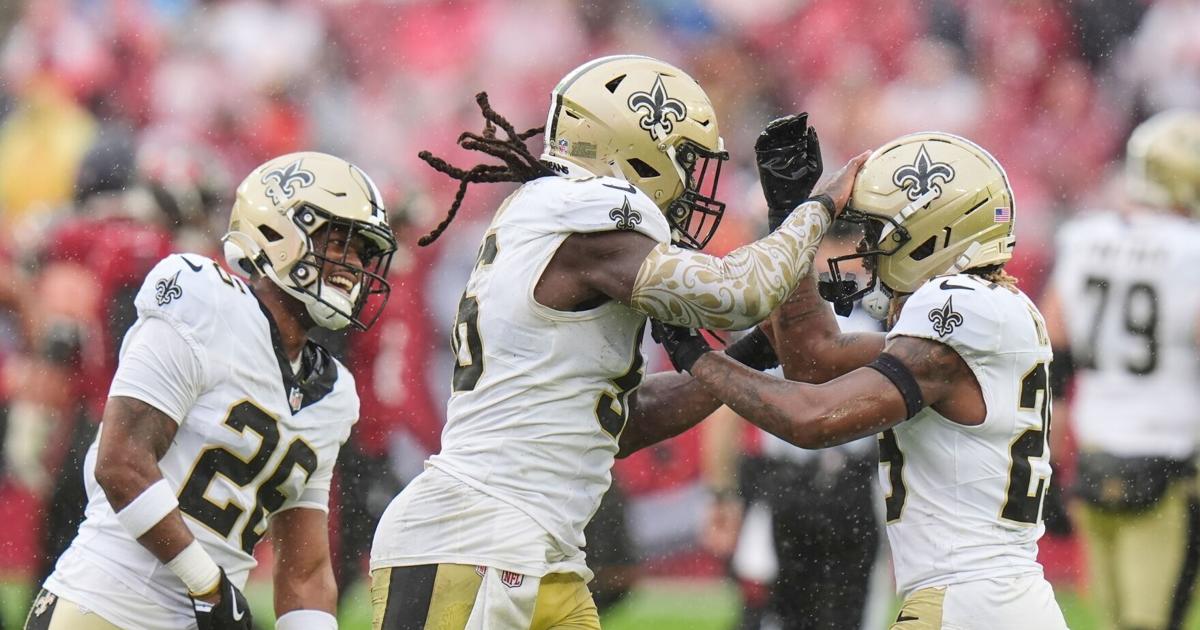
They say the best friend of a young quarterback is a good defense and a sound running game.
Tyler Shough has half of the formula working for him right now.
You might not have noticed amid the hype surrounding Shough’s recent play, but the New Orleans Saints defense is playing excellent football right now. Winning football.
For the past month, they’ve been one of the stingiest units in the league. In that span, they have held opponents to an average of 18 points a game and ranked among the stingiest defenses in nearly every major statistical category.
Since Week 10, the defense has ranked in the top five in the league in EPA per play, an advanced metric that measures performance while taking into consideration such factors as down and distance, field position, home-field advantage and time remaining.
“The thing I’ve been impressed with is the improvement,” Saints defensive coordinator Brandon Staley said. “Anytime we have had a setback or a tough stretch, our guys have bounced back and they’ve been resilient, and that shows a group that’s wired the right way.”
The Saints have had a top-5 defense, yes, that high, in EPA over the past month.
There is light at the end of the tunnel.
— https://t.co/LfypZFqaC0 pic.twitter.com/EtdcRKmqyZ
— Cody Alexander (@The_Coach_A) December 9, 2025
Like any good coach, Staley is quick to divert the praise to his players. But the cerebral 43-year-old coordinator is being characteristically modest. While implementing a new scheme to a hodgepodge cast of rookies, aging veterans and cast-off free agents, he’s orchestrated a dramatic turnaround. All things considered, it’s been one of the best coaching jobs in the NFL, the kind of work that shows why Staley was widely considered one of the top defensive minds in the league just a few years ago.
The Saints are better in nearly every key statistical metric from a year ago. They’ve improved from 30th in total defense, allowing 379.9 yards a game, to 12th, allowing 313.5 yards a game. On third down, they’ve gone from 21st (41.9%) to seventh (35.5%). And in pass defense, they’ve improved from 27th (238.5) to sixth (182.6).
And the Saints have done it without any spectacular individual efforts. In fact, the unit might not have a Pro Bowler in the bunch. The defense is classic example of the sum being greater than the individual parts.
“These guys have been fantastic,” Staley said. “They’re wired the right way. When you have a group that is wired the right way, you will see improvement. I love coaching these guys.”
The young secondary, in particular, has come together. It’s young group, with safety Justin Reid and fourth-year cornerback Alontae Taylor being the only veterans. Second-year cornerback Kool-Aid McKinstry, rookie cornerback Quincy Riley and rookie safety Jonas Sanker have gradually developed over the course of the season, transforming the unit from weakness to strength.
In recent weeks, the Saints have made life miserable for quarterbacks Bryce Young (62.8 passer efficiency rating), Tua Tagovailoa (55.9) and Baker Mayfield (55.1). Combined, the Saints limited that trio to three touchdown passes and a 55% completion percentage, while recording nine sacks and four interceptions.
“Those guys in the secondary are improving,” Staley said. “I think we’ve all seen it.”
As expected, there were growing pains early as the unit transitioned to the new scheme. Staley credited the leadership from veterans Reid, Demario Davis and Cam Jordan for buying into the plan and keeping the ship righted during the slow start. Over time, the unit started to come around and now is clicking on all cylinders.
He pointed to a 26-14 loss to the Chicago Bears as a turning point. The defense started slowly that day, but the unit held the Bears and quarterback Caleb Williams to just two field goals in their final six drives to keep the Saints within contention.
“Our guys were able to see we have what it takes,” Staley said. “We’re all a work in progress you never have it. And I think they have really taken on that spirit. Now we’ve just got to keep pouring pour into our culture, and you’ll see where we can take it.”