
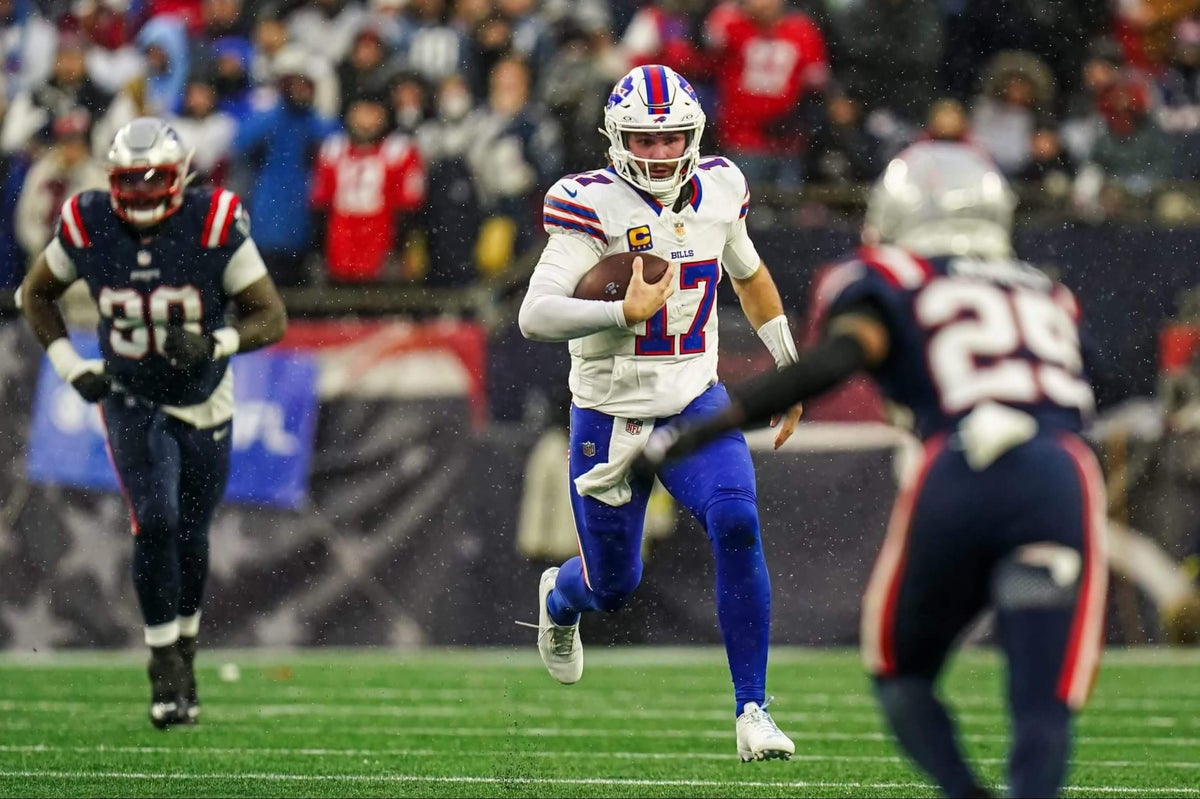
FOXBORO, Mass. — Before Mike Vrabel hit any other topics at his Monday news conference following the New England Patriots’ first loss since September, the head coach went out of his way to avoid placing any additional blame on the team’s defense.
It would’ve been easy to do that, of course, after the unit allowed five straight Buffalo Bills drives to finish in the end zone, arguably the biggest culprit in a 35-31 loss that snapped New England’s 10-game winning streak and dented their hopes of getting a first-round bye in the playoffs.
There was so much that went wrong for the Patriots’ defense that it was difficult to know where to start. The pass rush struggled to get home, couldn’t get Josh Allen to the ground when it did get to the quarterback and, particularly on a couple of crucial plays, gave him way too much room to operate. The secondary didn’t hold up well enough, allowing three touchdown passes. And the unit struggled to stop the run, another in a streak of poor performances, raising alarm about that phase of the game as the playoffs near.
It’s enough to wonder: Do the Patriots have a problem on defense? Is this something to be concerned about as this magical season approaches its most important games?
“Well, it’s not just that unit,” Vrabel said at the start of a long answer on the defense’s struggles.
But before we get to the rest of the answer, it’s worth looking at the stats, which raise some red flags about the defense as a whole. The issues are twofold: stopping the run and rushing the passer.
After a strong start to the season, the Patriots rank 30th in rushing expected points allowed, 25th in yards per rush allowed and 23rd in rushing success rate allowed since Week 8. Part of that is by design. (Or, if not by design, then in a calculated way.) The Patriots have played with a light box (six defenders or fewer) at the fourth-highest rate in the league during that time.
Essentially, they are devoting more resources to stopping the pass, perhaps partly because they’ve trusted the players they have up front to stop the run, which then allows them to allocate additional resources to the secondary. Early this season, that worked when Robert Spillane, Milton Williams and Khyiris Tonga — arguably their three most important players when it comes to stopping the run — were healthy. Since Week 8, each has dealt with injuries.
But the problems go beyond that, since that stretch has included some games when all three were healthy. And if it’s as simple as getting those players back, then good news is on the horizon for the Patriots. Tonga (chest) returned against the Bills on Sunday. Spillane (foot) was active for the game but didn’t play, a sign his injury is not long-term and that he could play against the Ravens on Sunday. And Williams will be eligible to return from his high ankle sprain after missing one more game.
“I think the one thing that we’ve done in victory has been to play very complementary (football), and I would say that to give the third-ranked offense the field position that they did (have) is tough,” Vrabel said Monday, trying to lessen the blame on the defense.
But what about the pass rush?
Since Week 8, the Patriots have just 11 sacks, which is the second fewest in the league in that stretch. That’s despite New England’s opposing quarterbacks taking the sixth-longest time on average to throw the ball. The Patriots’ average time to sack since Week 8 is 4.35 seconds, the fourth slowest in the league over that time. They also rank 14th in that time in blitz percentage, so it’s not as if they’re never sending extra rushers.
Part of the problem, again, could be injuries, namely to Williams, whose 3 1/2 sacks this season are the third most on the team. The hope during Williams’ injury was that Christian Barmore would step up and fill some of the void. But Barmore has just one sack this season, has just two quarterback hits in the last nine games and has posted five or more pressures in just two of his last nine games.
“I mean, we expect that in this league — we’ve said this — that your best players have to play good for you to win, and we consider him one of our better players, just like our quarterback,” Vrabel said of Barmore. “We expect the quarterback’s going to have to play good for us to win. Whoever we consider to be our best players, they have to play good in this league. That’s what this thing comes down to. So, we’ll continue to find ways to get production and get stops and show everybody the good ones and the things that we need to improve on.”
One other aspect of the Patriots’ struggles, at least in the micro sense when looking at their game against the Bills, is what Vrabel continually pointed to one day later. The Patriots didn’t play complementary football.
In the second half, the offense often stalled quickly. Then the special teams gave up valuable field position. Then the Bills went on time-consuming drives because they ran the ball easily, which made it tough for the Patriots’ defense. The Bills ran 46 plays in the second half to the Patriots’ 18.
“The best defense against a good offense is being able to possess the football, and we didn’t do that,” Vrabel said. “We didn’t do that in the second half. We didn’t put drives together. We didn’t convert when we needed to.”