
Did it seem like the waiver wire was thinner than usual this season? Did it feel harder to find a player for your Flex position? Well, it wasn’t just a feeling.
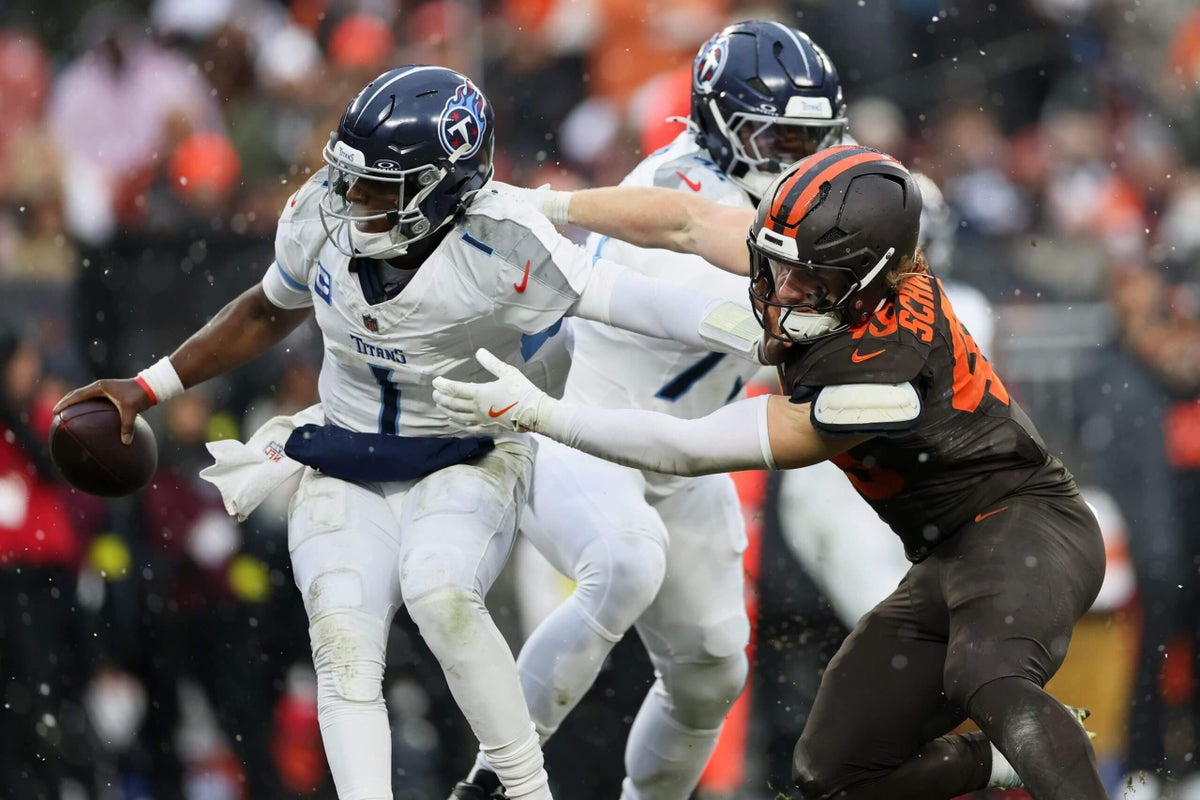
The cause? There were several. But one of the most glaring was that the Tennessee Titans, Las Vegas Raiders and Cleveland Browns combined to absolutely crush fantasy football in 2025. And not in a good way.
With most standard fantasy lineups consisting of at least two running backs, two wide receivers and a Flex position, RBs and WRs have an outsized impact on scoring. If you combine the fantasy point scoring totals of each team’s running backs and wide receivers, the 2025 Titans, Raiders and Browns produced the three lowest scoring totals by any teams since the 2021 NFL season.
It’s a truly remarkable confluence of fantasy futility. Those franchises weren’t just bad for fantasy managers; they were black holes, with only a few notable exceptions escaping their gravity to offer a glimmer of useful fantasy production.
What do they have in common? Look no further than poor quarterback play, which should be no surprise from organizations that have struggled to find a solution at the position. What’s stunning is that these new fantasy lows came a year after these franchises trotted out the likes of Will Levis, Gardner Minshew, Aidan O’Connell, Deshaun Watson, Jameis Winston and Dorian Thompson-Robinson. Apparently, it can always get worse.
Note: Metrics are via The Football Scientist, TruMedia, Stathead or NFL Next Gen Stats unless otherwise noted.
Tennessee Titans
The Titans made Cam Ward the No. 1 pick of the 2025 NFL Draft, and while he showed some improvement across the course of the season, he sure didn’t solve the franchise’s QB problem in Year 1. He completed just 59.1% of passes (44th among 50 QBs with one start), threw 13.9% of passes off target (45th), averaged only 5.6 yards per passing attempt (48th), was sacked on 10% of dropbacks (44th), finished with -0.18 expected points added per dropback (44th) and converted only 30.2% of third and fourth downs (41st) through Week 14. There are few, if any, wide receivers who could make up for such a deficit at QB.
Chimere Dike led the Titans’ receiving corps during the regular season from a fantasy perspective … as the 55th-ranked receiver for fantasy points, averaging 5.78 per game (half-point per reception scoring). Even if you want to blame the Titans’ dearth of receivers on the injury to Calvin Ridley, consider that he averaged only 5.54 fantasy points when healthy.
Even on a week-to-week basis, the Titans’ pass catchers were unhelpful. For RBs and WRs to offer a weekly benefit, they usually need to finish in the top 30 scorers at their position to serve as useful fantasy starters. Dike finished in the top 30 just four times. Elic Ayomanor and Van Jefferson finished with two top-30 finishes each. Ridley had one.
This level of inconsistency made any Titans WR unreliable and, therefore, unstartable and unrosterable in all but the deepest of leagues. And this pattern follows with the rest of the teams on this list (and a couple others).
Tennessee’s running back room wasn’t much better, though Tony Pollard at least finished in the top 30 for the fantasy regular season with 122.9 half PPR points. There are huge caveats there, too, since he averaged only 9.45 points per game and even that was largely buoyed by his 28.1-point breakout in Week 14. He only cracked double digits twice during the fantasy regular season, and his highest total before Week 14 was a meager 13.3.
Las Vegas Raiders
A similar scenario played out in the fantasy scoring desert that was Las Vegas. Through 14 weeks, Geno Smith was QB21 and was constantly under pressure. Smith took sacks at a higher rate than any QB other than J.J. McCarthy, Justin Fields, Tyler Huntley and Andy Dalton. Of course, his offensive line is partially to blame, but Smith’s passer rating ranked 37th, and his EPA/DB was 42nd. He completed a higher percentage of passes than Ward or the Browns’ QBs, but he also threw 14 interceptions to 16 TDs and struggled to convert on third- and fourth-down plays. His receivers’ production plummeted accordingly.
In 2024, Jakobi Meyers averaged 11.24 half-PPR points and scored over 10 in seven of 11 games. Before getting shipped (perhaps mercifully) to the Jaguars this season, he topped 10 points only once and averaged 7.39 points. After arriving in Jacksonville, he averaged 11.72 points with Trevor Lawrence through Week 14. The next-best fantasy WR on the Raiders, Tre Tucker, averaged 8.77 points per game, boosted largely by the anomalous 36.9 mark he posted in Week 3 against the Commanders.
The passing-game woes bled over into the backfield. Ashton Jeanty’s average draft position this season was 10th overall, and he was the fifth running back off the board. He finished as RB18 (on a per-game basis, through Week 14), averaging 12.38 half-PPR points. Livable? Yes. A disappointment? Absolutely. Of course, Brock Bowers steals the show for Las Vegas and finished as TE5 overall (even with games missed due to injury) and TE2 on a per-game basis. There just wasn’t much left for anyone else.
Cleveland Browns
There is literally a jersey that perfectly describes the Browns’ unyielding ineptitude to find a productive quarterback. They did not fare any better in 2025 with the likes of Joe Flacco, Dillon Gabriel and Shedeur Sanders. But unlike last year, when Jerry Jeudy persevered to finish 15th among wide receivers, no one could escape the maw this season.
Jeudy, who was ranked WR31 ahead of the season, finished as WR51. That dipped to WR63 on a per-game basis. Cleveland had a wide receiver finish in the top 30 only three times this year – even the Raiders had a top-30 finish by a WR six times. No other name even merits a mention from a fantasy perspective, leading to the worst combined RB/WR fantasy production by a team since 2021.
None of the Browns’ QBs produced an average passer rating of 80 or better in their starts, and every Cleveland QB had a very negative EPA/DB. Sanders threw fewer off-target passes than Gabriel and averaged the most yards per attempt, but there simply aren’t many positives. Flacco’s fantasy production improved greatly once he was away from the wasteland that is Cleveland.
Quinshon Judkins and Harold Fannin are the most fantasy-relevant players on the team, even after Judkins had a suspension to start the season. He still finished as RB18 in total points and averaged 12.17 half-PPR points per game; Harold Fannin finished as TE6 overall but averaged only 8.8 points (TE11 per clip). But that’s expected in an offense that can’t throw the ball to save its life.
While those three teams were truly notable for their lack of fantasy value, they were not alone. According to TruMedia, of the 160 team RB/WR combos since 2021, the 2025 Jets ranked 150th, and the Saints ranked 151st. In all, 2025 teams accounted for five of the 11 worst RB/WR scoring combos over the past five seasons. Only the Detroit Lions finished in the top 10.
On the whole, WR fantasy scoring was down notably across the league, and 11 teams saw a reduction of 14% or more in wide receiver fantasy points.
Median scoring
2021-24
2025
% change
QB1
23.6
23.9
1.30%
QB2
15.6
16.1
3.20%
RB1
20.9
21.5
2.90%
RB2
13.8
13.3
-3.60%
RB3
9.3
9.1
-2.20%
RB4
6.5
6.4
-1.50%
WR1
21.2
20.1
-5.20%
WR2
15
14.4
-4.00%
WR3
11.6
10.9
-6.00%
WR4
9.1
8.3
-8.80%
TE1
12.4
13
4.80%
TE2
7.1
7.9
11.30%
FLEX
11.6
11.1
-4.30%
The net effect? A receding tide that sank a number of fantasy rosters into the mire, particularly when compounded with the growing pains of J.J. McCarthy (the 2025 Vikings ranked 145th on the list) and crucial injuries to QBs Lamar Jackson and Jayden Daniels undermined what we thought would be high-scoring offenses in Baltimore and Washington.
While Flacco couldn’t save the Browns, he helped to bail out the Bengals, who ranked 79th on the list — a far cry from what we expected from a Joe Burrow-led offense, but a respectable, middle-of-the-road finish from a team that looked dead in the water with Jake Browning under center. With Browning starting, Cincy averaged 52.88 offensive fantasy points per game. With Flacco, that average rose to 96.31 (and with Burrow, the team averaged 88.62).
Having five teams place a drag on the overall talent pool means that in most weeks, 27 teams had to carry a disproportionate volume of the waiver wire weight. And that pain was even more keenly felt when one or more of the league’s productive offenses were on a bye week, leaving fantasy managers to sift through the dregs of these fantasy wastelands.