
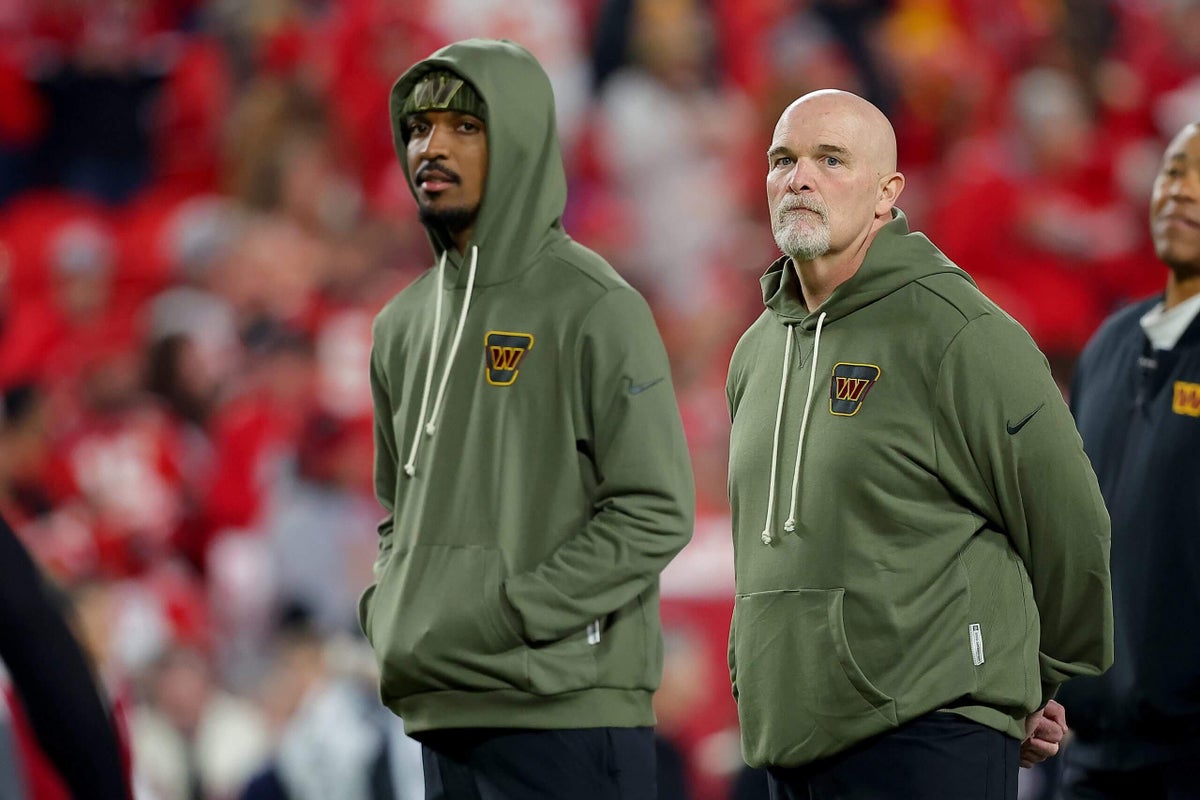
ASHBURN, Va. — The one thing that couldn’t happen happened. Quarterback Jayden Daniels, in his first game back from his latest and most significant injury, landed on the elbow he dislocated five weeks earlier and lay on the ground writhing in pain.
It was Week 14 of a lost season. Daniels had already missed six games because of three injuries, and by the time he emerged from the medical tent that afternoon, the Washington Commanders trailed the blitz-happy Minnesota Vikings, 24-0.
But three words from coach Dan Quinn after the game further muddied an already disturbing picture. Daniels was declared questionable to return to the game, “and could have,” Quinn said after the 31-0 loss.
Daniels didn’t, though, and he won’t play again until 2026. The team shut him down for the remainder of the season. Sort of. He’ll continue to practice.
“I know your first question likely is, ‘Well, DQ, what went into that?’ and the answer is it was a lot,” Quinn said this week. “Part medical and part team. … We believe this decision allows him to take advantage of the next few weeks in a different way.”
The confusing messaging has raised plenty more questions, including whether the team is coddling its young quarterback. It has also seemed to perpetuate a narrative that Daniels’ play style is reckless and makes him vulnerable to unnecessary hits (even if the game film shows otherwise).
When healthy, Daniels didn’t play at the level he did last season. Ensuring he stays available long term is and should be a priority. But the “can Daniels protect himself?” chatter has diverted focus from the issues that ultimately derailed Washington’s season; namely, a roster with clear deficiencies.
To be clear, the quarterback’s toughness and desire to be on the field should not be questioned. He played much of last season with a broken rib, has a well-documented work ethic and willed the Commanders to multiple wins last season.
It is common for players to experience more pain the following day, as Daniels did after the Vikings loss. As he himself said, “Adrenaline is a hell of a drug.” But he and the team stressed the importance of Daniels getting as many reps as possible to continue his growth at quarterback. It’s why Quinn kept him on the field late in Washington’s blowout loss to Seattle in Week 9. It’s also why it was perplexing that Quinn opted to hold him out for the rest of the Vikings loss when he said he believed Daniels was healthy enough to play.
To be fair, Quinn likely would’ve been criticized no matter his decision or his comments afterward. Had Daniels played the remainder of the Minnesota game, there would undoubtedly be comments asking, some would have asked, “Did Dan Quinn not learn anything from the Seattle game?!”
“It didn’t weigh on me,” Quinn said, referring to Daniels’ previous injuries. “Just where we were in the game, it wasn’t going like we wanted, and I thought this is the best call right here. … He wasn’t happy about it, but I thought, hey, this is the best decision right now, and I’ll continue to do that, whether it was him or anybody else in that spot.”
Washington’s season got off-course early and never found its way back for multiple reasons. Injuries undoubtedly played a significant part; a total of 25 players have suffered injuries that have cost them a combined 121 games, including those who will miss Saturday’s game against the Eagles.
And, yes, every team deals with injuries, and others this season have dealt with more injuries than the Commanders.
Washington, however, didn’t have the depth or structure to overcome them, and it was obvious as far back as training camp, when receivers Terry McLaurin and Noah Brown were absent. Daniels developed a connection with newcomer Deebo Samuel, but the offense generally struggled to find any consistent production without McLaurin and Brown in the lineup.
It was clear then that if either were lost during the regular season, the Commanders would undoubtedly pay a price. And they did — a much bigger one than anticipated because they lost five receivers at various points, plus their top pass-catching running back, Austin Ekeler, and later their top tight end, Zach Ertz.
As the Commanders cycled through various receivers, Daniels had to adjust on the fly each time he recovered from his injuries.
“I think when you haven’t practiced a ton with a certain group of guys, you’re always going to — there’s going to be some trust (issues),” offensive coordinator Kliff Kingsbury said earlier in the season. “You’re trying to figure things out, kind of in-game. And that’s always tough to kind of solve that when you’re playing against a really good defense.”
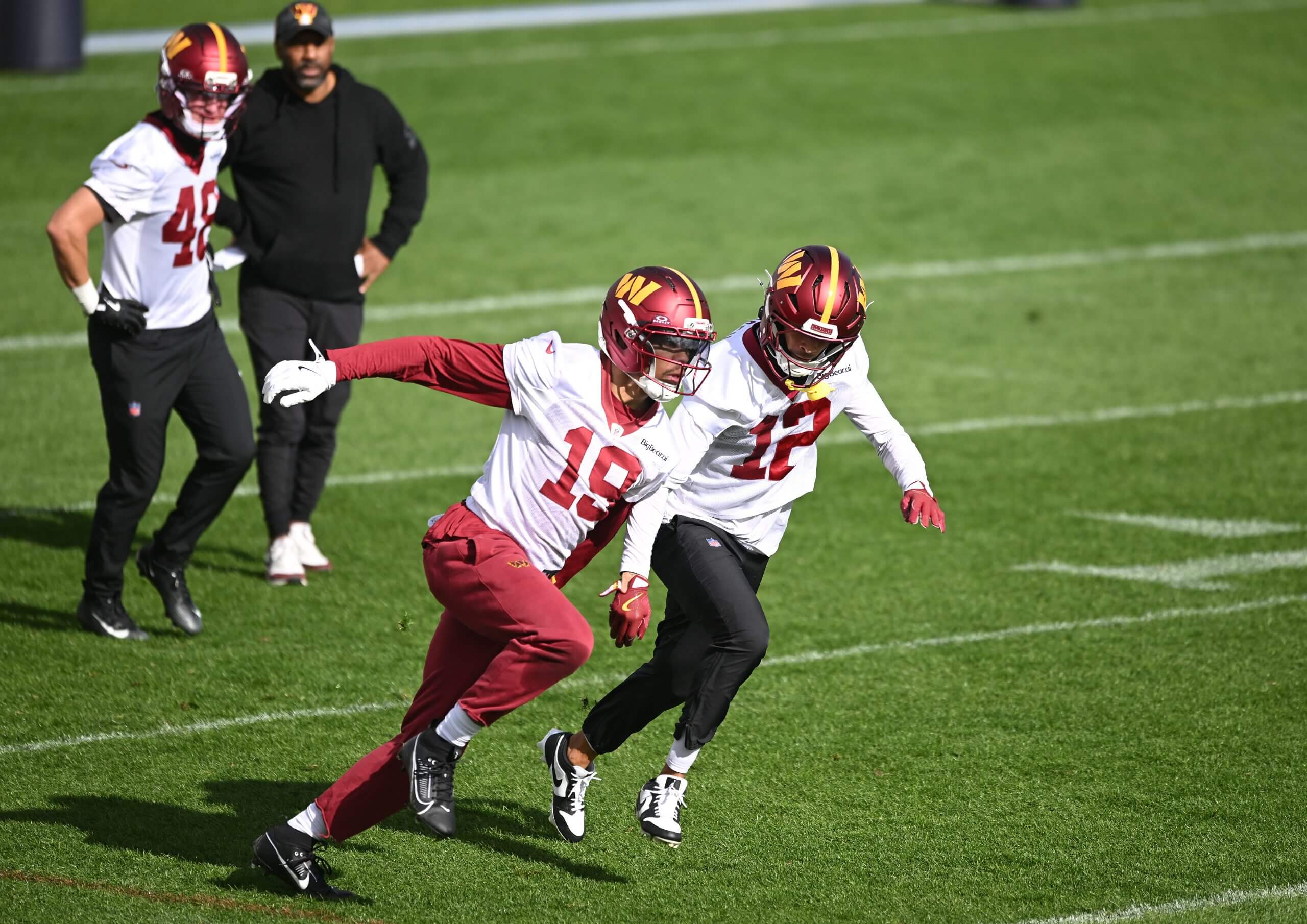
The Commanders, for much of the season, relied on backup receivers, including Chris Moore (19) and Robbie Chosen. (Denis Doyle / Getty Images)
The team did not sign a marquee pass rusher last offseason, and despite elevated play from defensive end Dorance Armstrong, it lacked consistent pressure. Armstrong was working on a career year before tearing his ACL in Week 7. He remained the team’s sack leader for another seven weeks while recovering.
Other things worked in Washington’s favor last season: a soft schedule, several games against backup quarterbacks and a middle-of-the-pack turnover margin that has devolved into the third-worst margin in the league in 2025.
And then, of course, there’s Daniels, whose play in 2024 quieted most concerns over his health and rib injury. His durability may always garner attention because of his position and lean frame, but in the Commanders’ lost 2025 season, it’s taken center stage.
Yet, Daniels doesn’t play rashly. He actually improved this season in learning when to take shots and how to get down. He seems to prefer diving over sliding, but there’s not enough research to declare one method safer than the other, and the NFL rulebook counts both styles as declaring himself as down.
Daniels’ three injuries — the knee sprain against the Green Bay Packers in Week 2, the hamstring strain against the Dallas Cowboys in Week 7 and the dislocated elbow against the Seattle Seahawks in Week 9 — weren’t bad plays.
On the first, he scrambled to evade pressure from Micah Parsons, who beat rookie tackle Josh Conerly Jr. on the right side; Daniels couldn’t avoid the low hit from safety Javon Bullard.
In Dallas, Daniels’s leg was folded awkwardly on a sack by linebacker Shemar James, a free rusher on a blitz.
If any of the three injuries were avoidable, it could have been the elbow.
“The one that he was injured is usually a runner or a throw to the flat,” Quinn said after the game. “It’s not a scramble. So, it wasn’t a designed read or play into that spot. If we’ve run it 50 times, it’s either hand off or a throw, you know, I’d say 50 times. So yeah, it’s a bummer, man in a big way.”
Quinn admitted the next day that he made a mistake by leaving Daniels in the game at that point. But the Commanders were already on their way to a 3-6 record that afternoon, and any blame is miscast if pegged only on those two.
Now, Washington must look ahead while trying to end the season respectably.
Players and staff evaluations are well underway, Quinn said, along with ways to possibly change the day to day and create different results.
“What could be different at camp? What could be different about an in-season format? What could be different about a practice?” Quinn said earlier this week. “You could do it in those live moments, but now even there’s some spaces, like, I wake up at night and write, ‘OK, what about this, what about that moment?’ I also lean in on a person like Zach (Ertz) … I’ve learned so much through the years from players. They’re the ones doing it, going through it. And so, I never want to miss those moments when I can.”
And even though Daniels is out for the final three games, he’s admitted there’s still plenty for him to learn as a practice player.
“Just continue to get better and see the game from a different lens,” he said. “Ask questions, as many questions as I can. Kind of have that time to really sit there and maybe ask (Quinn) about situational football or go talk to the DBs coach, (Jason Simmons), and all those guys to see what they’re thinking and how they would call this, and what are the rules and principles. So, there’s a lot I can learn.”
But many of the lessons Washington can take from this lost year will be in how it reshapes its roster this offseason.
Nearly two dozen of its players are headed for free agency, and there are roster holes aplenty. How it rebuilds, and how it helps its young quarterback will determine how far it goes.
“To say (the season) got off-course, no doubt about it,” Quinn told The Athletic last week. “If it were one reason, it’d be super easy to say, ‘Let’s never do that one thing.’ But in most things, it’s never that easy.”