
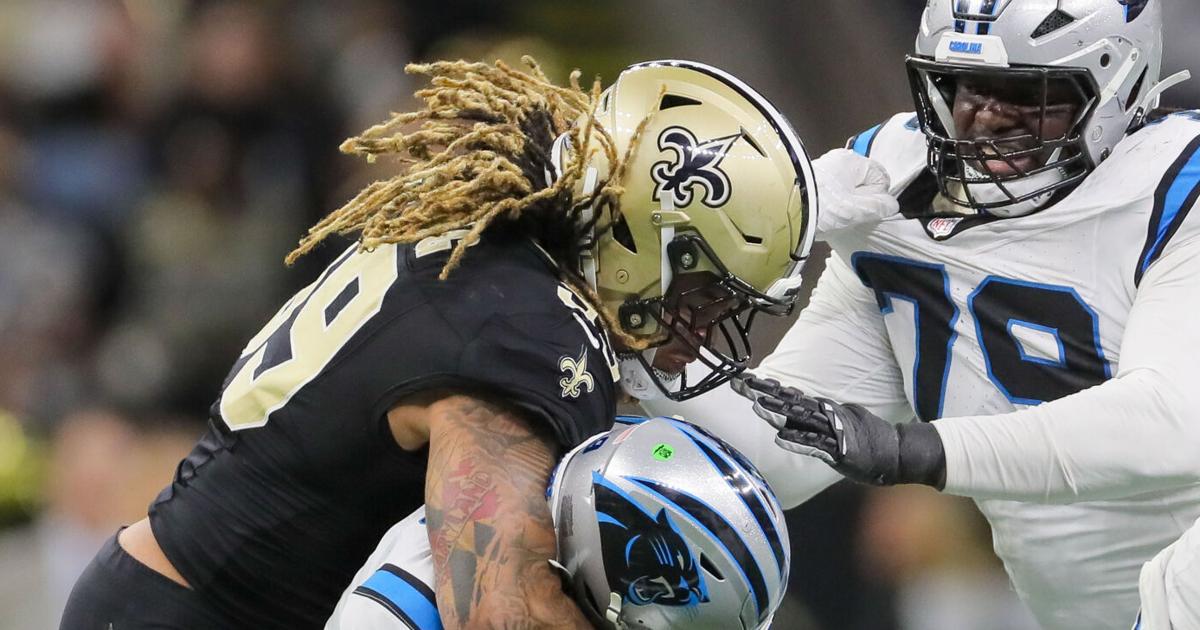
Chase Young insists he was labeled a bust four games into his career.
This seems highly unlikely, if not outright false. For one, the New Orleans Saints defensive end, then with Washington, doesn’t specify who wrote him off. And at that point in the season, Young racked up 2 ½ sacks in his first three outings before a groin injury forced him out of the lineup in Week 4. A bust? Who would jump to such conclusions so early on?
Memory, too, can be a fickle thing. The closest thing that comes to meeting Young’s claim was a Washington Post column from weeks later that declared he wasn’t meeting expectations — ironically written right before the seven-week surge that propelled Young to the Defensive Rookie of the Year award and helped push the Commanders into the playoffs.
But standing at his locker, days before Sunday’s game against the New York Jets, Young has a larger point to make about the narratives that follow him.
“I got hurt and they said I was terrible,” Young said. “Then I got a contract. Now, I’m good. So now what? You know what I’m saying? I could care less what anybody ever said.”
For a man who supposedly doesn’t hear or care about the “outside noise,” Chase Young has heard it all.
He has heard the draft analysts who hyped him up as a “generational” prospect, a savior who would rescue his hometown team. He has heard the praise that comes when delivering on that promise, only to have it disappear when such a horrific knee injury derailed his career. He has heard how his star status faded, how fans and media debated whether he was a bust — for real this time — following his unceremonious fall from the top.
He has been in the NFL long enough for the pendulum to swing back around quietly, now that he has become one of his team’s most important defenders — all while Young discovered what truly mattered, like being a father and taking better care of his body.
“Just watch what happens in the next couple years,” Young said. “Then what (will they say)?”
‘A tough tag’
When describing Young’s impact on the Saints this season, Carl Granderson uses a phrase that Young couldn’t escape in the pre-draft process.
“Chase Young, he’s just a generational player,” Granderson said.
Asked what makes the pass rusher once-in-a-generation, Granderson pointed to where most people would — his tape in college. At Ohio State, Young overwhelmed opponents on a weekly basis with a rare combination of speed, power and craftsmanship that resulted in a fourth-place finish for the Heisman Trophy. He finished with 16 ½ sacks in just 12 games, a total he says would have been even higher had he not been suspended for two games.
“That’s just crazy work,” Granderson said.
“I was unblockable that year,” Young said recently.
Even now, six years into Young’s career, that kind of tape occasionally shows itself. Just look at this past Sunday’s game against the Carolina Panthers. To wreck Carolina’s second-to-last drive, Young lined up out wide near tight end Ja’Tavion Sanders. But as soon as the ball snapped, and Sanders started to run his route, Young rushed toward left tackle Ikem Ekwonu and drove him straight back to knock over quarterback Bryce Young.
The sack, even on first down, changed the game. Carolina got into such an unfavorable down-and-distance that it was forced to punt and set up New Orleans’ game-winning drive.
But here’s the thing about that play, and it speaks to why, as talented as Young is, it’s hard for any player to live up to being labeled as generational: The pass rusher admitted that he used the same move three other times throughout the game without much success.
“It worked that time,” he said.
The 26-year-old could have perhaps gotten away with using the same move over and over in college, where the athletes are smaller and slower than the NFL. But as a pro, Young has had to fine-tune his techniques. This year, New Orleans’ coaching staff has emphasized being more precise with his hands at the top of his rush to turn his regular pressures into sacks. Last season, Young began to develop a better feel for preparing a pass-rush plan. In Washington, he relied too much on a stutter step that negated his power.
But that fine-tuning, not to mention the difference in talent, means that Young hasn’t come close to replicating his numbers at Ohio State. He has yet to have a double-digit sack season as a pro.
The Saints still see him as a “premium” player, defensive coordinator Brandon Staley said.
“Those types of words get thrown out far too regularly,” Staley said. “It’s definitely not fair to many, nearly impossible to live up to something like that. Everybody held Chase in the highest regard … but generational, that’s a tough tag for anybody to live up to.”
Staley will note how much Young has accomplished, despite that tag. There’s hardware from his rookie season and then when the Commanders traded him in 2023, Young made the Super Bowl with the San Francisco 49ers. San Francisco lost that game, but Young recorded a sack on the biggest stage.
And in a conversation with Young this year, Staley wanted to remind the pass rusher of something else, too: His age.
“He’s only 26 years old,” Staley said. “His best is in front of him. He’s just got to keep competing hard and believing in himself to get there.”
Fitting in
In his second year with the Saints, months after re-signing on a three-year, $51 million contract, Young is on pace for the best year of his career. Even after missing the first five weeks due to a calf injury that lingered far longer than initially anticipated.
Young has six sacks in nine games, putting him two away from a career-high with three games left to play. His 32 pressures, according to Next Gen Stats, lead the team. And his pressure percentage of 18.4% is not only a personal best, but the fourth-best rate among edge rushers with at least 150 pass rushes. He’s even converting pressures into sacks at a better clip, which has long been the knock on his career.
It might be tempting to suggest that this growth was the result of Young leaving his hometown. Young grew up in Upper Marbolo, Maryland — less than 30 minutes from where he’d play home games for the Commanders. Drafting Young brought immediate excitement to the area, and then-coach Ron Rivera went as far as to tell fans that he hoped the pass rusher could become the next Darrell Green — a Hall of Famer who spent 20 years with the franchise.
Did he just need to get away from it all?
Young chuckled.
“I was a Pro Bowler my rookie year,” he said. “Nah, I could play anywhere in the world and I’ll be fine.”
But anywhere turned out to be New Orleans, and that has undoubtedly left a positive impression on Young. He appreciated, for instance, the Saints’ patience as he worked his way back to full health earlier this season. In October, as questions about Young’s absence lingered, coach Kellen Moore took an unusual step to rule out the edge rusher early in the week so he could “simplify” the recovery process.
Moore didn’t have to do that. Beyond the tactical advantage that most coaches would try to gain by concealing a player’s status, the Saints also weren’t shy about their expectations entering the season for Young. Defensive end Cam Jordan said he wanted to see waves, not splashes. Linebacker Pete Werner, who was also Young’s college teammate, said the former Ohio State star had to be on “his game” come the fall.
If there was any frustration about Young’s rehab, it didn’t spill out publicly. That wasn’t the case in Washington, where Young’s approach to rehabbing his torn ACL away from the facility and in Colorado before the 2022 offseason occasionally caused a stir.
“Sometimes you try and put timelines on everything; everyone wants timelines, but sometimes that’s just not the way things work out,” Moore said.
“It makes you want to play for an organization when things like that happen,” Young said of the support.
Mom’s approval
Young may say he doesn’t care about what people say, but that’s not completely true.
Case in point: Carla Young.
“I’d rather be recognized by my mom, who’s always in my corner,” he said.
That doesn’t mean she’s an easy grader. Famously, when he was a rookie, Carla gave her son a “C+” through the first half of the season because he didn’t lead the league in sacks. She was pleased, though, when Young returned a fumble for a touchdown later that season. In a charming moment, Young turned over his post-game press conference to his mom — who just so happened to be on FaceTime with him during the session.
“Oh, my gosh, I’m just so worn out,” she said then. “It was just outstanding. I couldn’t even believe it. I was in shock. … He got it and kept trucking!”
Five years later, she’s still the same woman.
“Knowing Chase, he’s the right man to listen to a mom like his,” said Werner, whose parents are friends with the Youngs from their time tailgating at Ohio State games. “She’s great. She comes to every single game. She’s always going to be his biggest fan and his biggest critic.”
Werner, though, has seen how her son has changed in that time. The linebacker noted back in August that Young had “matured a lot” as a player, someone who understood how his team needed him to perform.
But that maturity extends to Young’s personal life, as well. These days, the pass rusher said he goes out less than he used to. He only discovered “the other day” that Louisiana has open-container laws — two years after moving to the south.
“I think I’m at a different stage,” Young said. “I just go to work and go home, but I don’t need to be (anywhere else). I really don’t be doing too much outside of here.”
The birth of his son Ace, who is now 15 months old, had a lot to do with that. Becoming a father has been “cool,” Young said. He landed on the name after taking his own and removing the “Ch,” but went with the conventional spelling.
Ace, he said, has kept him grounded. Where he might have been tempted to hit “the streets” in the past, especially in a new city, Young has a better reason to stay in.
“I got to come home,” Young said. “If I was the only dude in the house, I wouldn’t have to.”
That’s the only generation that Young is concerned about living up to.