
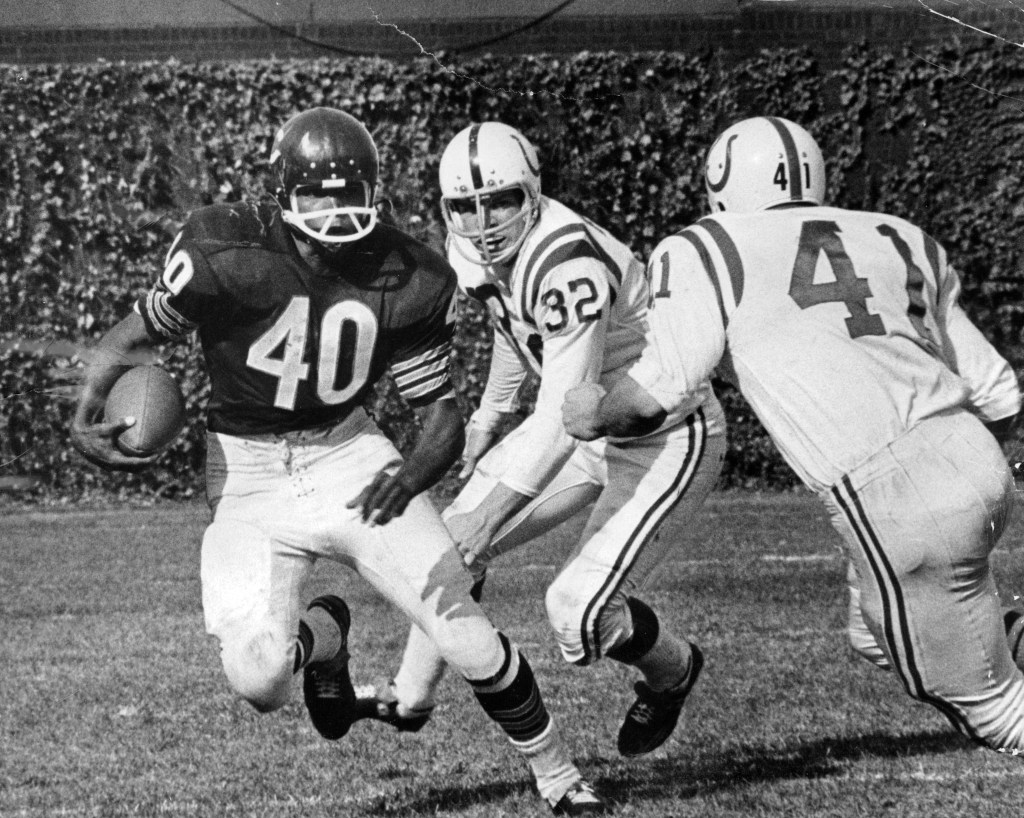
Regarding the op-ed “Gale Sayers and the greatest performance in Chicago sports history” (Dec. 12): Reflecting on Gale Sayers’ epic six-touchdown game as a Bears rookie provoked warm and wistful memories. I submit that there’s a technical reason that Sayers excelled amid the muck, the mud and the mire. He was a heel runner, not a toe runner, which enabled him to transform a screen pass into a 80-yard touchdown, a 50-yard touchdown run and an 85-yard punt return for a touchdown.
Op-ed writer Michael Peregrine mentions that Sayers was deemed the “Kansas Comet.” An apt nickname. Consider Halley’s Comet, which appears only every 75 to 80 years. Injury-ravaged, Sayers played only 68 career games; his career ground to a sad end at age 28. Oh but the thrills Sayers provided and still provides via YouTube.
Sayers led the league in rushing twice, and he led the league in kickoff return average in 1966. The Bears maximized Sayers’ touches: He ran from scrimmage, caught passes, and lugged the ball on punt and kickoff returns.
To watch Sayers at his Hall of Fame apex proved scintillating and startling. Although Bill Cosby is now a pariah, in 1970 as a respected celebrity, he wrote the introduction to the Sayers biography “I Am Third,” which was adapted into the tear-inducing saga “Brian’s Song.” Cosby wrote that Sayers was the only football player who split himself in two. He did; I witnessed it.
In the mid-1960s, CBS highlighted Sayers bedazzling and flummoxing NFL defenders. Sayers reduced them to perpetual haplessness and hopelessness.
Sayers repudiated the bombast and the braggadocio that pervade today’s sports landscape. However, he was endowed with a blowtorch-like desire to become great.
Fifty years later, it’s my distinct privilege to pay homage to the electrifying Sayers.
— Marc D. Greenwood, Opelika, Alabama
Connect historical dots
After reading Nina Metz’s perceptive review (“Chicagoans at work,” Dec. 9) of the WTTW-Ch. 11 program “Chicago Works,” I watched the show with even more disappointment than Metz acknowledged. Metz warned: “It would be unfair to expect something more along the lines of Studs Terkel’s ‘Working.’” Still, we needed more — and WTTW owed Studs more — than a show-and-tell.
It’s an odd contradiction that WTTW asks viewers to make donations toward its budget shortfall while it is willing to spend money on shows in which the program host admits he is getting paid to do things on his “bucket list.” WTTW’s seemingly endless pledge drives, which offer luxury “prizes,” seem oddly tone-deaf at a time when national and local politicians are arguing over issues of affordability, an issue called “a hoax” by our plutocratic president, the same president who caused the budget shortfall at WTTW by unjustly eliminating funding for PBS.
WTTW needs to connect the dots with a new show explaining why affordability issues are not a scam, but a continuation of the same exploitative policies behind the attempts to drive the Native population out of Illinois during the War of 1812 and again in the Black Hawk War in 1832. These policies continue to the Haymarket riot in 1886, the 1919 riots, the civil rights marches in the 1960s and the ongoing immigration raids.
Instead of shows in which the host pets Beluga whales and rides a Zamboni around the United Center or snorkels in Lake Michigan or enjoys a joyride in a helicopter, how about another episode of “Chicago Works” that explores the historical conflict between labor and management that still affects so many vital city services? This show could explain the commonalities linking Haymarket and Pullman and the stockyards to the current struggles of workers forming unions at Chicago museums, theaters, Starbucks, and the studios of WTTW and WFMT-FM 98.7.
These issues are worthy topics for a public media station claiming objective and accurate reporting in the age of affordability in “the city that works.” In the public interest, it’s time to move past the flashy scenery and witty soundbites and show what really makes the city work.
— Franz Burnier, Wheaton
Mag Mile lacks sparkle
I am writing to express my disappointment with this year’s Christmas decorations along North Michigan Avenue. For a street that has long been celebrated as a centerpiece of Chicago’s holiday spirit, this year’s display was underwhelming and failed to capture the joy and vibrancy the season deserves.
The decorations lacked creativity, cohesion and the festive charm that residents and visitors alike have come to expect. In a city known for its architectural brilliance and cultural richness, the holiday presentation on such a prominent avenue should reflect that same standard of excellence. Instead, it felt uninspired — earning, in my view, a failing grade. It was disappointing to see high-end stores not decorate.
It is a holiday tradition for many suburban families and visitors to come into the city to shop and view the lights and holiday windows. They spend a lot of money on parking, eating and shopping. I spent last Christmas in Madrid. That city went all out for the season. It was a well-spent eight-hour flight.
I hope future efforts will better honor the tradition and reputation of North Michigan Avenue, ensuring that Chicago’s holiday season shines as brightly as its people and history.
— Cammie McDaniel, Chicago
Personal mail a treat
Per Richard Dreger of Batavia’s Dec. 10 letter “Make effort for cards”: I, too, send out more than 50 holiday cards and always add a personal note in my cards. That is the point of sending out the cards each year, to keep in touch and share personal stories.
I love to get mail and must admit I send out five to 10 personal letters each week — I’m doing my part to keep the Postal Service in business. People love to get mail and letters. It is a nice surprise from the junk mail and bills in their mailbox each day.
So, Richard, please continue your tradition. I’m right behind you in line at the post office.
— Arlene C. Hogan, Naperville
Note to readers: We’d like to know your hopes for the new year. Please send us a letter, of no more than 400 words, to letters@chicagotribune.com by Sunday, Dec. 28. Include your full name and city/town.
Submit a letter, of no more than 400 words, to the editor here or email letters@chicagotribune.com.