
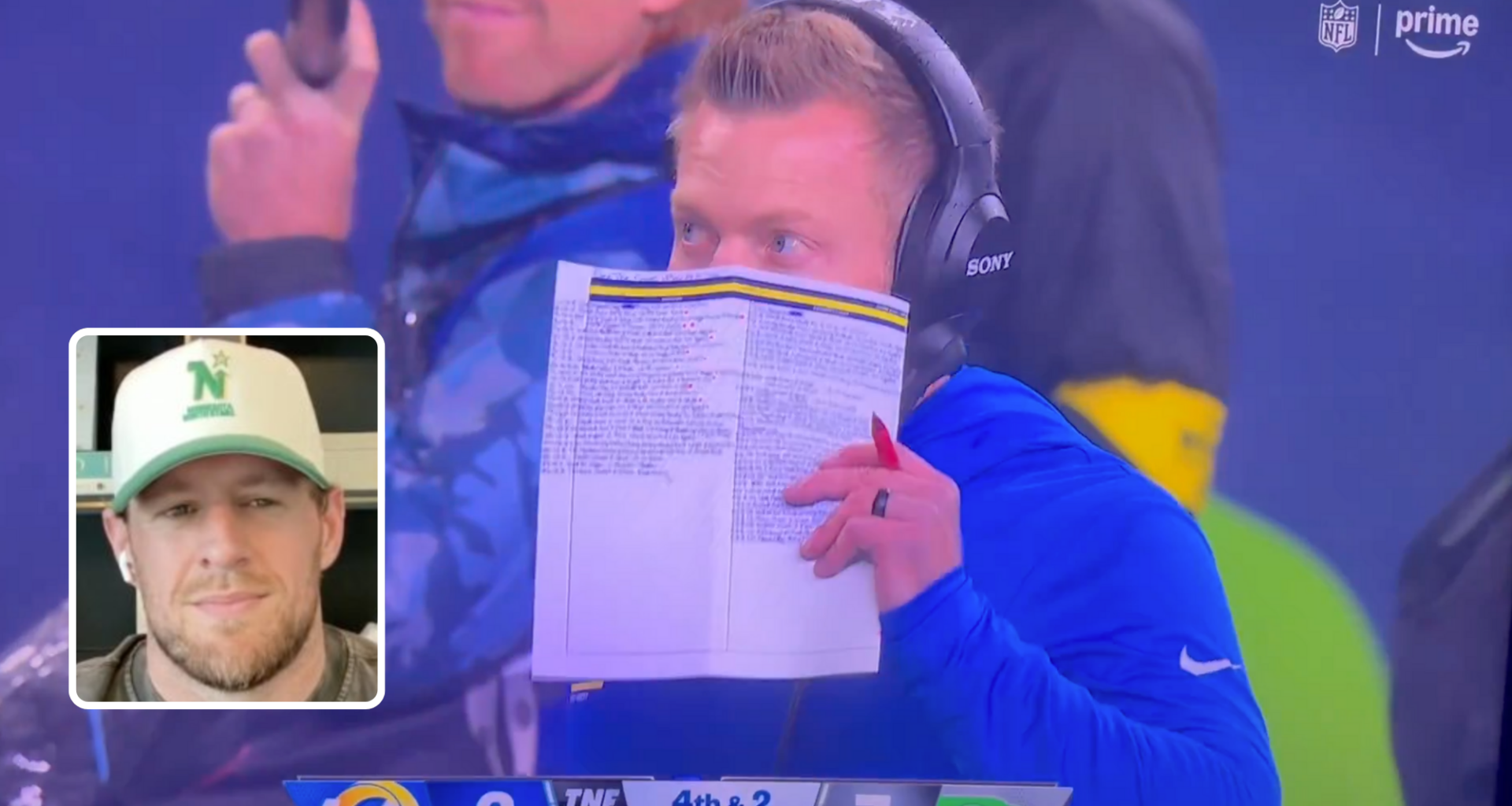
Football coaches go to great lengths to disguise their play calls.
We all remember Chip Kelly at Oregon with the obnoxiously goofy posters on the sideline, and of course there are the numerous code words that quarterbacks use at the line of scrimmage (think: “Omaha!”). The best teams hide their intentions on both sides of the ball with certain alignments and pre-snap activity. If a team loses that veil of mystery, the opponent has a huge advantage.
And yet, on nearly every NFL and college football broadcast, millions of viewers are exposed to one of the most valuable clues a team has as to its intentions: the play sheet.
TV cameras routinely zoom in on a play-caller or head coach holding their play sheet, with the team’s plans in full view of the television audience and the world.
This week on Thursday Night Football, Prime Video caught a shot of Los Angeles Rams head coach Sean McVay with his full play sheet in clear view. The video quickly went viral as fans speculated about why teams allow broadcasters to display such valuable information.
Allow former NFL superstar J.J. Watt to answer that question:
“There’s really not a huge advantage to having the opponents call sheet,” Watt wrote on X.
“The plays they run, the situations they run them in, the variations, etc. it’s all on film, documented and translated into the language of your own team.
“Having it in their language is only beneficial if you can clearly hear the QB calling the play in their huddle from behind the line of scrimmage, which is very rare. (during Covid it was a lot easier).”
There’s really not a huge advantage to having the opponents call sheet.
The plays they run, the situations they run them in, the variations, etc. it’s all on film, documented and translated into the language of your own team.
Having it in their language is only beneficial if… https://t.co/oJUN0grs1Q
— JJ Watt (@JJWatt) December 19, 2025
Of course, we also know how much more valuable a team’s signals and verbiage are than their on-field play calls. From the Patriots’ Signalgate to Connor Stalions, teams go to great lengths to learn their opponents’ signals and get an edge.
But Watt’s perspective is interesting.
Unless a team can intercept a play call in real time, it’s useless. To go back and see a play sheet on a broadcast might just tell you what you already would know from the game.
As Watt put it, most teams have a general idea of what’s coming from their opponents based on their history and game tape. At the highest levels, it is all about solving the team in front of you on the field of play.
Added Watt:
“And finally, at the end of the day, there remains the age old phrase…
“Go ahead and tell ‘em what we’re running. They still have to stop it.”