
CLEVELAND — Are we good here? Have we seen enough? Everybody get what they wanted?
For all of those who spent the season clamoring for Shedeur Sanders believing he was the future of the position in Cleveland, he has now appeared in 5 1/2 games as the quarterback of the Browns and has worse metrics than Dillon Gabriel, who started 5 1/2 games this year and is so unpopular that his mere presence on the field for one snap Sunday elicited boos from the few hundred Browns fans who bothered to attend the 23-20 loss to the Buffalo Bills.
Gabriel has a higher Expected Points Added per dropback than Sanders — although that isn’t really saying much since Gabriel and Sanders have the two lowest figures in the league this season. Sanders has thrown for more yards and is averaging more yards per attempt, but Gabriel has a higher completion percentage, a higher passer rating and a higher touchdown-to-interception ratio.
This isn’t to make the case for Gabriel to start; it’s to illustrate that the long-term answer isn’t on this roster. The Browns are going to be in position to take a quarterback at the top of next year’s draft and they have no choice but to do it. Gabriel certainly doesn’t appear to be the answer and neither does Sanders, who had opportunities against Super Bowl contenders the past two weeks to really assert himself and responded by throwing one touchdown and five interceptions.
Sanders’ minus-0.24 EPA/dropback in his six games this year is the lowest of any quarterback in the history of TruMedia’s database, which dates back to 2000. Lower than Ryan Leaf and Zach Wilson (both minus-0.19) and lower than JaMarcus Russell (minus-0.22), who was the worst on record until Sanders.
Could he improve with more reps? Of course. Unfortunately, the Browns don’t have time to waste. They put themselves in this position to make quick judgments when they drafted two mid-to-late-round quarterbacks, and unless Jimmy Haslam lights a candle by his Arch Manning poster every night dreaming of 2027, no team with this glaring a need at quarterback can own a top-5 pick in consecutive drafts and not take one at the top of either draft. It would be a level of malpractice that not even the Browns would likely commit.
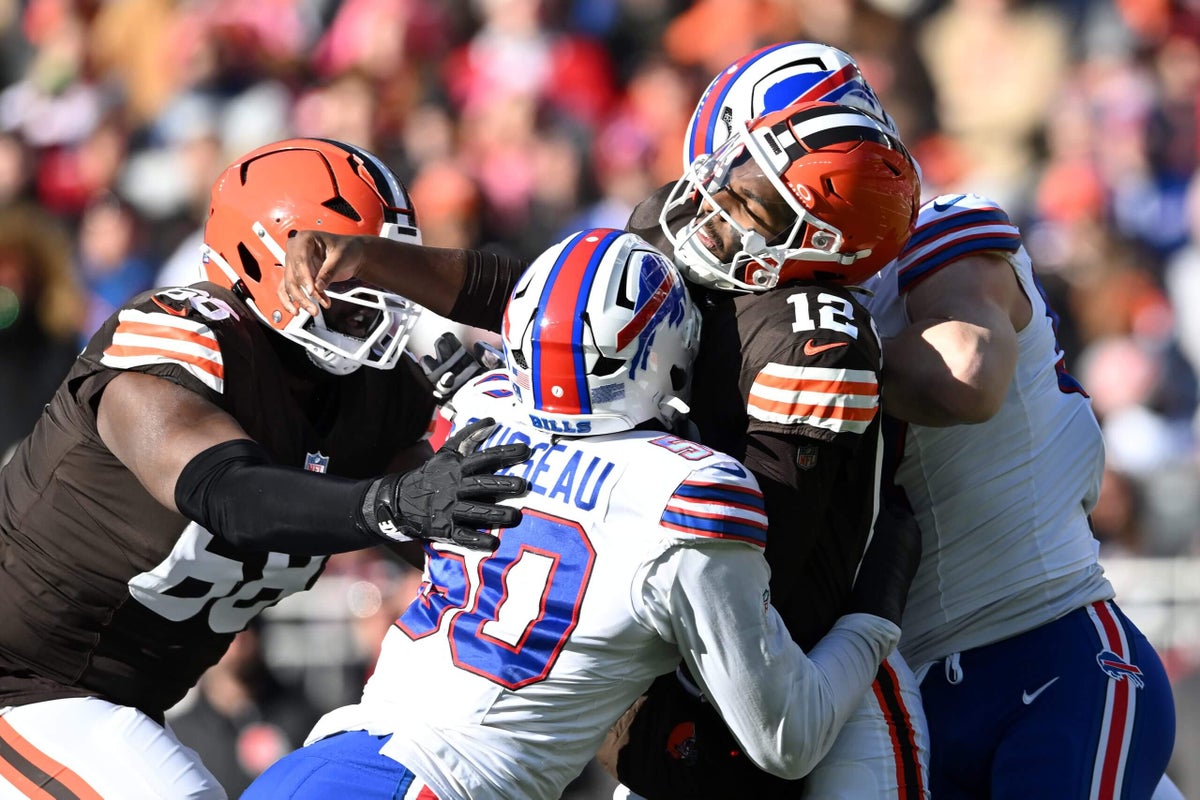
Sanders and the Browns’ offense jogged onto the field with 7:05 left to play Sunday and a chance to win the game. They lost 5 yards on the drive because Sanders was sacked for a loss of 13 on fourth-and-2.
He was sacked again on their final drive and also took an intentional grounding that nearly resulted in a safety, meaning the Browns lost 16 yards on their final two drives when they had a chance to pull off a stunning upset.
On five fourth-down dropbacks this year, Sanders has been sacked three times, according to TruMedia, thrown one incompletion and scrambled for 6 yards on fourth-and-26 before giving himself up and sliding.
When the Browns need something out of their quarterback in gotta-have-it moments, Sanders doesn’t have it.
I’ve been told he still struggles to understand what he’s seeing at times. He doesn’t flip protections very often and he doesn’t have a feel for protection calls or when he’s hot. Some quarterbacks don’t like to flip protections at the line of scrimmage — even an accomplished veteran like Joe Flacco didn’t do it very often when he was here — but Flacco had the awareness to know when he was hot and knew how to get rid of the ball. Too often, Sanders does not. He waits for receivers to be open rather than throwing with anticipation, which leads to holding the ball too long and taking unnecessary sacks.
In his defense, Sanders showed improvement Sunday in getting the ball out faster. His time to throw against the Bills was the quickest it has been all season. His average depth of target of 1.9 yards, however, was tied for the second-lowest in the league over the last two years, according to TruMedia, and his aDot was less than 1 yard for most of the game Sunday. Much of that can be attributed to the way the Bills defend with two high safeties.
Sanders, to his credit, is trying to get better at reading what he’s seeing. Still, he needs to be elsewhere next season.
Sanders is out of time to prove he’s the starter, and he can’t be the backup here behind another rookie. The noise surrounding him is too disruptive. Teams would tolerate all the noise if his play on the field warranted it. It has not to this point. Will the Browns live to regret giving up on him if he flourishes elsewhere? Perhaps, but they have no other choice.
I briefly wondered if they could run it back with Sanders as their starter next year, use their top picks to fill other pressing needs and then target a quarterback in 2027 if it didn’t work with him. That was before they continued to creep up the draft board and before Sanders demonstrated against the Bears and Bills that he just isn’t ready yet.
The Browns are up to third in the draft, and a loss next week to the Pittsburgh Steelers at home will nudge them up to second after someone wins between the New York Giants and Las Vegas Raiders. The Browns will leap the winner of that game based on strength of schedule. It’s not out of the question that the Browns could fumble their way into the top pick of the draft.
It could mean a blowout of everybody currently employed at headquarters, but it could also mean the opportunity to take a franchise quarterback without having to trade other valuable pieces to move up. The Browns need to rebuild their offensive line and they need more playmakers on the outside. None of it will matter, however, until they fix quarterback.
For those who may not understand why I keep referring to EPA as a guiding metric, it’s the best stat to remove emotion and simply look at the data. It takes into account down and distance, field position, time remaining, timeouts and venue (home or away). It is the single best metric for determining success at the most important position on the field.
Throw out Sanders’ dismal performance when he was rushed into duty against the Baltimore Ravens, just study his first five starts, and the numbers aren’t much better.
The names at the top of EPA/dropback through the first five career starts are names you’d expect to see, even with such a small sample size. Tony Romo, Patrick Mahomes, Philip Rivers, Ben Roethlisberger and Jayden Daniels are the top five since 2000. The top 20 is littered with other top names like Dak Prescott, Brock Purdy, Aaron Rodgers and Justin Herbert.
How can the Browns bet the long shot with the high draft pick they’re about to possess?
The Browns appear to be running out of time. All of them. This coaching staff, front office and, yes, even Sanders. More new faces, more fresh starts. Same old Browns.