
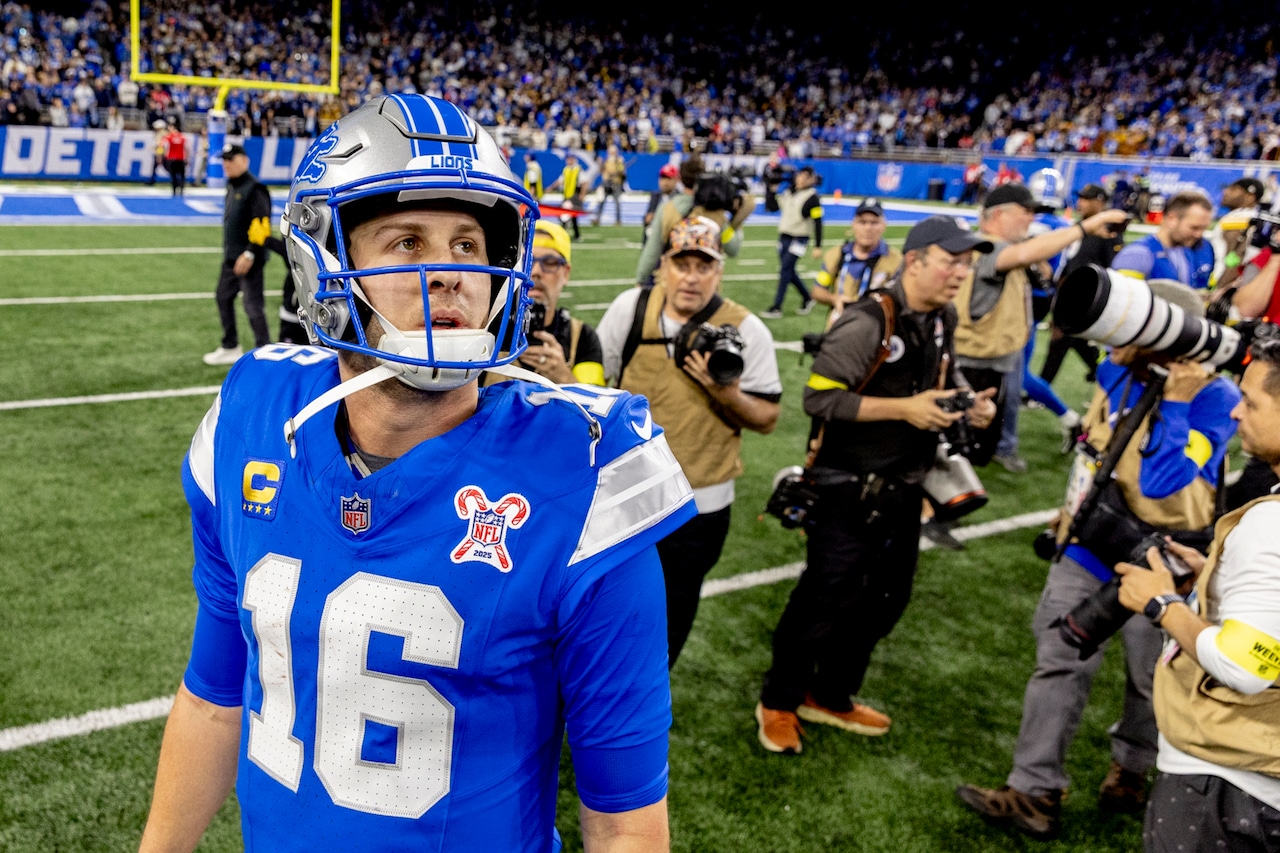
The Detroit Lions desperately needed to play their best football and secure a win in their regular-season home finale to breathe life into their postseason hopes and keep a puncher’s chance at a third consecutive division title.
Instead, by the final whistle — one that was controversial, to say the least — the Lions’ playoff odds dropped to somewhere between 6% and 16%, depending on the outlet, after a 29-24 Week 16 loss to the Pittsburgh Steelers.
On both sides of the ball, the Lions were overwhelmed in the trenches. They failed to establish a running game and were unable to stop the Steelers from doing precisely that. Defensively, they couldn’t make life difficult for Aaron Rodgers, while offensively, they made things harder on their own quarterback, Jared Goff.
Above all, questionable coaching decisions left the Lions closer to elimination than to clinching a playoff berth as their postseason path continues to narrow.
Quarterback: Jared Goff was in for a rough afternoon as early as the second play of the game, when the pocket collapsed, and he was quickly taken to the ground — a theme that persisted throughout the day. He had little time or room to operate, but still completed roughly 63% of his passes, throwing for more than 364 yards and three touchdowns, and posting a 101.2 passer rating. With the run game ineffective, Goff put the team on his back over the final three drives, resulting in two touchdowns and nearly one of the more memorable walk-off scores in Ford Field history after catching a lateral from Amon-Ra St. Brown and diving into the end zone. The play would have stood as the game-winner if not for an offensive pass interference call. Grade: A
Running backs: When the Lions can’t run the ball, they can’t win. A significant part of that issue was the offensive line’s inability to create lanes for Jahmyr Gibbs and David Montgomery, which is worth noting. Still, finishing with 15 rushing yards is a recipe for disaster and rendered the offense completely one-dimensional. Montgomery’s 17-yard run was the longest of the game as the Lions posted their lowest single-game rushing output since 1970. Gibbs’ unforced fumble on the opening drive foreshadowed a difficult day for the unit. He did contribute in the passing game, catching 10 passes for 66 yards and a touchdown, but the overall impact was minimal. Grade: D-
Wide receivers/tight ends: It was a rough day for Amon-Ra St. Brown, who had a few uncharacteristic drops and drew an offensive pass interference penalty on the game’s final play — the correct call — that wiped out Goff’s potential game-winning touchdown. Jameson Williams eclipsed the 1,000-yard mark on the season, finishing with five receptions for 70 yards. Kalif Raymond and rookie Isaac TeSlaa delivered when their numbers were called, each catching four passes and a touchdown. Tesla’s offensive pass interference penalty on the final drive negated a St. Brown go-ahead score, though the call was questionable. Anthony Firkser also contributed, with two early receptions of 18 and 14 yards on the opening drive to help extend it. Grade: B+
Offensive line: From Jared Goff absorbing nine quarterback hits and three sacks — one of them a safety — to the inability to create running lanes for Jahmyr Gibbs and David Montgomery, it was a rough day for Hank Fraley’s group. Kingsley Eguakun and Michael Niese briefly filled in for the injured Graham Glasgow, and the drop-off in pass protection was noticeable early. The unit’s inefficiency played a significant role in the Lions’ offensive struggles throughout the game. Christian Mahogany saw his first action since returning from a lower-leg injury and was responsible for two of the three sacks Goff took. Grade: F
Defensive line: Remove the two sacks recorded by Aidan Hutchinson, and this was a largely forgettable performance. The unit failed to generate consistent pressure on Aaron Rodgers, finishing with just three quarterback hits, and once again struggled to stop the run. The Steelers rushed for 230 yards, including 198 in the second half alone. Outside of Hutchinson, the unit recorded only one additional tackle for loss, which came from a struggling Alim McNeill. Grade: D
Linebackers: Jack Campbell was in position early on the fumble recovery and was solid against the run, but the unit as a whole struggled. Jaylen Warren scored twice, with Derrick Barnes and Alex Anzalone beaten in coverage on both plays. Anzalone was also in coverage on Kenneth Gainwell’s improbable catch near the end of the first half, a play that tied the game at 10-10. He was slow to get to his feet and unable to prevent Gainwell from reaching the end zone. Along with the defensive line, the linebackers shared responsibility for the Steelers’ success on the ground. Grade: D-
Secondary: The lone positive for this group was that it didn’t surrender another 360-plus passing yards, something that happened in three of the previous four games. Still, it marked a fifth consecutive contest in which an opposing quarterback threw for at least 250 yards. Thomas Harper turned in an admirable performance, finishing with seven tackles, a tackle for loss, and a pass deflection. He was also around the ball on the Darnell Washington fumble. Washington later delivered a big hit on D.J. Reed on a screen pass that drew an offensive pass interference penalty and erased a touchdown. Reed hasn’t looked the same since returning from his hamstring injury. Grade: D
Special teams: Jake Bates and Jack Fox handled their responsibilities, with Bates converting his lone 36-yard field goal and Fox averaging 53 yards per punt. Jacob Saylors and Tom Kennedy were effective on kick returns, averaging 27 yards per return, each with a long of roughly 30 yards. Punt returns were another story. Raymond totaled just 16 yards and had a second-quarter mishap when he failed to signal for a fair catch, a decision that could have ended far worse. Grade: B-
Coaching: While three points didn’t ultimately decide the game, opting to go for it on fourth down from the Steelers’ 3-yard line instead of taking a chip-shot field goal from Jake Bates continued a trend of questionable fourth-down decisions by Dan Campbell. Although the offense has regained life since Campbell assumed play-calling duties, the choice added unnecessary pressure to chase points rather than play a more measured brand of football against a tough Steelers team. At times, his feel for the game hinders the team as much as it helps. Additionally, the offense’s tempo and urgency on the final three drives stood in stark contrast to earlier possessions — a pace the Lions have shown only when trailing. The offense has been at its best operating that way. The question remains: why does it take desperation to unlock it? Grade: D