
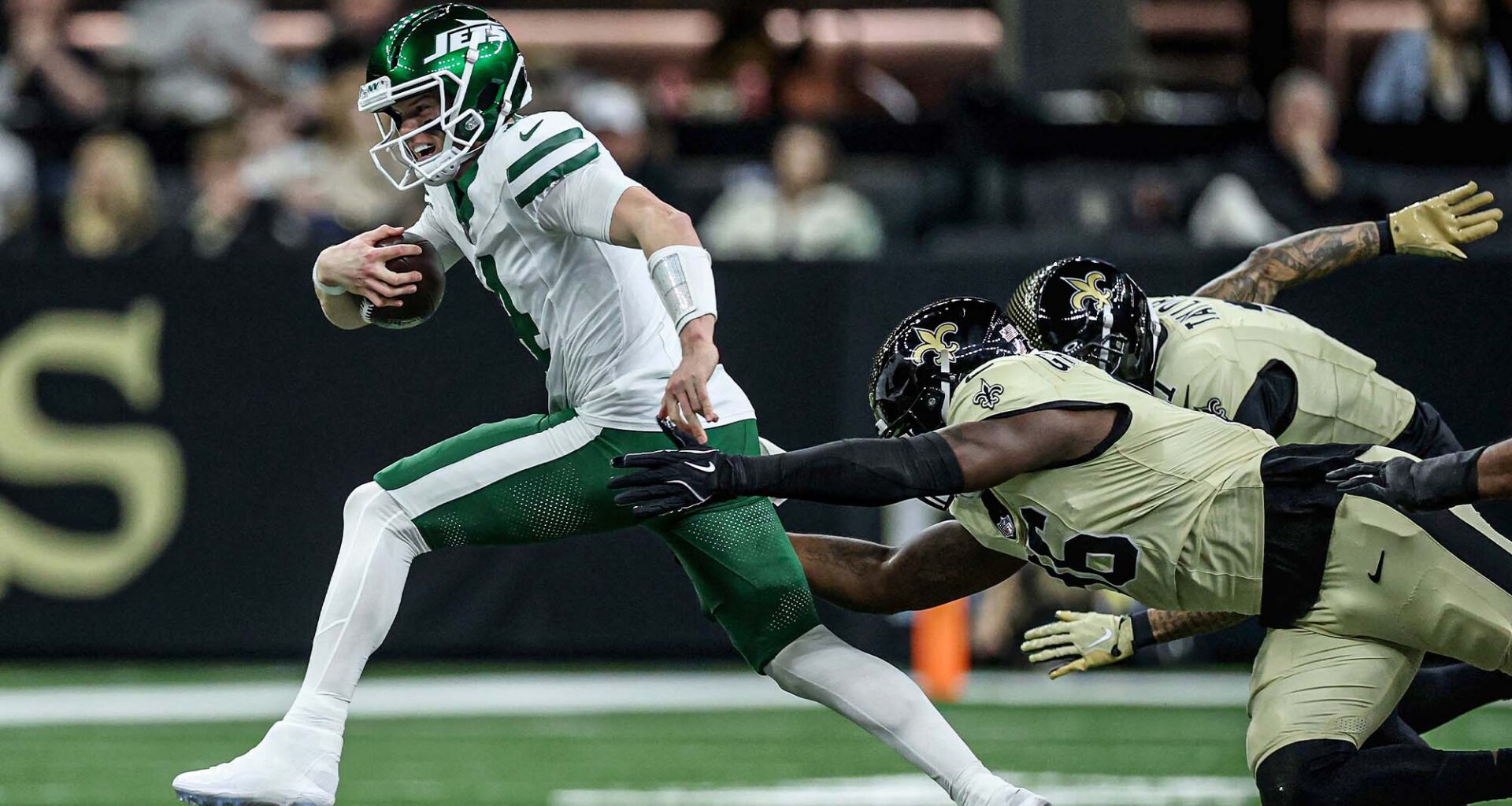
As the Jets prepare to welcome a rookie quarterback in 2026 (a possibility that is only becoming likelier as they fly up the draft board), the most crucial part of the roster to fortify is their offensive line.
In a broader sense, we can include the team’s entire pass-protection unit, encompassing the tight ends, running backs, wide receivers, and coaches, for their respective roles in protecting the quarterback.
On the surface, it might seem like the Jets are failing miserably in this regard. Their current starting quarterback, Brady Cook, was sacked eight times in the team’s recent loss to the New Orleans Saints. It brought the Jets to a league-leading total of 58 sacks in the 2025 season.
That might send the message to fans that New York isn’t ready to protect a young quarterback, be it Fernando Mendoza, Dante Moore, or Ty Simpson. This, however, is a fallacy, one that can be exposed through a plunge into the numbers.
Jets’ OL was not as bad as it looked (again)
Whenever a quarterback takes eight sacks, as Brady Cook did on Sunday, the offensive line is going to absorb the brunt of the blame.
That isn’t always fair, and this is one of those cases.
Most of the sacks taken by Cook in New Orleans were his own fault. Based on Pro Football Focus’ tracking, the Jets’ blockers (offensive linemen or otherwise) were blamed for only two sacks in New Orleans: one apiece for center Josh Myers and right guard Joe Tippmann.
Overall, the Jets’ offensive line actually did a very nice job. Cook was pressured on just 25% of his dropbacks (11 of 44), the sixth-lowest rate among quarterbacks in Week 16.
However, across the mere 11 dropbacks on which Cook was pressured, the rookie allowed himself to be sacked on eight of them. That’s a shocking pressure-to-sack rate of 72.7%, the highest mark of Week 16 by over 17% compared to the second-ranked quarterback, fellow rookie Jaxson Dart (55.6%).
In fact, Cook’s 72.7% pressure-to-sack rate is the worst mark of the 2025 season by any qualified NFL quarterback in a game, and it isn’t particularly close. The previous high was 60%, achieved by three passers, one of them being Cook himself:
Steelers’ Aaron Rodgers (3 sacks on 5 pressures in Week 9)
Dolphins’ Tua Tagovailoa (3 sacks on 5 pressures in Week 11)
Cook (6 sacks on 10 pressures in Week 14)
The 2025 league average is 17.7%, putting into perspective how shocking it is to see a quarterback take eight sacks on 11 pressured dropbacks. At that volume of pressure, the expectation is that Cook takes about two sacks; he quadrupled that number.
Cook’s sack-stravaganza continues a year-long trend for New York. While the Jets’ offense has taken a league-high 58 sacks, New York owns the 15th-best team-wide pass-blocking grade at Pro Football Focus (67.3). This disparity indicates that the quarterbacks are to blame for the abundance of sacks, not the pass protection.
Between Cook, Tyrod Taylor, and Justin Fields, the Jets’ quarterbacks have hung the offensive line out to dry all year long. All three quarterbacks have a pressure-to-sack rate above the 2025 league average of 17.7%.
Cook is the worst of the bunch (and the NFL) at 53.1%, which is in its own stratosphere. His predecessors were not quite as bad, but Justin Fields’ 23.3% rate still ranks sixth-worst out of 39 qualified passers, while Tyrod Taylor’s 19.7% is semi-respectable, ranking 14th-worst.
The Jets’ offensive line has not been a juggernaut this year, but it clearly has not been anywhere close to as bad as the team’s league-worst sack total would suggest. This has been an approximately league-average offensive line, made to look worse by a trio of sack-prone passers (the latest being sack-prone to an unfathomable degree).
Considering the offensive line’s youth and the challenge of blocking for these types of quarterbacks, the foundation has been laid for this unit to climb into the elite ranks in 2026. The marriage between the Jets’ blocking and quarterbacks has been completely out of sync all year, and yet, the offensive line has still managed to put up respectable numbers in OL-focused metrics.
That isn’t easy to do; although those metrics (PFF grades, pressure rates, sacks allowed, etc.) are supposed to be contextualized, evaluating the blockers independently of their surroundings, there is still a heavy correlation between a QB’s ability to protect himself and his OL’s performance in OL-focused metrics. The quicker the QB gets the ball out and the better he is at dodging sacks, the better the OL will look, whether you’re evaluating them via something as basic as the team’s sack total or something more advanced like their PFF grades or pressure rates.
For the Jets’ offensive line to sustain average-to-good numbers in OL-focused metrics shows how productive this group could become if it is lucky enough to be paired with a competent quarterback who can get the ball out in rhythm with the protection scheme.