
Kansas City Chiefs Chairman and CEO Clark Hunt said the decision to leave Arrowhead Stadium was painful, but ultimately driven by timing, certainty, and a more straightforward path forward offered by Kansas.Speaking after Monday afternoon’s announcement that the Chiefs will build a new domed stadium and mixed-use district across the state line, Hunt said Missouri leaders remained engaged until the end. Still, unresolved issues and a complex approval process stalled progress.“We had a great dialogue with Missouri all the way through the end of last week,” Hunt said. “Just frankly, not everything was resolved that needed to be resolved. The big difference is we were working with one party here, the State of Kansas, and in Missouri, we were working with the governor’s office, the county, and also the city. We just didn’t get there for the timeline.”Since Question 1’s failure in Jackson County, Missouri elected a new governor, and Jackson County voters successfully recalled former County Executive Frank White. After the 2024 election in Jackson County, it took Kansas under 90 days to approve an initial STAR bonds proposal for the Chiefs and the Kansas City Royals. It took the State of Missouri’s legislature over 400 days for a stadium package to be approved. The Chiefs will move to Kansas after more than 50 years at Arrowhead, one of the NFL’s oldest and most iconic venues.Hunt acknowledged the emotional weight of that decision, especially for fans.“There is some pain on leaving Arrowhead, and I’ll be at the top of that list,” Hunt said.Hunt said the team will look to preserve Arrowhead’s well-established tailgating culture and record-setting noise.Fan surveys, Hunt said, communicated those two priorities for any new stadium. Kansas Gov. Laura Kelly announced the agreement Monday, calling it a “game changer” for the state.The deal includes a roughly $3 billion domed stadium in Wyandotte County, a $300 million team headquarters and training facility in Olathe, and at least $700 million in surrounding mixed-use development.Hunt said the dome was an important part of the Kansas plan and aligns with the franchise’s long-term vision.“It gives Kansas City the opportunity to bid on events we can’t host right now, like Super Bowls, college football playoff games, and NCAA Final Fours,” Hunt said.The stadium and training complex will be a public-private partnership, with a 60-40 arrangement between the Chiefs and the State of Kansas. Hunt said decisions on personal seat licenses have not been made but will be evaluated as plans take shape.Hunt thanked Missouri for decades of partnership and said that the decision was made with fans and the franchise’s future in mind.“At the end of the day, we made a decision as a family that this was the right opportunity and the best thing for the organization,” Hunt said.The new stadium is expected to open for the 2031 NFL season.
KANSAS CITY, Mo. —
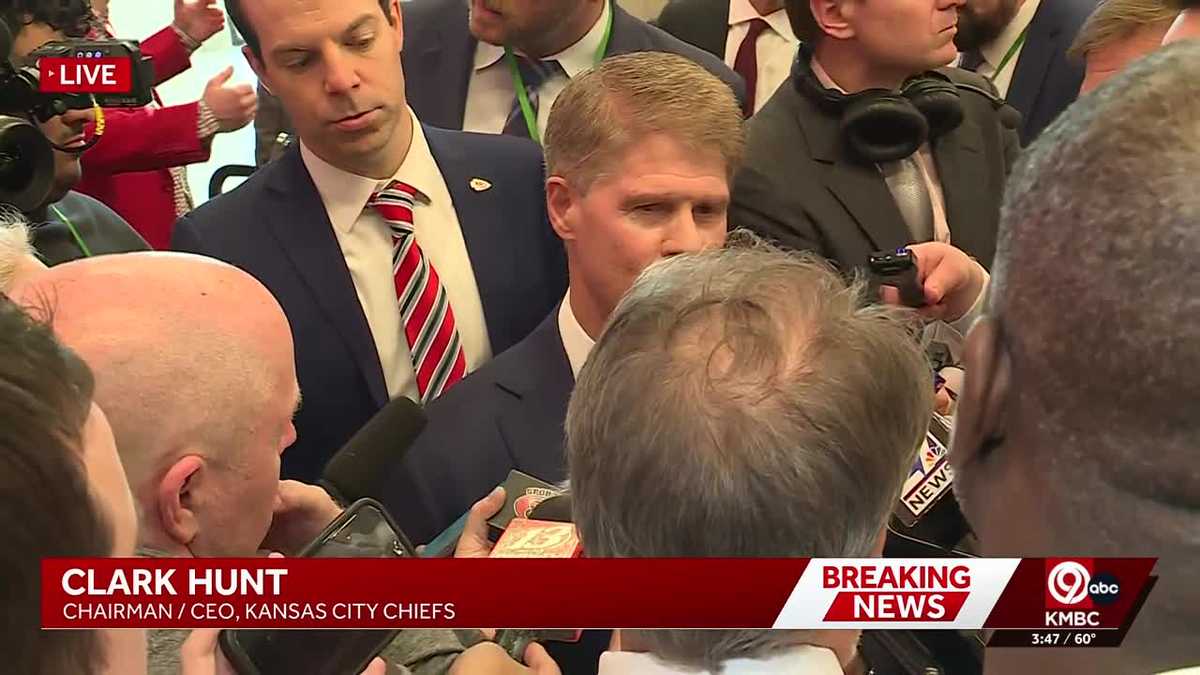
Kansas City Chiefs Chairman and CEO Clark Hunt said the decision to leave Arrowhead Stadium was painful, but ultimately driven by timing, certainty, and a more straightforward path forward offered by Kansas.
Speaking after Monday afternoon’s announcement that the Chiefs will build a new domed stadium and mixed-use district across the state line, Hunt said Missouri leaders remained engaged until the end.
Still, unresolved issues and a complex approval process stalled progress.
“We had a great dialogue with Missouri all the way through the end of last week,” Hunt said. “Just frankly, not everything was resolved that needed to be resolved. The big difference is we were working with one party here, the State of Kansas, and in Missouri, we were working with the governor’s office, the county, and also the city. We just didn’t get there for the timeline.”
Since Question 1’s failure in Jackson County, Missouri elected a new governor, and Jackson County voters successfully recalled former County Executive Frank White.
After the 2024 election in Jackson County, it took Kansas under 90 days to approve an initial STAR bonds proposal for the Chiefs and the Kansas City Royals.
It took the State of Missouri’s legislature over 400 days for a stadium package to be approved.
The Chiefs will move to Kansas after more than 50 years at Arrowhead, one of the NFL’s oldest and most iconic venues.
Hunt acknowledged the emotional weight of that decision, especially for fans.
“There is some pain on leaving Arrowhead, and I’ll be at the top of that list,” Hunt said.
Hunt said the team will look to preserve Arrowhead’s well-established tailgating culture and record-setting noise.
Fan surveys, Hunt said, communicated those two priorities for any new stadium.
Kansas Gov. Laura Kelly announced the agreement Monday, calling it a “game changer” for the state.
The deal includes a roughly $3 billion domed stadium in Wyandotte County, a $300 million team headquarters and training facility in Olathe, and at least $700 million in surrounding mixed-use development.
Hunt said the dome was an important part of the Kansas plan and aligns with the franchise’s long-term vision.
“It gives Kansas City the opportunity to bid on events we can’t host right now, like Super Bowls, college football playoff games, and NCAA Final Fours,” Hunt said.
The stadium and training complex will be a public-private partnership, with a 60-40 arrangement between the Chiefs and the State of Kansas.
Hunt said decisions on personal seat licenses have not been made but will be evaluated as plans take shape.
Hunt thanked Missouri for decades of partnership and said that the decision was made with fans and the franchise’s future in mind.
“At the end of the day, we made a decision as a family that this was the right opportunity and the best thing for the organization,” Hunt said.
The new stadium is expected to open for the 2031 NFL season.