
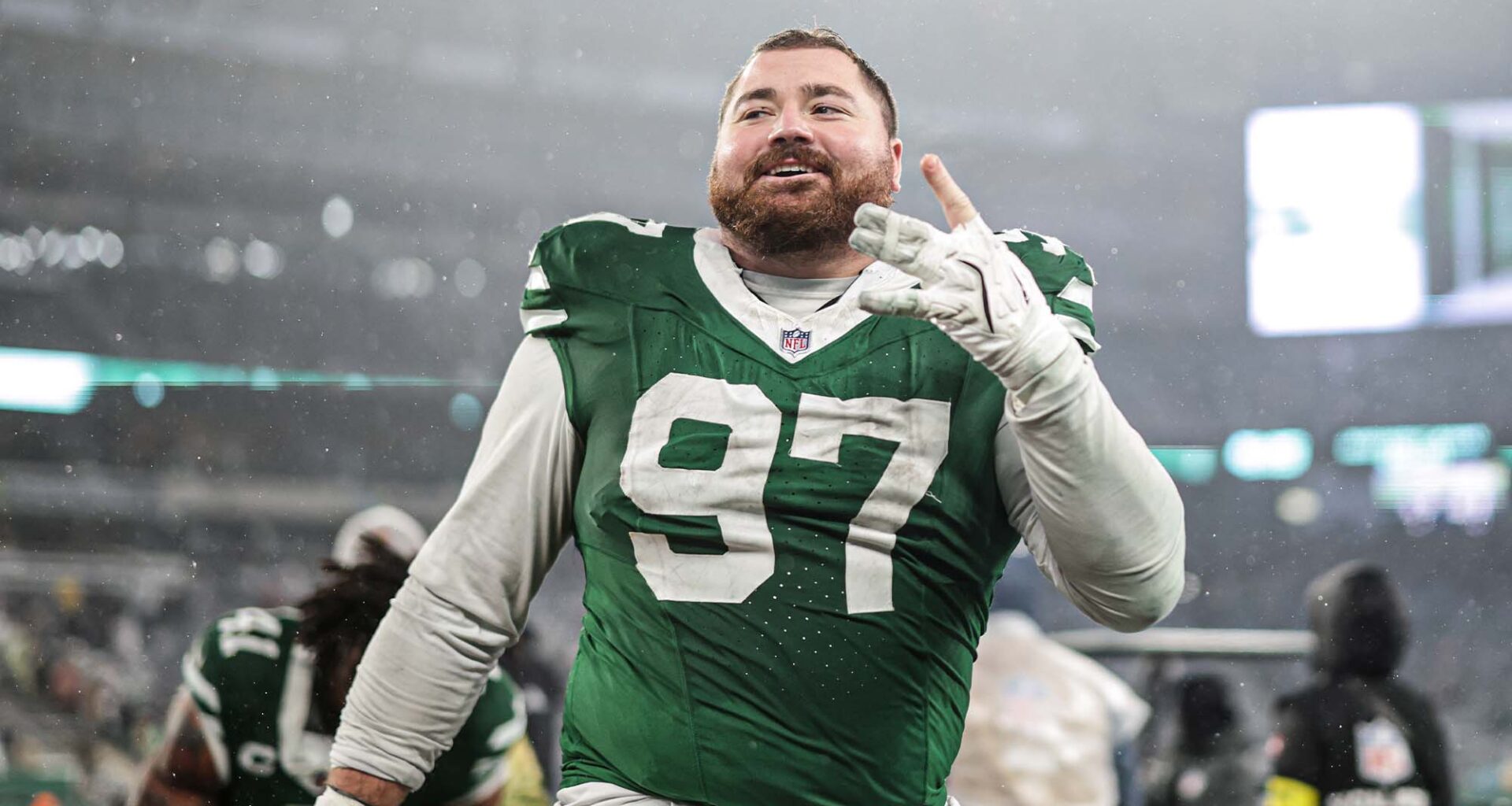
The 2025 New York Jets are two games away from being put out of their misery. Then, the team can finally put this nightmarish season behind them and begin utilizing their sparkling slew of assets to lay the foundation for brighter days.
For months now, the Jets’ games have been useful for nothing more than evaluating players on the roster who could be a part of the team’s future. While most of the focus in that department lies on the team’s young pieces, it is also important for the Jets to evaluate the veteran players who could contribute to the squad in 2026.
Veterans like Quincy Williams and Breece Hall have been under the microscope all year. However, not much attention has been paid to a particular longtime vet whose future represents one of the Jets’ most interesting decisions of the 2026 offseason: defensive tackle Harrison Phillips.
The Jets’ Harrison Phillips situation
The 29-year-old defensive tackle is under contract with New York through the 2026 season, when he is slated to have a cap hit of $7.5 million. However, it is completely non-guaranteed. The Jets can release Phillips to clear $7.5 million in cap space without owing any dead money.
New York isn’t in desperate need of cap space. The Jets are currently projected to have $90.9 million of cap space in 2026, per Over The Cap, ranking fourth-highest in the NFL.
However, Phillips’ contract situation is noteworthy because it represents the Jets’ only viable option to clear a significant chunk of space. Beyond Phillips, the Jets do not have a single player who would yield even just $2 million in cap space if released, let alone anywhere close to $7.5 million.
The Jets’ second-highest potential cap yield for a release belongs to Joe Tippmann at $1.9 million, and he isn’t getting cut. After Tippmann, it’s Jeremy Ruckert at $1.3 million, who also isn’t going anywhere after signing an extension just last week.
Once the offseason rolls around, most (if not all) NFL teams will have more flexibility to clear cap space than the Jets. By the time we get to March, the Jets’ cap situation won’t look quite as sublime relative to the rest of the league. They will still be in great shape, but for a team with perhaps the worst roster in the NFL between offense and defense, they need every penny they can scrape up to improve the team.
That leaves the Jets in a catch-22 with Phillips. He has been a valuable presence for the Jets in 2025, but he is also on the brink of turning 30, while offering the best path to increased financial flexibility for a team that needs as much of it as possible.
General manager Darren Mougey has to answer a simple question: Is Phillips worth a $7.5 million cap hit in 2026?
Is Harrison Phillips worth $7.5 million?
Any conversation about Phillips has to begin with his off-field value.
A former Vikings team captain and three-time Walter Payton Man of the Year award nominee, Phillips is a gem of a human whose locker-room impact can be felt through every word he speaks to the media. He offers the type of leadership presence that can be integral to turning around the culture of a star-crossed franchise like the Jets.
Phillips is about as cerebral a football player as you’ll find, offering a deep level of insight to the media that stands out as a needle in a haystack amidst a sea of cookie-cutter answers. Considering that he probably goes into ten times as much detail with his teammates and coaches, it cannot be understated how valuable his insight is to the Jets’ young defenders.
“it’s really fun. I had to adjust my game to how fast they’re coming downhill”
Harrison Phillips on playing with LBs Jamien Sherwood and Quincy Williams pic.twitter.com/50BhhCGJ6U
— New York Jets (@nyjets) September 4, 2025
There is no disputing Phillips’ off-field value. For a $7.5 million cap hit, though, he has to bring excellent impact to the field, too. That number is currently slated to rank 38th among defensive tackles in 2025, which means he should be expected to perform like a high-level DT2. Has he done that for the Jets in 2025?
This is where things get a little complicated.
Phillips remains an excellent run defender. Through 15 games in 2025, Phillips is tied for 16th among defensive tackles with 21 run stops, per Pro Football Focus. He also has a 70.3 PFF run defense grade, placing 10th out of 89 qualifiers (min. 160 run defense snaps).
Phillips blowing up another run
Back doors the center, ripping the inside arm, throw the right arm out into the LG (what I call a chicken wing) to control the spacing of the a-gap
Cuts off the RB and tracks him down for the tackle pic.twitter.com/ypJ368MFyQ
— Joe Blewett (@Joerb31) December 23, 2025
When it comes to stopping the run, Phillips is still one of the sport’s premier players. The problem is that he might be the least productive pass rusher in the NFL among starting defensive tackles.
Across 15 games and 299 pass-rush snaps for the Jets, Phillips has recorded zero quarterback hits, a half-sack, and just eight total pressures.
Among the 89 defensive tackles with at least 200 pass-rush snaps, Phillips’ 2.7% pressure rate is the worst. He also ranks 84th in pass-rush win rate (3.5%) and 75th in PFF’s pass-rush grade (56.1).
To put into perspective how quiet Phillips is against the pass, consider that he has finished with zero pressures in 10 of the Jets’ 15 games this year. Each of those games was a start in which Phillips played at least half of the Jets’ defensive snaps.
In the Jets’ most recent game, a 29-6 loss to the Saints, Phillips registered zero pressures on 30 pass-rush snaps. His lackluster pass rushing has quietly been among the most significant detriments to the Jets’ defense this year, contributing heavily to New York placing second-worst in sacks (25).
With strong numbers against the run but almost no ability to affect the passing game, Phillips is a player who would be best suited in a backup role where his snaps lean toward early-down situations. He has been miscast as a starter for the Jets’ talent-starved defense, especially after the Quinnen Williams trade.
Not to mention, with Phillips set to turn 30 years old in January, his production is likelier to decline than improve in future years.
Overall, Phillips profiles as a solid rotational run-stuffer in 2026.
Is that worth $7.5 million?
Run stuffing still has value in today’s league, but as we all know, this is a passing league first and foremost. So far in 2025, NFL teams have employed an approximately 60%/40% split between passing dropbacks and designed rush attempts.
Pass-game impact is more valuable than run-game impact, if for no other reason than pass plays are 1.5 times as common as run plays. Thus, players who excel in the run game but do little to impact in the pass game are becoming less coveted.
Phillips does not profile as a player worth $7.5 million for the Jets. However, due to his off-field value and tremendous skills against the run, he is still a player worth having around for the right price.
Therefore, the Jets should try to bring Phillips back at a reduced cost.
How the Jets should handle Phillips
Phillips’ contract structure gives the Jets leverage to negotiate a pay cut. They can release him to clear his entire salary off the books, which would leave Phillips vulnerable to the uncertainty of the open market. That could make it appealing for Phillips to accept a pay cut for assured money while staying in a familiar situation.
Smart organizations would use this to their advantage. The Jets do not have the reputation of a smart organization, but they can start earning that reputation with shrewd moves like this.
Before cutting Phillips and allowing him to test the market, the Jets should offer Phillips the security of having a guaranteed salary in 2026, in exchange for slicing a few million dollars off his cap hit. Perhaps they can tack on incentives or an extra year onto his contract; there are different ways to sweeten the pot for Phillips while still shaving the cap number.
Let’s be clear: Keeping Phillips around on his $7.5 million cap hit would not send the franchise into a spiraling descent toward relegation to the Arena Football League. Still, it would be good business for the Jets to maximize their leverage in an effort to open up as much team-building flexibility as possible.
The league’s most consistently successful organizations are those that do the best job of producing value on the dollar. Look no further than the Los Angeles Rams, who sold out to win a Super Bowl, only to rapidly climb back into contention by making the most out of minimal cap space and draft picks.
While lazily throwing money around could work for one year (as we saw with the 2015 Jets), it is not the path to sustained contention. Again, this isn’t to say that the Phillips deal is an abomination of colossal proportions that would make Trumaine Johnson blush, but if the Jets want to start proving to their fans that they should be viewed as a competent organization with a modernized team-building approach, they will utilize every avenue at their disposal to help squeeze the most on-field impact out of each penny they spend.
Phillips is a good player and better leader who the Jets should want to have around in 2026. It has to be at the right price, though. There are better ways to utilize $7.5 million in cap space than on a 30-year-old rotational run-stuffing defensive tackle who cannot affect the pass game. The best route forward is to hopefully get Phillips to agree on a pay cut, allowing them to allocate part of his cap hit toward another high-level backup or low-level starter.
In the worst-case scenario, cutting Phillips and allocating the $7.5 million to a more impactful player, whether it’s an offensive weapon or a pass-game-centric defender, would be a more effective use of cap space.
While Phillips has won over Jets fans off the field, emotions cannot get in the way of business when building a football team. The Jets did an excellent job of “culture-building” this year by adding players like Phillips and hiring a coach like Aaron Glenn, and look where it got them:
Update: The Jets’ combined offensive and defensive DVOA has dropped from -40.4% to -42.2%.
Now on pace to be the 7th-worst mark in history (1978-present).
Worst by any NFL team in 16 years & worst all-time by a Jets team (and it’s not remotely close) https://t.co/EjEge3mywN
— Michael Nania (@Michael_Nania) December 22, 2025
The Jets will return to contention by finding talented pass rushers who can help them generate more than zero interceptions and 25 sacks, not by “building a culture.” The only way to truly build a culture is to win, and the only way to win is by accumulating guys with on-field skills that make a direct impact on the scoreboard.
It is critical for New York to be pragmatic about players’ worth, including someone as revered in the locker room as Phillips. There is value to what he offers, but just like any player, he has a price.
The message here for the Jets is simple: Don’t overvalue buzzwords like “culture” and “toughness” in the quest to build a formidable NFL team. This is no slight on Phillips, who is superb at what he does on and off the field; however, valuing run-stuffing and leadership at a $7.5 million cap hit would represent an archaic team-building philosophy.
In his first year leading the Jets, Darren Mougey has made many moves that hint at his possible shrewdness as a GM, with the pick-swap trade for Phillips being one of them. Other examples include multiple additional pick-swap trades (yielding Jowon Briggs and Jarvis Brownlee Jr.), the trade deadline hauls for Sauce Gardner and Quinnen Williams, and a pair of in-season contract extensions.
Mougey’s first true test, however, will be the 2026 offseason, when he must begin capitalizing on the assets that he used the 2025 calendar year to accumulate. His success will not be determined by whether he can win free agency sweepstakes for Le’Veon Bell or make blockbuster trades for Aaron Rodgers, but by whether he can make the most of every ounce of capital that New York spends.
That means Mougey must prioritize value with every move, even those as small as turning $7.5 million into one Harrison Phillips and another valuable player, rather than settling for one Harrison Phillips at the same price. It might seem like a trivial matter—some would argue that it is not even worth discussing due to Phillips’ reputation—but these little moves represent the fine line that separates the NFL’s most complete rosters from its thinnest.
Phillips’ contract situation is just one of many decisions that will shine a spotlight on Mougey’s ability to maximize value.