
The match lasts only 32 seconds.
On one side is a heavyweight from a rival high school. On the other is Mykel Williams, the underdog, at least in terms of weight. Twelve seconds into the match, Williams already has his opponent on the ground. At 14 seconds, he has pounced on his back.
And five seconds after that, Williams has his long arms coiled around the bigger boy like a python on a piglet. There’s no escape.
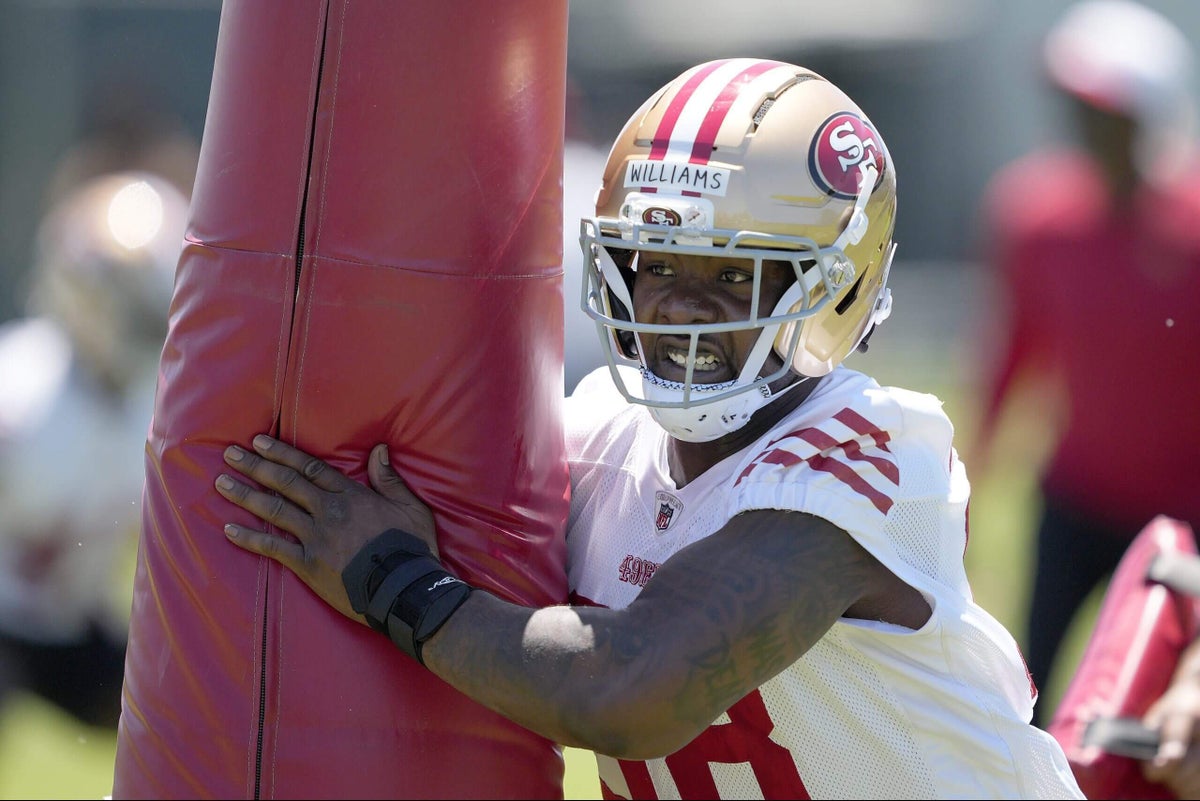
The match might not be a technical masterpiece. Williams had only started wrestling a year or so earlier and was still very much a novice. But his high school mat experience highlights everything the San Francisco 49ers liked about the Georgia defensive end, who signed his four-year rookie contract Thursday.
The first is that Williams has been longer and stronger than his peers since the third grade. When he was 16, he reached the “1400 Club,” which meant his max in the squat, bench-press and power clean totaled 1,400 pounds.
The second is that he’s a relentless worker. Williams only took up wrestling to complement his football skills. Still, he trained, dropped weight and studied books on wrestling, reaching the state championship round as a sophomore.
Finally, he doesn’t say uncle. Though the match below doesn’t show it, Williams’ lack of polish meant his opponents sometimes got the upper hand initially, especially when he encountered more experienced grapplers in regional and state events. But there were no quick pins against Williams, and he developed a reputation as a comeback king.
“He was just a dog, to be honest with you,” Mike Smith, Williams’ wrestling coach at Hardaway High, recalled. “He doesn’t know what quit is. He’d just keep going until it was over.”
Williams grew up in Columbus, Ga., a city of 200,000 on the Alabama border. Like a lot of kids his age, he initially split his time between football and basketball. He had good feet in the paint and a nice touch around the rim. And given he was already 6 feet 1, 210 pounds as a freshman, he was a powerful rebounder.
“He’d be playing Division II basketball if he’d made it his sport,” his father, John Johnson, said. “And that wouldn’t have been a bad thing.”
But although he was good at basketball, his coaches thought he could be special at football. That realization hit them like a thunderbolt during Williams’ sophomore year, when he was invited to a prestigious all-star camp in the state.
He had mostly played along the offensive line as a freshman because Hardaway had suffered an injury at the position and needed bodies. In the all-star game, he’d be playing defensive end, and he asked Hardaway’s head football coach at the time, Michael Woolridge, to give him some pointers. Williams met him on a Sunday before the camp began, and Wooldridge remembers laying out hula hoops and teaching the 15-year-old how to bend and sink his hips.
Then, Woolridge watched with amazement as his protégé collected five sacks.
“These were the top offensive linemen in the state of Georgia,” he recalled. “And he destroyed ’em. He absolutely destroyed ’em. I think that was a turning point. We all saw that he had size and strength, and we always knew he had a chance. But that all-star game, it was an exclamation mark. After that, it was, ‘How high can this kid go?’”
After that game, Williams’ activities were recalibrated. Basketball was out. All the jumping put him at risk of ankle and knee injuries that could impact football.
Wrestling? Smith badly wanted the long, tall sophomore on his squad but knew it would be a tough sell. Few kids in Columbus wrestled, and if they knew anything about the sport, it was from watching the WWE.
“It’s just kind of foreign to them,” Smith said. “Or they look at the singlet and are like, ‘No, I’m not wearing that.’”
But at that point in his career, Smith had developed a successful sales pitch for football-first boys like Williams.
“I showed him the data,” he said. “I said, ‘Look at all the first-round draft picks. Look at Ray Lewis. Look at Roddy White. Look at these guys you think of as great. They were state champions in wrestling.’”
Williams was sold, and he started putting the same work into wrestling as he did football. A relative who had coached wrestling gave him a book to study. And anyone who lived around Columbus’ Lakebottom Park would regularly see Williams running through the park and up the hills to build stamina and cut weight after football season.
“He’s always had that grit,” said Jon Burton, one of Williams’ football coaches who became close to Mykel and his family. “I define Mykel as a high-character kid with an old-school work ethic. The new age (kids) don’t have that.”
As Williams became more and more dominant in high school, those around him realized he had what was needed not just for Division I football but to reach the NFL. He already had a pro body; they wanted to give him a pro mentality, too. Burton began taking him to youth camps to talk to the pee-wee players. He took part in bookbag giveaways and turkey donations around Thanksgiving. Last year, he started his own youth camp in Columbus.
“He’s been brought up the right way, and I think he’s going to continue on that path because it’s stuff he genuinely likes to do,” Burton said.
As far as wrestling and the ways it enhanced his football skills, Williams said it helped his grip strength, balance and body control. He tallied 17 sacks as a high school junior and another 12 1/2 as a senior, and he said the hand fighting he learned in wrestling was an asset in batting away blockers to get to the quarterback.
As a junior, he was able to cut weight from football season and get below the 220-pound mark for wrestling. By his senior year, he’d grown closer to the 260 pounds he weighs today and wrestled in the 285-pound class.
By that point, no other boys at the high school would practice with him. Even the coaches began to bow out.
“We did the best we could,” Smith said. “Me and the other coaches would get in there and roll with him. But I eventually said, ‘I can’t practice with you anymore. You’re grabbing onto me and clubbing my head, and I feel like I’ve got a concussion.’”
One final benefit from wrestling came when a Georgia recruiter, then-Bulldogs assistant coach Dell McGee, arrived to check out Williams. Burton recalls showing McGee the video of Williams pinning his opponent in the cradle. When he pushed play, he saw McGee’s eyes light up.
“That’s the video that got Dell excited,” Burton said. “He called Kirby (Smart) and said, ‘We’ve gotta get this kid!’”
(Photo: Tony Avelar / Associated Press)