
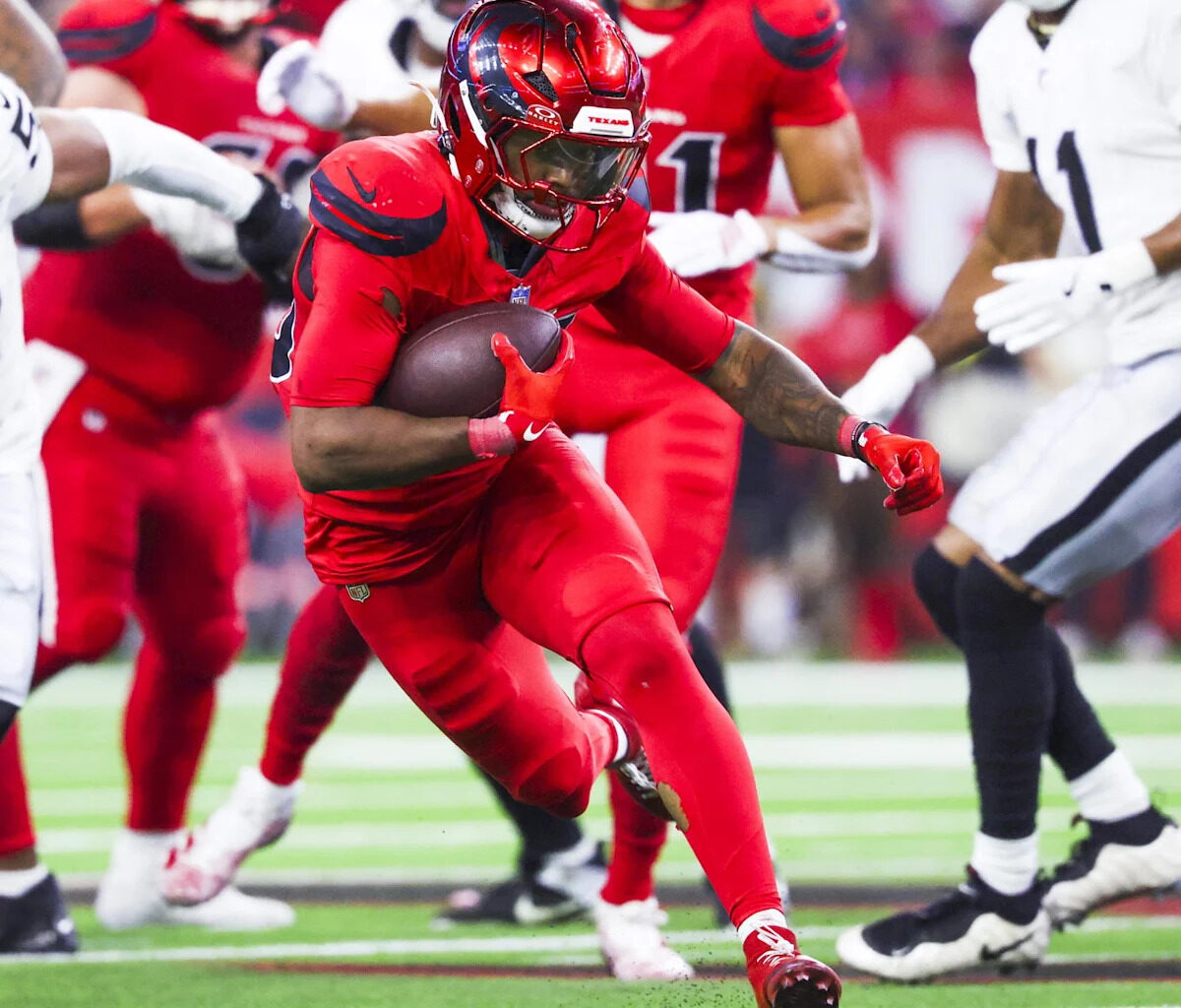
The Houston Texans suffered an offensive regression Sunday afternoon against the Las Vegas Raiders. They narrowly defeated the Raiders by a margin of 23-21, mainly due to how outmatched and overpowered Houston’s offensive unit looked throughout the course of the entire game.
In fact, offensive coordinator Nick Caley and his unit didn’t even engineer a goal-line score until the 7:44 mark in the fourth quarter. It made the score 23-14 in favor of Houston.
Before then, it was a pick-six by cornerback Derek Stingley and three field goals by kicker Ka’imi Fairbairn that kept the team afloat.
Advertisement
All this is made worse when you are reminded that the Raiders were a team on an eight-game losing streak with defensive rankings of higher than 15th in various significant statistical categories.
They had given up at least 24 points to five consecutive opponents, including three games of 31 points or more. Within those point totals, the Raiders allowed their three most recent opponents each to eclipse 150+ rushing yards, 340+ total yards and 10 combined offensive touchdowns.
Instead of Houston following the trend and racking up impact yardage like their many predecessors, fans were on pins and needles as they watched Raiders’ defensive end Maxx Crosby and co. decimate every other play concept that the Texans put on the field.
Advertisement
Texans quarterback C.J. Stroud looked uncomfortable from the first drive, going 23/35 (65.7 cmp%) for 187 yards (5.3 average), one touchdown pass and an 88.6 passer rating. Stroud’s 187 passing yards was the lowest output of his season so far, and his 5.3 yards per attempt was the third fewest (lowest since week seven’s 4.7 against the Seattle Seahawks).
The run game also struggled a bit, gaining only 83 yards on 26 carries (3.19 yards/carry) combined between Jawhar Jordan, a returning Nick Chubb, Dare Ogunbowale and Stroud.
Raiders defensive coordinator Patrick Graham put together an effective game plan that limited much of what the offense wanted to do, making almost every catch contested and every run a fight at the line of scrimmage.
Don’t let the zero sacks fool you; the Raiders defense gave Houston’s offense fits all afternoon long. This was evidenced by the Texans suffering four total 3-and-outs, including a third-quarter drive that went for -8 yards and was arguably their worst offensive sequence of the season (followed by audible boo’s from fans raining down in NRG Stadium).
Advertisement
This was a “back to square one” kind of moment for Caley and the offense. After scoring 40 points and totaling 399 total yards against the Arizona Cardinals the week prior, it felt like the scheme collectively turned back into a pumpkin and reminded fans and media why there’s hesitation with really buying into any serious “contender” talk for the team.
If you take away the pick-six and three field goals, Houston only mustered 7 points as an offense. That was the sixth time all season for Houston to score one offensive touchdown or less in a game (Rams, Jaguars, Seahawks, Broncos, Titans and Raiders). A win is a win, but this one had too much of a stink to it.
That kind of production is unacceptable at this late a stage in the season, but Stroud and the offense know that. Their next game comes against a Los Angeles Chargers defense that ranks third-best in total yards per game (283.1) and eighth-best in scoring (20.1).
Advertisement
On a short week, the Texans have no choice but to learn some tough lessons from the Raiders game and immediately put them into action on the field of play on Saturday afternoon.
Even if it’s against an upper-tier defense, Houston must find a way to devise a comprehensive game plan and overcome its situational football miscues and poor execution on offense. An eighth-straight win, an eleventh total victory and a spot in the AFC Playoffs will be waiting for them if they can pull it off.
Do you think the offense bounces back against the Chargers? Let us know in the comment section below and on the official Texans Roundtable X account, @Texans_RTB!