
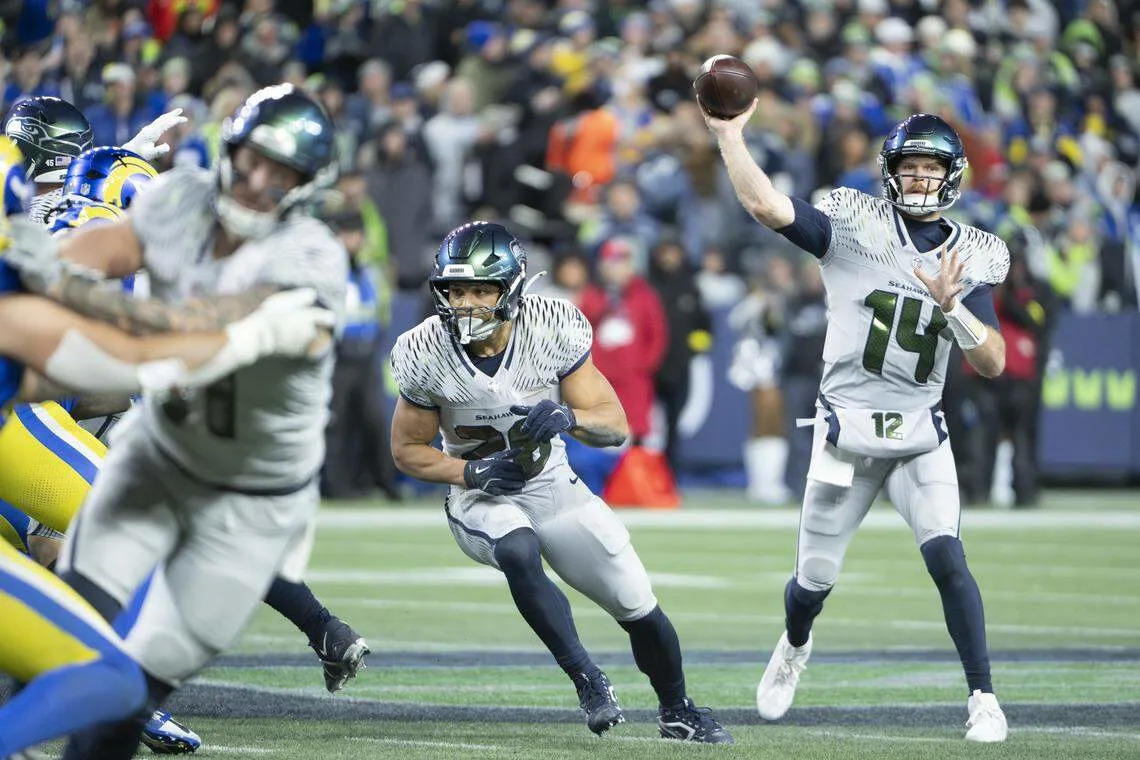
I would not say that I trust Sam Darnold.
I do believe in him, though.
That may sound like a contradiction, but it’s actually a reflection of the mental tug-of-war that I’ve found to be unavoidable when it comes to following sports.
Advertisement
On the one hand, I try to be logical or at least rational in my observations, tempering expectations with the reality of past performances.
And given Darnold’s tendency to throw the ball to opposing players, especially those in Rams attire, it’s hard to feel confident that he’ll guide the Seahawks on a deep playoff run.
On the other hand, I want to remain open to the possibility that players grow and evolve. That they learn from their mistakes, and the more experience they get in high-pressure situations, the better they become at maneuvering through those moments.
Advertisement
This belief in improvement is its own industry in America, and yet when it comes to professional sports, there is a tendency to surrender any and all faith whenever there’s a rough patch. Whether it’s the coach calling stupid plays or the general manager who can’t draft an offensive line or a quarterback with an unfortunate habit of giving the ball away in critical moments, we have a tendency to make sweeping judgments while ignoring the possibility that losses can be lessons.
Darnold is already proof that players do grow.
Three years ago, he was an afterthought in the NFL. Drafted No. 3 overall by the Jets in 2018, he lasted just three years as that team’s quarterback of the future before moving to Carolina for two fairly forgettable seasons.
Advertisement
His career had reached such a low point that it was something of a surprise in 2023 when he went to San Francisco and earned the job as Brock Purdy’s backup. Even that was taken as more a reflection of Trey Lance’s failure than Darnold’s potential.
That season in San Francisco turned out to be a pivot point. He signed with Minnesota in the offseason, became the Vikings starter when the first-round pick J.J. McCarthy suffered a knee injury, and all Darnold has done since is go 26-7 as a starting quarterback, including the playoffs. On Tuesday, he was named to the Pro Bowl for the second straight season.
Now there’s a different suspicion that’s hanging over Darnold’s head. He may be able to rack up regular-season victories, but he’s overwhelmed when the stakes get heightened.
Advertisement
Last season in Minnesota, Darnold was 18-for-41 passing for 166 yards in the regular-season finale against Detroit, the Vikings failing to score a touchdown in a 31-9 loss that decided the division. The next week, in a playoff game against the Rams, Darnold was sacked nine times in a 27-9 loss.
This season with the Seahawks, he has been intercepted 13 times, third-most of any quarterback in the league. Geno Smith, whom Darnold replaced in Seattle, and Tua Tagovailoa are the only two quarterbacks who’ve been picked off more often. Six of Darnold’s interceptions have come in the two games against the Rams, and by the time he was picked for the second time last Thursday, it seemed pretty clear that the difference between the Seahawks and the Rams was their quarterbacks.
Maybe this is something of a ceiling for Darnold. As good as he has become, pressure may be his Achilles heel, whether it’s the pass rush bearing down on him or the magnitude of a big game.
Advertisement
But it’s also possible that the setbacks he has suffered are just the next part of his learning curve. That the disappointing performances at the end of last season in Minnesota and this year in Seattle will leave him callused and better prepared for the next time he’s in that situation. That things will slow down or at the very least not speed up, and he’ll be able to recognize there’s a defensive tackle dropping into coverage and not throw it directly to that opponent.
The fact is that the Seahawks are not 12-3 in spite of Darnold, but 12-3 because of him. This is a team that traded its starting quarterback and top wide receiver in the offseason yet has seen its scoring rise by an average of 7.4 points per game. The Seahawks run the ball as often as anyone in the league, but their big-play passing game is the reason they rank No. 3 in scoring.
Darnold is at the helm of that, and while recent history shows that pressure is an issue, he’s also got an opportunity to change that over the next two regular-season games and in the playoffs this January.
Advertisement
Do I trust Darnold will be able to carry the Seahawks on a deep postseason run? I wouldn’t go that far, but I am choosing to believe that he can.
Danny O’Neil was born in Oregon, the son of a logger, but had the good sense to attend college in Washington. He’s covered Seattle sports for 20 years, writing for two newspapers, one glossy magazine and hosting a daily radio show for eight years on KIRO 710 AM. You can subscribe to his free newsletter and find his other work at dannyoneil.com.