

On Tuesday, New York Jets head coach Aaron Glenn announced that the team placed quarterback Justin Fields on injured reserve, ending his 2025 season.
Despite being inked to a two-year deal last offseason, given how rough Fields’ first year with the Jets was, including a 2-7 record over his nine starts and a mid-season benching, there is a significant chance that Fields and the Jets part ways this offseason.
Today, we break down Fields’ contract and explain the cap ramifications if he and the Jets part ways this offseason.
Explaining Fields’ contract
Fields signed a two-year, $40 million contract this offseason, which included $30 million guaranteed. He remains under contract for next season and is owed $10M in guaranteed salary.
His cap hit for 2026 is currently set at $23M after carrying just an $8M cap number this season. Beyond next year, there is no guaranteed money remaining on his deal.
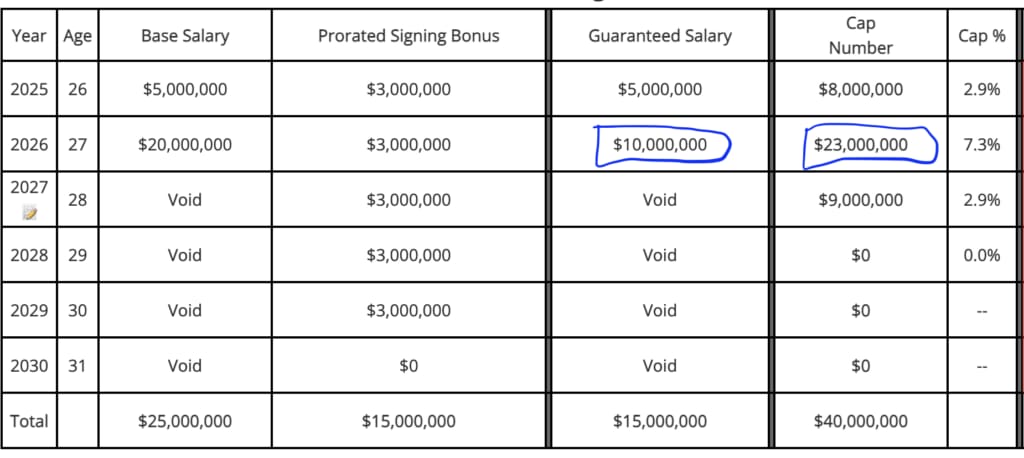 Justin Fields’ contract data, per Over the Cap
Fields also has a void year in 2027 that carries a $9M cap hit. Void years function as placeholder seasons added to a contract to spread out money, but once a deal reaches a void year, any remaining bonus money accelerates onto that season’s cap.
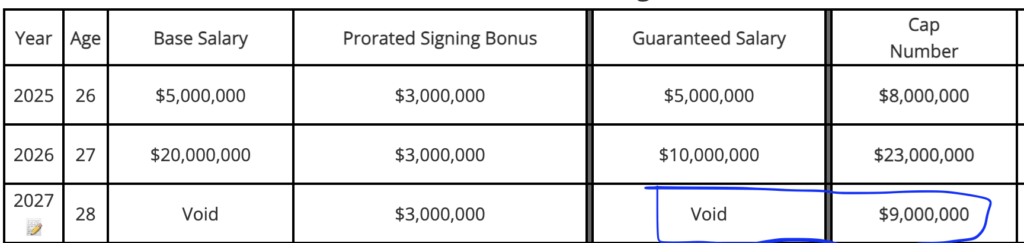
How the Jets can part ways with Fields
Cut, pre-June 1
New York can move on by releasing Fields before June 1. In that scenario, the Jets would absorb a $22M dead-cap charge on this offseason’s cap, saving just $1M, along with a $9M hit in 2027.
Two additional void years would then be added in 2028 and 2029. The dead-cap charge would be $6M in 2028 and $3M in 2029.
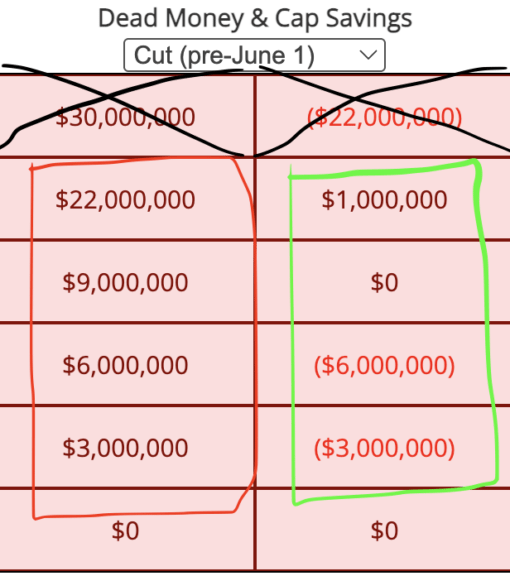
Cut, post-June 1
Designating Fields as a post-June 1 cut would allow the Jets to spread the cap impact over multiple seasons.
Instead of absorbing a $22M dead-cap hit this offseason, New York would carry $13M on the 2026 cap, while creating $10M in cap savings.
The final effects would come in the form of void years, with a $3M dead cap hit from 2027-2029. $6M in savings would also be created in 2027.
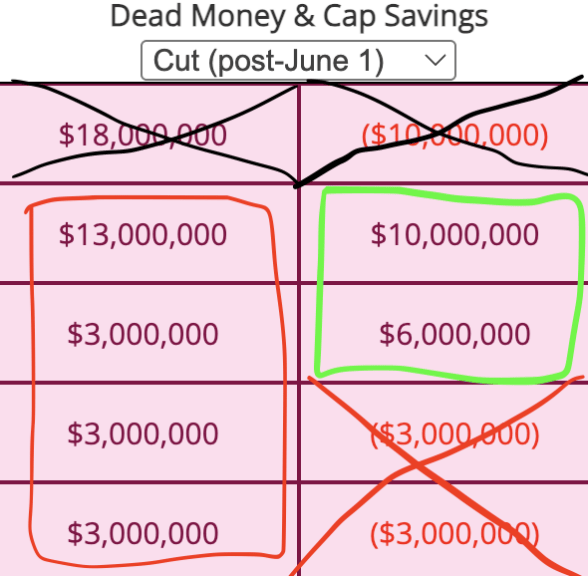
Evaluating the options
It is important to note that the prorated signing bonus is money the Jets have already paid to Fields. That cost is unavoidable and will be counted against the salary cap, regardless of the team’s decision.
The real question is when. New York must decide whether to push a large portion of that cap hit into 2027-29 or absorb the majority of it in 2026.
It is also worth noting that the Jets owe Aaron Rodgers $35M this offseason and are still projected to have just over $90M in cap space, which ranks fourth in the league, according to Over The Cap. If New York moves on from Fields with a pre-June 1 designation, the Jets would be carrying $57M in cap charges for two quarterbacks no longer on the roster.
As Jets X-Factor’s Rivka Boord initially pointed out, Fields’ contract was poorly constructed from the start.
By structuring the deal with significant guarantees, especially in 2026, Jets general manager Darren Mougey made a sizable commitment to Fields from the jump. While the Jets still have a path to move on ahead of next season, the contract clearly reflects a belief that Fields would have been more than a short-term experiment.
At this point, the Jets would be best served by releasing him with a post-June 1 designation. That move would create roughly $10M in cap savings this offseason and another $6M in 2027, while still carrying a $13M dead-cap hit this year and spreading the remaining money into manageable $3M charges through 2029.
Entering an offseason in which New York must make significant upgrades in free agency, the team needs as much cap space as possible to work with.